The global recycled polyester market is witnessing significant expansion as sustainability becomes a core priority across industries. Valued at USD 17.32 billion in 2025, the market is projected to grow from USD 18.93 billion in 2026 to USD 42.11 billion by 2035, registering a robust CAGR of 9.29% during the forecast period. This growth trajectory reflects the increasing shift toward circular economy models, rising environmental regulations, and strong demand for eco-friendly textile solutions.
In 2025, Asia Pacific emerged as the dominant regional market, accounting for 51.01% of global revenue, driven by its strong manufacturing ecosystem and expanding demand for sustainable materials.
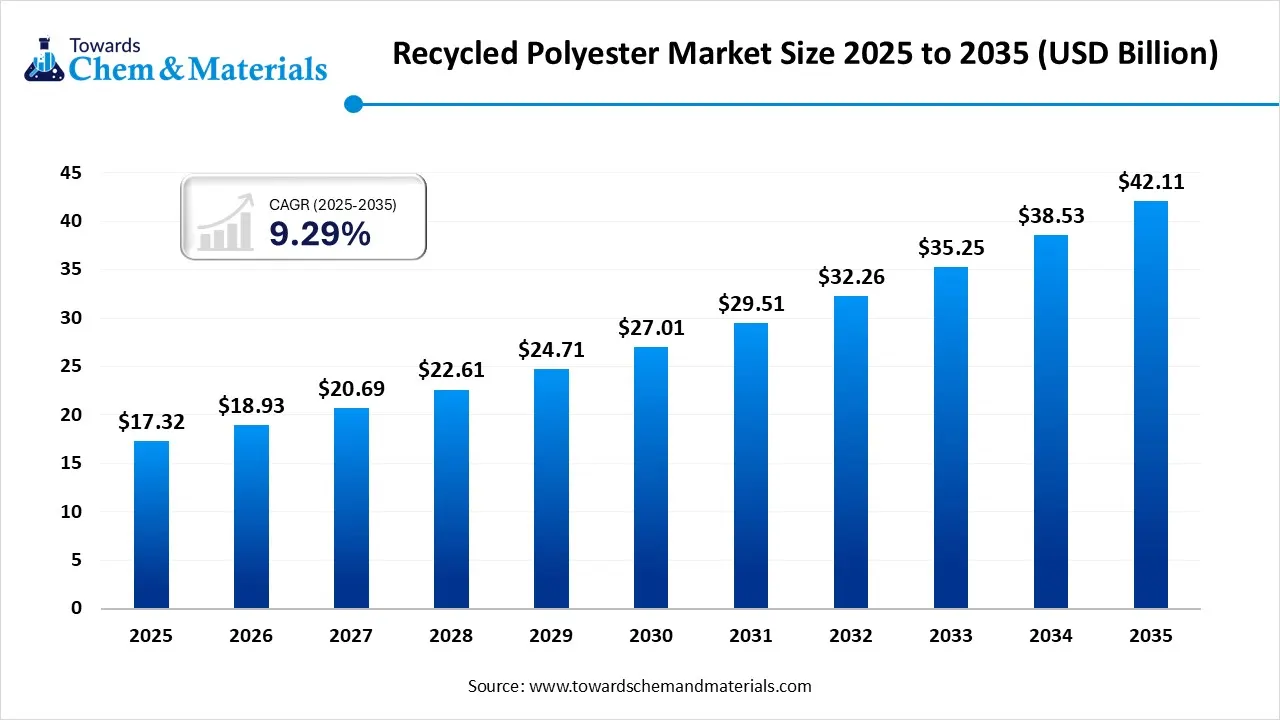
Download a sample of this report @ https://www.towardschemandmaterials.com/download-sample/5656
Market Dynamics: Sustainability at the Core
The rapid expansion of the recycled polyester market is largely fueled by growing sustainability standards in manufacturing and textiles. As industries face mounting pressure to reduce carbon emissions and plastic waste, recycled polyester has emerged as a viable alternative to virgin polyester derived from petrochemicals.
Manufacturers are increasingly incorporating recycled materials into their supply chains to align with global environmental commitments and evolving consumer preferences. Brands across apparel, automotive, and home furnishing sectors are prioritizing eco-friendly materials to enhance brand value and meet regulatory requirements.
Product & Application Insights
By product type, cotton spinning material dominated the market in 2025, accounting for 44.00% of total revenue share. This dominance is attributed to its extensive use in textile manufacturing and apparel production.
Meanwhile, the filling material segment is expected to witness the fastest growth, expanding at a CAGR of 12.96% from 2026 to 2035 (by volume). The increasing use of recycled polyester in cushioning, insulation, and home furnishing products is contributing to this strong momentum.
From an application standpoint, the apparel segment led the market in 2025 with a 54.94% revenue share. The widespread adoption of recycled polyester in sportswear, casual wear, and fast fashion has strengthened its market position. However, non-apparel applications are rapidly gaining traction.
Industries such as automotive interiors, home textiles, and packaging are increasingly utilizing recycled polyester due to its durability, flexibility, and cost-effectiveness. This diversification of applications is creating new growth avenues beyond traditional textile use.
To own our research study instantly, Click here @ https://www.towardschemandmaterials.com/checkout/5656
Technological Advancements Accelerating Growth
One of the key drivers shaping the market is the development of advanced recycling technologies. Improved mechanical and chemical recycling processes are enhancing fiber quality, efficiency, and scalability. These innovations are expected to significantly transform the recycling industry over the next decade.
Technological advancements are also enabling better processing of post-consumer plastic waste, reducing landfill dependency and supporting circular production systems.
Government Support and Regulatory Push
Governments worldwide are playing a crucial role in promoting recycled materials through subsidies, tax incentives, and sustainability mandates. Stricter environmental regulations in large-scale manufacturing sectors are encouraging companies to transition toward eco-friendly alternatives.
The regulatory push, combined with corporate sustainability commitments, is expected to sustain long-term market growth.
Regional Analysis: Asia Pacific Leading the Landscape
Asia Pacific continues to dominate the global recycled polyester market. The regional market was valued at USD 8.41 billion in 2025 and is projected to reach USD 20.48 billion by 2035, expanding at a CAGR of 9.31%.
The region’s leadership can be attributed to:
-
Its status as a global textile manufacturing hub
-
Strong domestic demand in countries such as China, India, and Vietnam
-
Increasing environmental regulations
-
Expanding investments in recycling infrastructure
With a well-established production base and rising awareness about sustainability, Asia Pacific is expected to maintain its dominant position throughout the forecast period.
You can place an order or ask any questions, please feel free to contact us at [email protected]
Recent Industry Developments
Innovation remains central to competitive growth in the recycled polyester market.
In November 2024, Kvadrat introduced a new line of recycled polyester textiles in collaboration with designer Teruhiro Yanagihara. The textiles are made from waste fabric, reinforcing circular production practices.
In May 2025, Teijin unveiled an advanced recycled polyester fabric designed to mimic the texture of natural materials. The product is primarily manufactured from post-consumer plastic waste, highlighting the company’s commitment to sustainable innovation.
Competitive Landscape
The global recycled polyester market features a mix of established multinational corporations and regional players. Companies are focusing on capacity expansion, advanced recycling technologies, and strategic collaborations to strengthen their market position.
Key players operating in the market include:
-
Indorama Ventures
-
Far Eastern New Century
-
Unifi Inc.
-
Reliance Industries Limited
-
Sinopec Yizheng Chemical Fibre
-
Alpek Polyester
-
Zhejiang Jiaren New Materials Co., Ltd.
-
Polyfibre Industries Pvt. Ltd.
-
Bottloop
-
Margasa Group
About Us
Towards Chemical and Materials is a leading global consulting firm specializing in providing comprehensive and strategic research solutions across the chemical and materials industries. With a highly skilled and experienced consultant team, we offer a wide range of services designed to empower businesses with valuable insights and actionable recommendations.
Explore the comprehensive statistics and insights on healthcare industry data and its associated segmentation: Get a Subscription


Leave a Reply