The global tempered glass market is poised for steady growth from 2026 to 2035, with rising demand across multiple industries such as construction, automotive, consumer electronics, and furniture. As urbanization accelerates and construction projects expand, tempered glass continues to play a crucial role in various applications, including safety, aesthetics, and energy efficiency. This article will explore the market’s growth trajectory, dynamics, insights, and key segments that define the tempered glass industry, while also highlighting the key players shaping its future.
Market Overview: The Growth of the Tempered Glass Industry
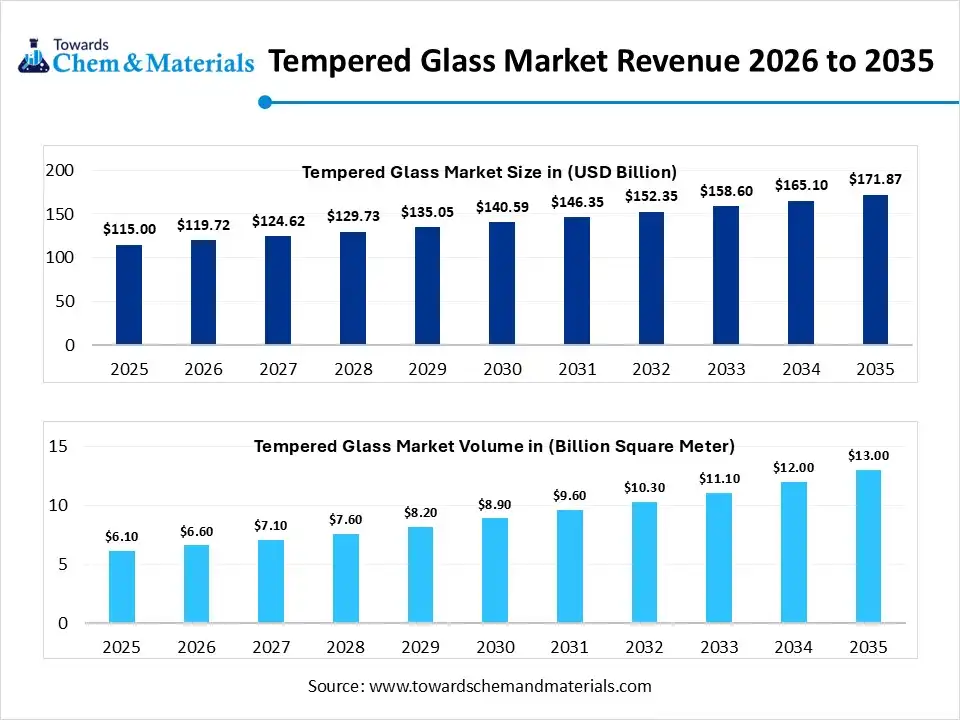
Tempered glass is a type of safety glass that has been heat-treated to be stronger than regular glass. It is commonly used in a variety of applications due to its durability, safety features, and resistance to thermal stress. The global tempered glass market was valued at approximately USD 115.00 billion in 2025 and is projected to grow at a compound annual growth rate (CAGR) of 4.10%, reaching USD 171.87 billion by 2035. Volume-wise, the market is expected to expand from 6.1 billion square meters in 2025 to 13 billion square meters by 2035, with a CAGR of 7.83% during this period.
Asia Pacific is expected to continue dominating the market, accounting for 54% of the total volume share in 2025. This region’s growth is primarily driven by the surge in construction, both commercial and residential, and the rapid urbanization in emerging economies, particularly in China and India.
Get All the Details in Our Solutions –Download Sample: https://www.towardschemandmaterials.com/download-sample/6197
Market Dynamics: Key Drivers and Challenges
Drivers
-
Surge in Construction Activities: One of the primary drivers of the tempered glass market is the increasing construction of commercial and residential infrastructure. As urban areas expand, the demand for high-quality building materials, including tempered glass, has grown significantly. The need for safer, more energy-efficient building materials has also contributed to the growing popularity of tempered glass in construction.
-
Urbanization in Emerging Economies: As developing countries in Asia Pacific, Africa, and Latin America experience rapid urbanization, the demand for tempered glass is expected to rise significantly. These regions are witnessing large-scale investments in infrastructure, including commercial buildings, homes, and roads, all of which require tempered glass for safety, design, and functionality.
-
Automotive Sector Growth: The automotive industry is another significant contributor to the growth of the tempered glass market. Increasing demand for energy-efficient and safer vehicles, combined with the rise in automotive production, is expected to boost the need for high-quality tempered glass in car windows, windshields, and other components.
-
Consumer Electronics Demand: The consumer electronics sector, particularly mobile phones, tablets, and laptops, has seen a significant rise in demand for tempered glass. As the need for durable, scratch-resistant materials increases, tempered glass is used extensively as cover glass for these devices, which is expected to drive market growth.
-
Technological Advancements in Manufacturing: The advancement of manufacturing technologies has made the production of tempered glass more efficient and cost-effective. Innovations in glass treatment processes, such as improved heat-treatment technologies, have resulted in stronger, lighter, and more affordable tempered glass products, further increasing adoption in various industries.
Challenges
-
Fluctuating Raw Material Prices: The production of tempered glass relies on raw materials such as soda ash, limestone, and silica sand, and any fluctuation in the prices of these materials can directly impact the overall cost of production. This presents a challenge for manufacturers, especially in periods of volatility.
-
Competition from Alternative Materials: While tempered glass offers several advantages, competition from alternative materials, such as laminated glass or acrylic, may pose a threat to its market share in certain applications. These alternatives may provide cost-effective solutions with comparable performance, which could limit the adoption of tempered glass.
-
Environmental Concerns and Recycling: The environmental impact of glass production, particularly in terms of energy consumption and waste, remains a challenge. Efforts to recycle tempered glass more effectively are ongoing, but finding efficient and sustainable ways to recycle this material could enhance its environmental appeal.
Market Insights: Key Trends Shaping the Future
Several emerging trends are shaping the future of the tempered glass market, reflecting evolving consumer needs and technological innovations:
-
Rising Demand for Smart Glass: The rise of smart building materials and innovations in the architectural sector have led to an increase in demand for smart or dynamic glass, which can change its opacity or transparency in response to light or heat. This trend is likely to boost the growth of tempered glass as it can be integrated into energy-efficient building designs.
-
Sustainability Focus: With a growing emphasis on environmental sustainability, the demand for greener production methods and recyclable glass is increasing. Companies are focusing on making tempered glass production more energy-efficient and reducing the carbon footprint associated with its manufacturing process.
-
Customization and Design Flexibility: As consumer preferences evolve, the demand for customized and uniquely designed tempered glass products is growing. Innovations in shaping and coloring tempered glass are making it a popular choice in high-end furniture, architecture, and automotive applications.
-
Technological Integration in Automotive: The integration of tempered glass in advanced automotive technologies, such as electric vehicles (EVs), autonomous driving, and smart windshields, is driving the market. These vehicles require lightweight, durable, and scratch-resistant materials for safety and enhanced performance, further increasing the demand for tempered glass.
-
Increased Investment in Production Capacity: To meet growing demand, companies are expanding their production capabilities. For example, in August 2025, India launched its first tempered glass production facility in Noida, marking a significant step in the country’s industrial capabilities and providing a boost to its electronics ecosystem.
Market Segments: A Breakdown of the Tempered Glass Market
The tempered glass market can be segmented into various categories, such as type, shape, application, thickness, and region:
-
By Type:
-
Plain Tempered Glass: This is the most widely used type of tempered glass, accounting for a significant share of the market. It is primarily used in building and automotive applications.
-
Colored/Tinted Tempered Glass: This segment is growing, driven by the demand for aesthetically appealing and privacy-enhancing glass for residential and commercial buildings.
-
Others (Reflective, Frosted, etc.): These specialty glass types are used in specific applications where additional features, such as privacy or decorative elements, are required.
-
-
By Shape:
-
Flat Tempered Glass: The flat segment holds a major share of the market and is expected to grow rapidly in the coming years. It is primarily used in buildings and automotive applications.
-
Bent/Curved Tempered Glass: This segment is witnessing growth, particularly in automotive and architectural designs that require unique shapes.
-
-
By Application:
-
Building & Construction: The largest share of the tempered glass market is dominated by this segment. The growing construction industry, coupled with the need for safe, energy-efficient materials, drives the demand for tempered glass in windows, facades, and doors.
-
Automotive: With the increasing use of tempered glass in car windows, windshields, and side panels, this segment continues to expand, especially with the growth of the electric vehicle market.
-
Consumer Electronics: The rise of mobile phones, laptops, and other consumer electronics has created substantial demand for tempered glass, particularly for screen protectors and touchscreens.
-
Furniture & Others: The demand for tempered glass in furniture, such as tables and display cases, is growing due to its aesthetic appeal and strength.
-
-
By Thickness:
-
5mm to 10mm: This segment is the largest, accounting for 48% of the total market volume in 2025. Tempered glass in this thickness range is commonly used in windows, doors, and automotive applications.
-
< 5mm: This segment accounts for 32% of the market and is typically used in applications requiring thinner glass, such as tabletops and mobile screens.
-
> 10mm: The thicker tempered glass is used in specialized applications requiring extra strength, such as in certain automotive parts and large building facades.
-
-
By Region:
-
North America: The North American tempered glass market is expected to grow at a substantial CAGR of 7.61% from 2026 to 2035.
-
Europe: This region accounted for a significant volume share of 16% in 2025, with strong growth prospects in building & construction and automotive sectors.
-
Asia Pacific: Dominating the market with a 54% volume share in 2025, Asia Pacific is the largest consumer of tempered glass, driven by rapid urbanization and construction activities.
-
Latin America and Middle East & Africa: These regions are experiencing steady growth in the tempered glass market, with significant demand in construction and automotive industries.
-
For more information, visit the Towards Chemical and Materials website or email the team at [email protected]| +1 804 441 9344
More Insights in Towards Chemical and Materials:
- U.S. Glass Product Manufacturing Market :The U.S. glass product manufacturing-market size was valued at USD 24.22 billion in 2024, grew to USD 25.46 billion in 2025, and is expected to hit around USD 39.90 billion by 2034, growing at a compound annual growth rate (CAGR) of 5.12% over the forecast period from 2025 to 2034.
- Glass Manufacturing Market : The global glass manufacturing market size was reached at USD 121.77 billion in 2024 and is expected to be worth around USD 211.18 billion by 2034, growing at a compound annual growth rate (CAGR) of 5.66% over the forecast period 2025 to 2034.
- Flat Glass Coatings Market : The global flat glass coatings market size was USD 4.47 billion in 2025 and is predicted to increase from USD 5.10 billion in 2026 and is expected to be worth around USD 16.86 billion by 2035, growing at a CAGR of 14.20% from 2026 to 2035. Asia Pacific dominated the flat glass coatings market with the largest revenue share of 60.23% in 2025.
- Natural Gas Market : The global natural gas market size accounted for USD 4.19 trillion in 2024 and is predicted to increase from USD 4.41 trillion in 2025 to approximately USD 6.96 trillion by 2034, expanding at a CAGR of 5.20% from 2025 to 2034.
- Gas Separation Membrane Market : The global gas separation membrane market size was valued at approximately USD 1.85 billion in 2024 and is projected to grow at a CAGR of 6.95% from 2025 to 2034, reaching a value of USD 3.62 billion by 2034.
- Bio-Renewable Chemicals Market : The global bio-renewable chemicals market size was valued at USD 15.11 billion in 2024 and is growing to approximately USD 39.01 billion by 2034, with a developing compound annual growth rate (CAGR) of 9.95% over the forecast period 2025 to 2034.
- Natural Aroma Chemicals Market : The global natural aroma chemicals market size was reached at USD 4.55 billion in 2024 and is estimated to surpass around USD 5.91 billion by 2034, growing at a compound annual growth rate (CAGR) of 2.65% during the forecast period 2025 to 2034.
- Natural Ferulic Acid Market : The global natural ferulic acid market size was reached at USD 14.82 billion in 2024 and is expected to hit around USD 30.40 billion by 2034, exhibiting a compound annual growth rate (CAGR) of 7.45% during the forecast period 2025 to 2034.
Top Companies in the Tempered Glass Market
-
Saint-Gobain S.A.
-
About: Saint-Gobain is a global leader in the production of construction materials, including tempered glass. The company operates in nearly 80 countries and has a significant presence in the building and construction sector.
-
Products: The company manufactures high-performance glass products for architectural, automotive, and industrial applications.
-
Market Cap: Approximately $34 billion USD.
-
-
AGC Inc.
-
About: AGC is a Japanese multinational company, one of the world’s largest producers of glass. It is renowned for its automotive and architectural glass products.
-
Products: AGC offers a wide range of tempered glass products, including safety glass, heat-absorbing glass, and insulating glass.
-
Market Cap: Approximately $18 billion USD.
-
-
Corning Incorporated
-
About: Corning is known for its innovation in glass products, particularly in the consumer electronics sector. It is the creator of Gorilla® Glass, used in mobile devices.
-
Products: Corning’s Gorilla® Glass is widely used in mobile phones, tablets, and other consumer electronics for its damage-resistant properties.
-
Market Cap: Approximately $43 billion USD.
-
-
Guardian Industries (Koch Industries)
-
About: Guardian Industries, part of Koch Industries, is a leader in glass manufacturing and one of the largest suppliers of tempered glass.
-
Products: Guardian manufactures tempered glass for both the construction and automotive industries, including solar control and low-emissivity glass.
-
Market Cap: Private company (part of Koch Industries).
-
Frequently Asked Questions
1. What is the growth rate of the tempered glass market?
-
The tempered glass market is expected to grow at a CAGR of 4.10% from 2026 to 2035.
2. Which region is expected to dominate the tempered glass market?
-
Asia Pacific is expected to dominate the market, accounting for 54% of the global volume share in 2025.
3. What are the key drivers of the tempered glass market?
-
The major drivers include the surge in construction activities, rapid urbanization, growth in the automotive sector, and increasing demand for consumer electronics.
4. What types of applications use tempered glass?
-
Tempered glass is used in building & construction, automotive, consumer electronics, and furniture industries, among others.
5. Which companies are leading the tempered glass market?
-
Leading companies in the market include Saint-Gobain, AGC Inc., Corning, Guardian Industries, and others.
Immediate Delivery Available | Buy This Premium Research Report@ https://www.towardschemandmaterials.com/checkout/6197
About Us
Towards Chemical and Materials is a leading global consulting firm specializing in providing comprehensive and strategic research solutions across the chemical and materials industries. With a highly skilled and experienced consultant team, we offer a wide range of services designed to empower businesses with valuable insights and actionable recommendations.
Our Trusted Data Partners
Precedence Research | Statifacts | Towards Packaging | Towards Healthcare | Towards Food and Beverages | Towards Chemical and Materials | Towards Consumer Goods | Nova One Advisor |
For Latest Update Follow Us: https://www.linkedin.com/company/towards-chem-and-materials/
USA: +1 804 441 9344
APAC: +61 485 981 310 or +91 87933 22019
Europe: +44 7383 092 044
Email: [email protected]


Leave a Reply