Europe is at the forefront of a global shift toward sustainability, with the Biodegradable Plastics Market serving as a critical engine for change. Driven by stringent environmental policies, a powerful consumer demand for eco-friendly products, and continuous innovation, this market is entering a phase of rapid, transformative expansion.
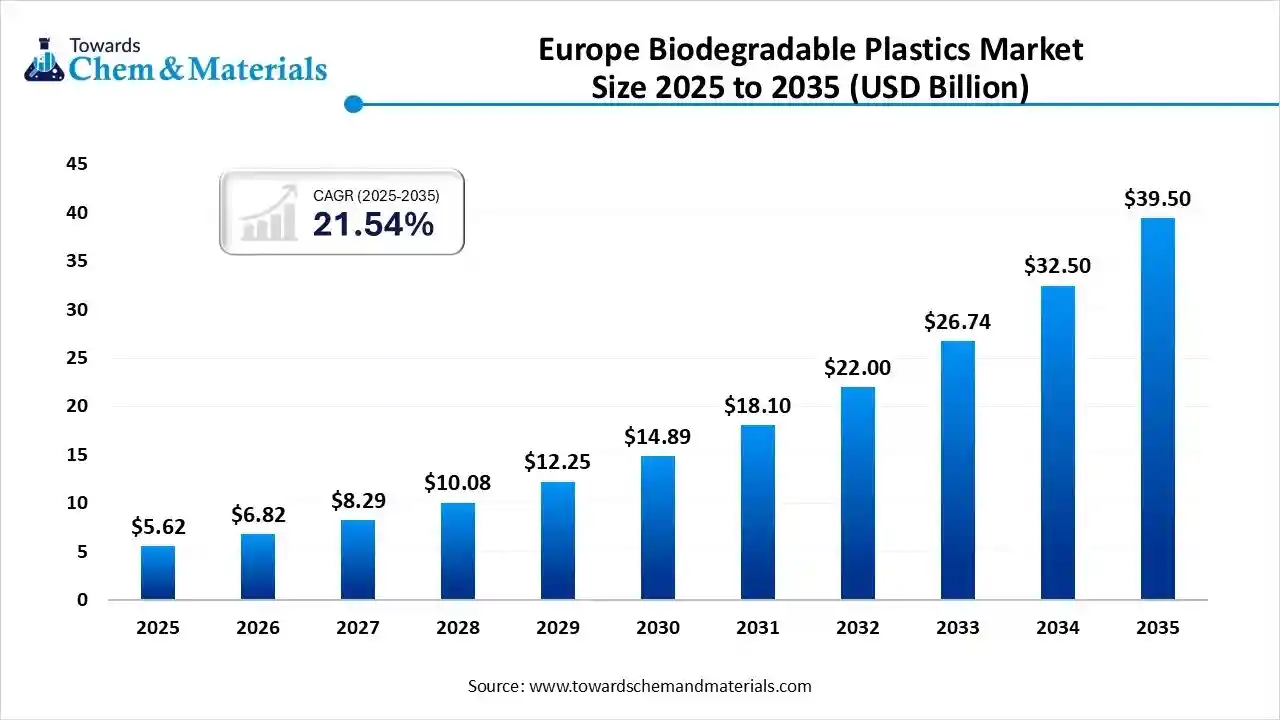
The Europe biodegradable plastics market size is calculated at USD 5.62 billion in 2025 and is predicted to increase from USD 6.82 billion in 2026 and is projected to reach around USD 39.50 billion by 2035, The market is expanding at a CAGR of 21.54% between 2026 and 2035. The market is growing rapidly, driven by strict environmental regulations, increasing consumer demand for sustainable products, and technological advancements, which fuel the growth of the market.
Download Sample Here : https://www.towardschemandmaterials.com/download-sample/6063
Significance of the European Market
Europe’s biodegradable plastics sector is more than just a growing industry; it’s a global model for sustainability. Its importance is defined by several key factors:
- Policy Leadership: Strict EU regulations, such as those promoting a circular economy and reducing single-use plastics, create a mandated demand for bio-based and biodegradable alternatives, forcing a market-wide transition.
- Waste Reduction: By providing alternatives to fossil-fuel-based polymers, the market plays a crucial role in tackling plastic pollution and mitigating the long-term environmental impact of plastic waste.
- Innovation Hub: Europe, with countries like Germany leading the charge, is a center for research and development. Continuous innovation is introducing new and improved materials like Polylactic Acid (PLA) and Polyhydroxyalkanoates (PHA) that are gaining significant market share.
- Strong End-User Adoption: Fueled by high consumer environmental awareness, key sectors — especially packaging (the largest end-user), foodservice, personal care, and agriculture — are rapidly integrating these sustainable materials.
Key Growth Trends Driving the Market
- Stricter Regulatory Push: EU policies and the Circular Economy Action Plan are shifting demand from conventional plastics to bio-based polymers like PBAT and PLA. Recent developments, such as the EU Bioeconomy Strategy aiming to fast-track binding targets for bio-based plastics by 2027, underscore this policy commitment.
- Corporate and Consumer Demand: Increased public concern over plastic waste, combined with corporate sustainability commitments, is boosting the appetite for eco-friendly materials across all end-user industries.
- Technological Advancements: Innovation in material science is driving down costs and improving the performance of biodegradable plastics. For instance, the recent launch of competitively priced, 100% recyclable, biodegradable stretch wrap is a testament to technological progress matching traditional plastic costs.
- Application Diversification: While food and beverage packaging remains the largest application, the materials are increasingly being adopted in areas like agricultural films, mulch, and disposable consumer goods, further expanding the market’s reach.
For more information, visit the Towards Chemical and Materials website or email the team at [email protected]| +1 804 441 9344
More Insights in Towards Chemical and Materials:
· U.S. Bioplastics Market : The U.S. bioplastics market is projected to grow from USD 3.72 billion in 2025 to USD 21.84 billion by 2035, growing at a compound annual growth rate (CAGR) of 19.35% over the forecast period from 2026 to 2035.
·Aerospace Plastics Market : The global aerospace plastics market size is calculated at USD 9.19 billion in 2025 and is predicted to increase from USD 10.09 billion in 2026 and is projected to reach around USD 23.28 billion by 2035, The market is expanding at a CAGR of 9.74% between 2026 and 2035.
· Bio-Renewable Chemicals Market : The global bio-renewable chemicals market size was valued at USD 15.11 billion in 2024 and is growing to approximately USD 39.01 billion by 2034, with a developing compound annual growth rate (CAGR) of 9.95% over the forecast period 2025 to 2034.
· Natural Aroma Chemicals Market : The global natural aroma chemicals market size was reached at USD 4.55 billion in 2024 and is estimated to surpass around USD 5.91 billion by 2034, growing at a compound annual growth rate (CAGR) of 2.65% during the forecast period 2025 to 2034.
· Natural Ferulic Acid Market : The global natural ferulic acid market size was reached at USD 14.82 billion in 2024 and is expected to hit around USD 30.40 billion by 2034, exhibiting a compound annual growth rate (CAGR) of 7.45% during the forecast period 2025 to 2034.
Recent Market Developments
- November 2025: The EU Bioeconomy Strategy was accelerated to include binding targets for bio-based plastics. This move is designed to boost industrial competitiveness and integrate these materials into the Packaging and Packaging Waste Regulation (PPWR) by 2027, scaling up the market and reducing fossil fuel dependency.
- October 2025: BioNatur Plastics initiated European production of a biodegradable and 100% recyclable stretch wrap. This new product is positioned to compete directly on price, matching the cost of traditional, non-biodegradable films, which is a significant breakthrough for widespread adoption.
Frequently Asked Questions (FAQ)
1. What is the primary significance of the European biodegradable plastics market?
The primary significance is its leadership role in driving global sustainability through strict environmental regulations and high consumer demand. The European market provides the necessary scale and policy framework to accelerate the shift from fossil-fuel-based polymers, reducing plastic waste in sectors like packaging and agriculture.
2. How quickly is the market growing in Europe?
The market is expanding at a significant rate. It is expected to grow from USD 5.62 billion in 2025 to approximately USD 39.50 billion by 2035, representing a robust Compound Annual Growth Rate (CAGR) of 21.54% over the 2026–2035 forecast period.
3. What are the main types of biodegradable plastics seeing growth?
The market is seeing strong growth in materials like Polylactic Acid (PLA), Polyhydroxyalkanoates (PHA), and blends based on Polybutylene Adipate Terephthalate (PBAT). PLA, derived from renewable resources like corn starch or sugarcane, is especially prominent in packaging applications.
4. Which end-user industry is the largest consumer of these materials?
The packaging sector, particularly in food and beverage applications, is currently the largest end-user industry for biodegradable plastics. However, other sectors like agriculture (for mulch films) and foodservice (for single-use items) are also key areas of expansion.
5. What are the core factors driving this market’s expansion?
The market’s rapid growth is fundamentally driven by three factors: strict governmental policy and regulatory mandates from the EU, increasing consumer and corporate demand for sustainable and eco-friendly products, and continuous technological advancements that are improving material performance and cost-competitiveness.
Immediate Delivery Available | Buy This Premium Research Report@ https://www.towardschemandmaterials.com/checkout/6063
About Us
Towards Chemical and Materials is a leading global consulting firm specializing in providing comprehensive and strategic research solutions across the chemical and materials industries. With a highly skilled and experienced consultant team, we offer a wide range of services designed to empower businesses with valuable insights and actionable recommendations.
Our Trusted Data Partners
Precedence Research | Statifacts | Towards Packaging | Towards Healthcare | Towards Food and Beverages | Towards Chemical and Materials | Towards Consumer Goods | Nova One Advisor |
For Latest Update Follow Us: https://www.linkedin.com/company/towards-chem-and-materials/
USA: +1 804 441 9344
APAC: +61 485 981 310 or +91 87933 22019
Europe: +44 7383 092 044
Email: [email protected]


Leave a Reply