TowardsChem&Materials

Insights Driving the Chemistry of Innovation

U.S. Detergent Alcohols Market Size, Share & Forecast: Driving Sustainable Surfactant Innovations (2026-2035)

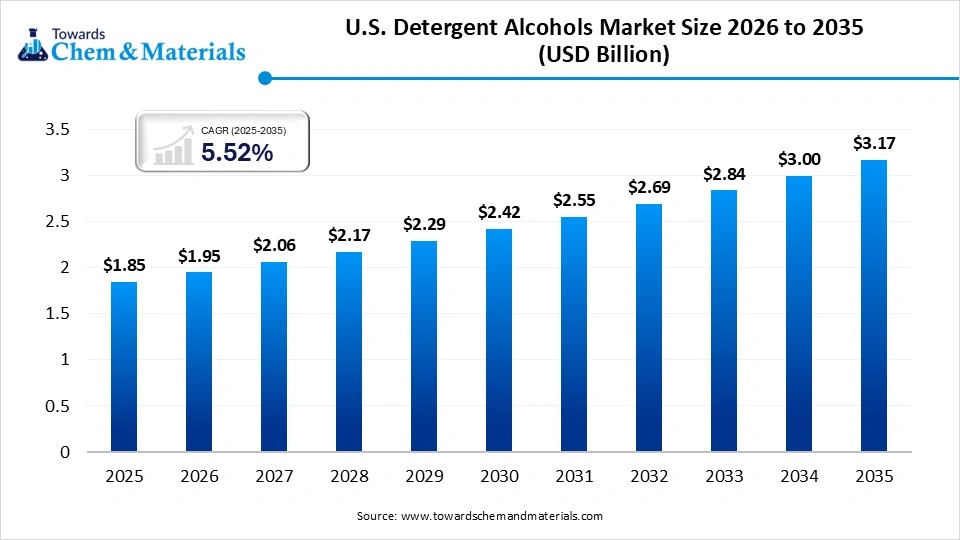
The U.S. detergent alcohols market is experiencing a significant evolutionary shift, heavily driven by the consumer and regulatory demand for bio-based, high-performance cleaning solutions. Formally valued at USD 1.85 billion in 2025, the market has reached an estimated USD 1.95 billion in 2026. Projections indicate it will scale to USD 3.17 billion by 2035, expanding at a steady Compound Annual Growth Rate (CAGR) of 5.52% over the forecast period. This growth trajectory highlights an industry-wide pivot toward concentrated formulations and sustainable feedstocks across the household care, industrial cleaning, and personal care sectors.
Market Overview: What is the U.S. Detergent Alcohols Market?

Detergent alcohols—primarily linear fatty alcohols spanning carbon chain lengths between $C_{12}$ and $C_{18}$—serve as the foundational raw materials for manufacturing intermediate surfactants like alcohol ethoxylates (AE) and alcohol ether sulfates (AES). These compounds are the workhorses behind the foaming, emulsifying, and cleaning actions found in everyday items like laundry detergents, body washes, industrial degreasers, and shampoos. The market encompasses both natural fatty alcohols (derived from vegetable oils like palm kernel and coconut oil) and synthetic fatty alcohols (derived from petrochemical feedstocks via the Ziegler or OXO processes).

Market Dynamics: What Are the Key Factors Driving the Market?

What are the primary drivers for this market?

  • Surge in Bio-Based Cleaning Products: Consumers are rapidly discarding conventional formulations in favor of eco-friendly, biodegradable alternatives. This behavioral pivot is forcing consumer packaged goods (CPG) companies to replace petrochemical surfactants with oleochemical-derived alternatives.

  • Shift Towards Concentrated Formulations: The industrial transition toward liquid concentrates, unit-dose pods, and compact powders requires highly efficient surfactant intermediates. Detergent alcohols provide the structural versatility needed to stabilize these water-reduced formulas.

  • Elevated Hygiene Standards Post-Pandemic: Heightened institutional and residential awareness regarding sanitation continues to fuel sustained demand for liquid hand soaps, sanitizing agents, and hard-surface cleaners.

What are the Key Market Trends?

A prominent trend shaping the market is the optimization of carbon-chain lengths to maximize performance at lower washing temperatures. As cold-water washing becomes the standard for energy conservation, formulators are heavily favoring natural $C_{12}$$C_{14}$ Lauryl-Myristyl alcohol fractions for their superior cold-water solubility and rapid flash-foaming characteristics.

Additionally, the personal care and cosmetics sector is emerging as a high-growth avenue. Beyond basic cleansing, detergent alcohols act as vital emollients and thickeners in premium skincare and haircare systems, aligning perfectly with the clean-beauty movement that restricts harsh synthetic sulfates.

Why Is the Market Important?

Detergent alcohols represent the literal backbone of the modern cleaning and hygiene economy. Without them, the high-efficiency performance expected from modern automatic dishwashing, commercial laundering, and industrial food-plant sanitation would be chemically impossible. They bridge the gap between agricultural or oil-refinery outputs and advanced molecular surface-active chemistry.

What Benefits Are Driving Global Adoption?

Formulators rely on modern detergent alcohols because they provide uncompromised performance alongside structural flexibility. They offer:

  • Excellent Biodegradability: Rapidly breaking down into non-toxic components, minimizing environmental toxicity in aquatic systems.

  • High Performance in Hard Water: Providing robust calcium-ion tolerance compared to traditional soap bases, ensuring consistent detergency across varying regional water qualities.

  • Skin Compatibility: Natural fatty alcohol derivatives reduce the trans-epidermal water loss associated with older, harsher surfactant varieties, upgrading the sensory profile of personal care products.

Market Segmentation: Deep-Dive Analysis

Which segment accounted for the largest market share?

By application, the laundry detergent segment dominated the market in 2025 and remains the primary volume driver in 2026. This dominance is sustained by rapid urbanization, automated machine-wash penetration, and the persistent technical demands of modern high-efficiency (HE) washing systems.

Conversely, the personal care and cosmetics segment is projected to grow at the fastest CAGR through 2035. On the source side, while natural detergent alcohols currently claim the largest market share due to the green movement, the synthetic segment is forecasted to exhibit the fastest growth speed, meeting critical supply-security needs and offering price stability for high-volume industrial applications.

Below is an overview of how these distinct market sectors align:

Segment Category Leading Sub-Segment (2025/2026) Fastest-Growing Sub-Segment (2026-2035) Key Growth Drivers
By Source Natural Detergent Alcohols Synthetic Detergent Alcohols Sustainability vs. Cost-Effectiveness & Industrial Scale
By Application Laundry Detergents Personal Care & Cosmetics Urbanization, Premium Clean Beauty, Post-Pandemic Hygiene

What Are the Recent Government Initiatives?

Regulatory pressure is fundamentally reshaping chemical compositions across the United States. The EPA’s Safer Choice Program actively encourages formulators to source biodegradable surfactants derived from natural detergent alcohols. Furthermore, stringent state-level regulations—such as New York’s strict limits on 1,4-dioxane traces in household cleansing products—are forcing manufacturers to re-engineer their ethoxylation lines. This directly impacts how fatty alcohols are ethoxylated, favoring cleaner, tightly controlled manufacturing technologies.

Competitive Landscape: Key Companies & Strategic Profiles

The U.S. landscape features a blend of diversified chemical giants, specialized oleochemical refiners, and innovative surfactant formulators navigating shifting feedstock dynamics.

1. Procter & Gamble (P&G) Chemicals

  • About: A massive global leader in consumer goods, operating a highly integrated chemical division that stands as one of the world’s largest producers and consumers of fatty alcohols.

  • Products: Premium-grade natural fatty alcohols ($C_{12}$$C_{18}$ cuts) marketed globally for sulfation and ethoxylation.

  • Market Capitalization: Approximately USD 354 Billion (as of mid-2026).

2. Stepan Company

  • About: A major global manufacturer of specialty and core surfactants used heavily across household, institutional, and industrial cleaning sectors.

  • Products: Comprehensive portfolios of alcohol sulfates (AS), alcohol ether sulfates (AES), and custom bio-derived surfactants.

  • Market Capitalization: Approximately USD 1.23 Billion (as of mid-2026).

3. Kraton Corporation

  • About: Known broadly for polymer technologies, Kraton also specializes in highly sustainable pine-based and bio-refined performance chemical intermediates.

  • Products: Bio-based specialty chemical blocks, co-products, and refined tall oil derivatives utilized in specialized industrial surfactant applications.

  • Market Capitalization: Private (Acquired by DL Chemical; maintains an active debt/bond market footprint with revenues around USD 1.8B to 2B).

4. Pilot Chemical Company

  • About: A prominent privately-held specialty chemical manufacturer recognized for its advanced sulfonation and sulfation capabilities.

  • Products: Calfoam and Masodol® series, featuring premium linear primary alcohol ethoxylates designed for high-performance cleaning applications.

  • Market Capitalization: Privately held.

5. Vantage Specialty Chemicals, Inc.

  • About: A premier provider of naturally derived ingredients focused strongly on the personal care, food, and industrial consumer markets.

  • Products: High-purity fatty alcohols, methyl esters, and natural emollients tailored for mild personal care formulas.

  • Market Capitalization: Privately held.

What Are the Recent Developments by Major Companies?

  • Stepan Company (2026): Stepan continues to drive operational efficiencies in its core surfactant business, integrating advanced AI models into its technical processing lines to offset fluctuating raw material costs and optimize product consistency for household applications.

  • Pilot Chemical Company: Pilot has expanded its portfolio around the Masodol® series (including linear primary alcohol ethoxylates like Masodol 25-9), positioning them as highly biodegradable, zero-toxicity drop-in replacements for outdated alkyl phenol ethoxylates (APEs).

  • Regulatory Upgrades: Major producers are altering production lines to incorporate stripped ethoxylation processes, minimizing trace 1,4-dioxane side-products to ensure absolute compliance with evolving North American regional water-safety standards.

Future of the Market: A Forward-Looking Perspective

The next decade belongs to high-efficiency, zero-compromise sustainability. The U.S. detergent alcohols market will likely see an accelerating convergence of natural feedstock sourcing and advanced synthetic engineering. As biotech advancements yield custom, bio-engineered microbial pathways capable of synthesizing precise fatty alcohol carbon chains without relying on traditional agricultural soil footprints, the market’s reliance on tropical oils will naturally balance out. Companies that invest heavily in low-dioxane processing and circular-economy material streams will inevitably capture the lion’s share of this burgeoning USD 3.17 billion marketplace.

About Us

Towards Chemicals And Materials Analytics and Consulting is a leading global consulting firm specializing in providing comprehensive and strategic research solutions across the chemical and materials industries.

Connect with Us

Registered Office:

Office No 707, 7th Floor, Nandan Probiz, Laxman Nagar, Balewadi Baner, Pune, MH – 411045 India

Client Support:

USA: +1 8044 419344
APAC: +91 87933 22019
Europe: +44 7383 092 044

[email protected]

Leave a Reply

Your email address will not be published. Required fields are marked *