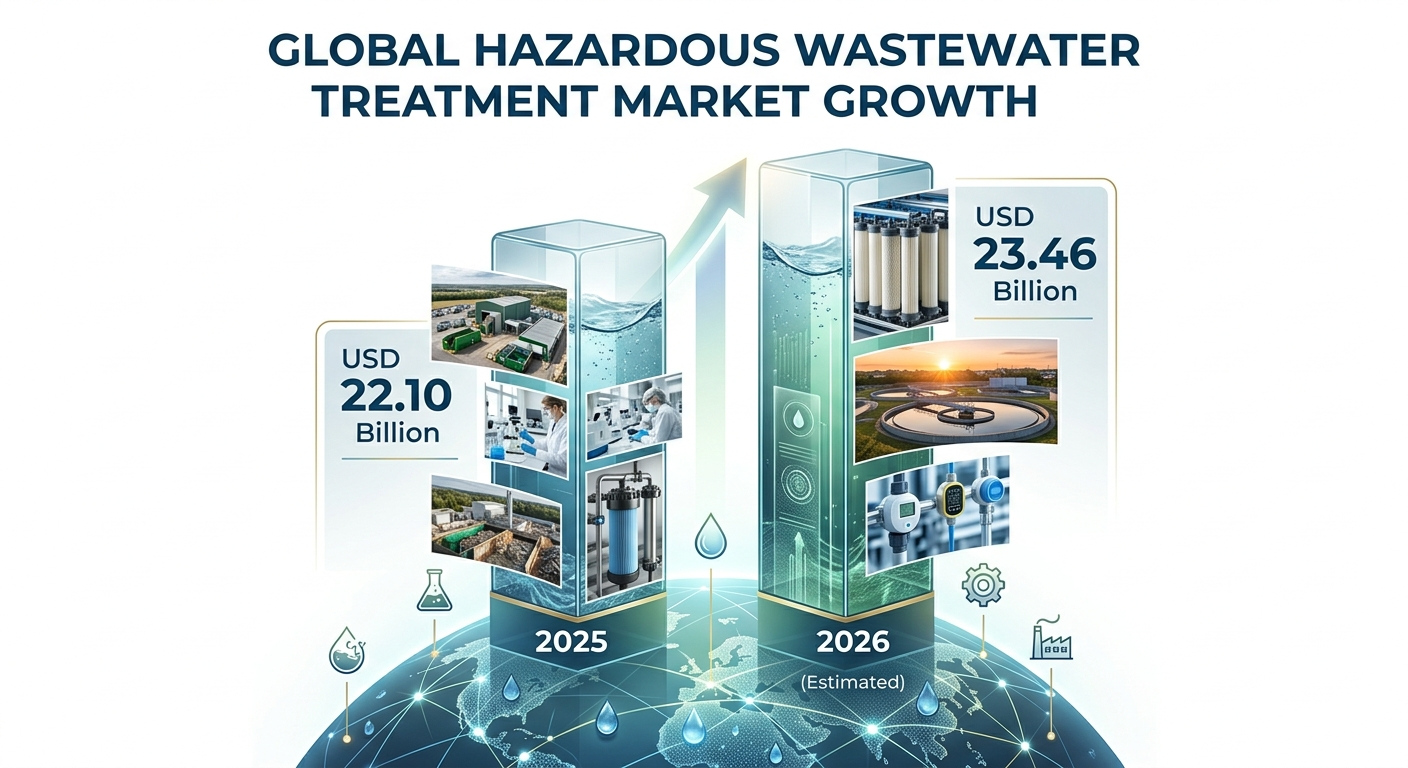
The global hazardous wastewater treatment market is positioning itself for a decade of sustained, compliance-driven expansion. Valued at USD 22.10 billion in 2025, the market is estimated to reach USD 23.46 billion in 2026. Driven by a massive structural shift toward cleaner, zero-carbon manufacturing and a rising need to neutralize complex chemical streams, the market is projected to reach USD 40.14 billion by 2035. This represents a value compound annual growth rate (CAGR) of 6.15% over the forecast period from 2026 to 2035.
In terms of processing volume, the industry tracks a steady upward trajectory, moving from 41.25 billion cubic meters in 2025 to a projected 68.42 billion cubic meters by 2035, displaying a volumetric CAGR of 5.19%. Looking at the interim horizon, standard industry projection modeling maps the market to hit an estimated valuation of USD 33.40 billion by 2032. This growth highlights an industry-wide transition toward circular resource recovery and advanced multi-stage treatment infrastructures.
Market Overview: What is the Hazardous Wastewater Treatment Market?
The hazardous wastewater treatment market comprises the specialized engineering technologies, chemical solutions, and physical processes utilized to neutralize, treat, and safely dispose of toxic industrial effluents. Unlike standard municipal sewage, hazardous wastewater contains heavy metals, volatile organic compounds (VOCs), persistent organic pollutants (POPs), and highly acidic or alkaline chemical mixtures that cannot be processed by standard treatment plants.
The industry deploys a complex sequence of physical, chemical, and biological processing methods. These include advanced oxidation processes (AOP), membrane bioreactors (MBR), electrocoagulation, and thermal evaporation units engineered to handle corrosive and toxic streams. This critical service infrastructure supports major global sectors, including chemical manufacturing, pharmaceutical synthesis, oil and gas refining, electronic semiconductor fabrication, mining operations, and specialized metal finishing.
Market Dynamics: What Are the Key Factors Driving the Market?
What are the primary drivers for this market?
The primary driver accelerating the market is the rapid globalization of strict environmental protection frameworks and zero-liquid discharge (ZLD) mandates. Downstream chemical and pharmaceutical companies face unprecedented legal pressure to thoroughly detoxify their process streams before discharging them into natural water bodies. Furthermore, the global push toward water stewardship and circular economy initiatives forces companies to treat wastewater as an alternative source of recycled process water, lowering intake costs and driving the adoption of high-efficiency processing systems.
What are the critical market restraints?
Conversely, the market faces strong headwinds from heavy capital expenditure requirements and high energy costs. Operating multi-stage advanced treatment facilities, particularly thermal evaporation and membrane system loops, demands substantial power and continuous chemical consumption. These high ongoing operational costs frequently place a heavy financial burden on medium-sized manufacturing operations in developing industrial corridors, creating compliance friction where regional monitoring frameworks remain lax.
Market Insights: Why Is the Hazardous Wastewater Treatment Market Important?
Hazardous wastewater treatment is fundamentally critical because it prevents irreversible environmental destruction and the widespread toxic contamination of public water tables. Unmanaged industrial effluents carrying heavy metals or toxic organic molecules pose severe health hazards to human communities and aquatic ecosystems. By acting as a strict safety barrier between toxic manufacturing operations and the biosphere, this industry ensures that heavy industrial growth does not completely destroy environmental public health.
Furthermore, this market is vital for stabilizing international manufacturing supply chains. In an era where corporate legal exposures and environmental litigation can bankrupt major enterprises, verified hazardous waste processing acts as an operational insurance policy. Factories that integrate reliable, scale-ready effluent treatment facilities avoid sudden regulatory closures, protect their corporate brand equity, and ensure continuous, uninhibited production flow.
What are the Key Benefits of Using Advanced Hazardous Wastewater Treatment?
Modern hazardous wastewater treatment facilities provide massive operational and compliance advantages over rudimentary settlement ponds or basic filtration loops. Their advanced chemical oxidation and membrane technologies allow factories to isolate and break down highly stable, toxic chemical bonds, ensuring absolute compliance with changing regional environmental laws. This proactive compliance shields corporations from punitive clean-up fines and expensive legal actions.
Additionally, the transition to advanced closed-loop treatment setups enables maximum water and resource recovery. Modern processes allow facilities to reclaim valuable heavy metals and useful salt byproducts directly from waste streams while recycling clean water back into production cycles. This circular process significantly lowers raw water utility costs and minimizes fresh water demands, helping modern industrial plants meet their corporate ESG targets.
Market Segments: Which Segment Accounted for the Largest Market Share?
Treatment Technology and Industrial Demographics
The chemical precipitation and physical-chemical treatment segment historically accounts for the largest market share, serving as the baseline processing method for heavy manufacturing and metal plating effluents. However, advanced oxidation processes (AOP) and membrane-based treatment systems are charting the fastest growth rates, driven by the expanding pharmaceutical and microelectronics sectors that produce highly complex, non-biodegradable waste streams.
Application and Regional Splits
From an application perspective, chemical manufacturing and petrochemical refining represent the largest volume consumers of these services. Geographically, the Asia-Pacific region commands the largest market share, propelled by intense industrial concentration, massive chemical production complexes, and tightening environmental rules in China, India, and Southeast Asia. North America and Europe follow with mature, service-oriented markets focused heavily on upgrading existing plants to zero-liquid discharge (ZLD) capabilities and tracking complex chemical contaminants.
Data Presentation: Technology Categorization and Operational Fit
To properly evaluate the trajectory of the market, it is essential to map out how different processing methods stack up against changing industrial requirements. The table below details the core technology divisions shaping the 2026–2035 forecast period.


Leave a Reply