The Asia Pacific paints and coatings market is positioning itself for a decade of sustained infrastructure-driven expansion. Valued at USD 105.11 billion in 2025, the market is expected to expand steadily to reach an impressive USD 182.11 billion by 2035. Driven by intense urbanization, domestic manufacturing capacity expansions, and strict regulatory pivots toward non-hazardous alternatives, the market will exhibit a value compound annual growth rate (CAGR) of 5.65% over the forecast period from 2026 to 2035.
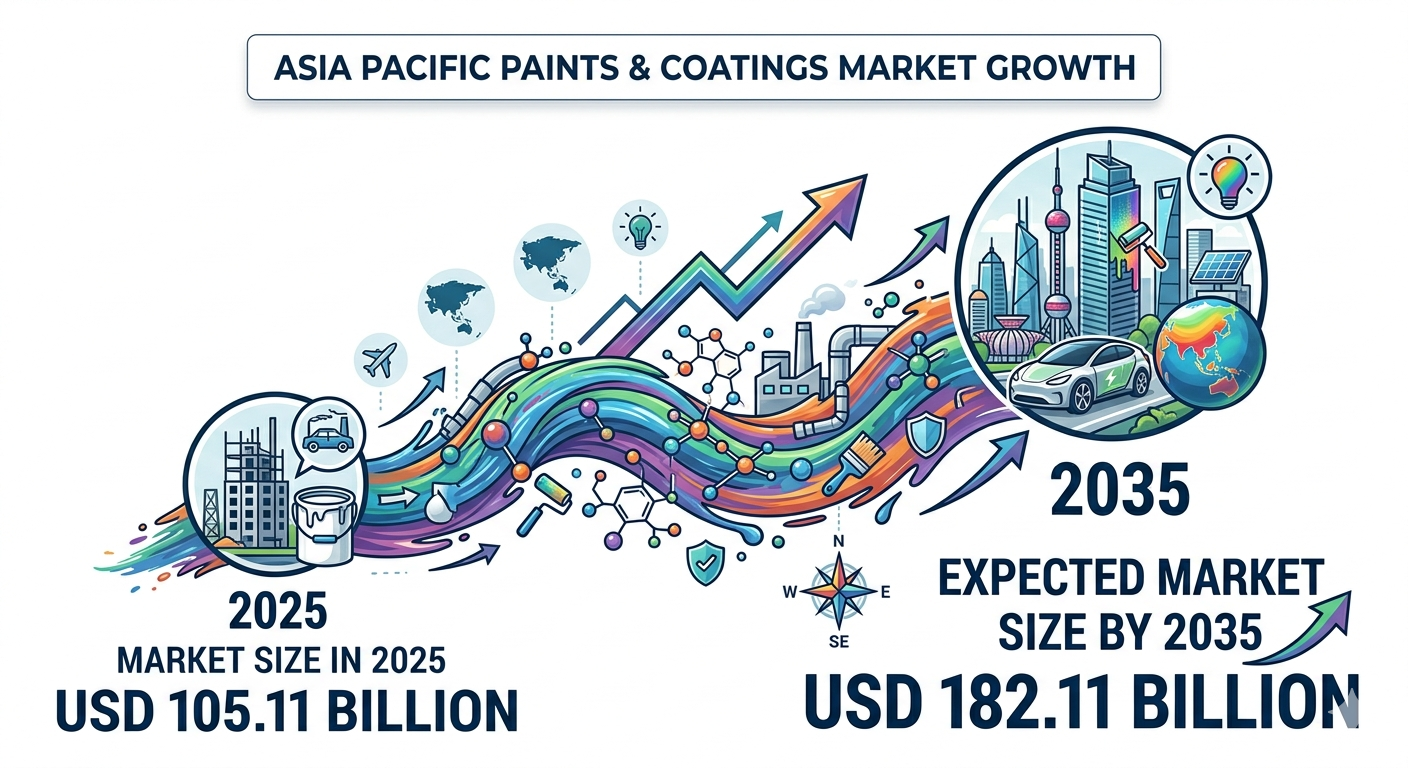
In terms of production volume, the industry is tracing a parallel upward path, moving from 35.11 million tons in 2025 to a projected 58.01 million tons by 2035, displaying a volumetric CAGR of 5.15%. Looking at the interim horizon, a market trajectory calculation establishes that the industry is comfortably on track to hit an estimated valuation of USD 151.80 billion by 2032. This solid scaling highlights a profound transition toward high-durability performance coatings and ultra-low VOC (Volatile Organic Compound) structural solutions.
Market Overview: What is the Asia Pacific Paints and Coatings Market?
The Asia Pacific paints and coatings market comprises the development, manufacturing, and commercial distribution of liquid and powder formulations engineered to protect, preserve, and visually enhance structural or industrial surfaces. These coatings serve as the primary defensive barrier against environmental degradation, weathering, ultraviolet radiation, and mechanical abrasion, significantly extending the service life of underlying substrates.
Characterized by complex polymer matrices including acrylics, epoxies, polyurethanes, and alkyds, modern paints and coatings are formulated to offer quick curing times, exceptional adhesion, and long-term color retention. They serve as a foundational utility across critical regional sectors, including residential and commercial construction, automotive assembly lines, marine vessels, heavy industrial machinery, and consumer electronics packaging.
Market Dynamics: What Are the Key Factors Driving the Market?
What are the primary drivers for this market?
The primary catalyst accelerating the market is the relentless pace of urbanization and residential development across emerging Asian economies. Massive public transport infrastructures, smart-city initiatives, and surging middle-class housing investments require billions of liters of high-performance architectural coatings annually. Furthermore, the massive expansion of localized automotive production hubs and heavy manufacturing yards in mainland Asia actively drives the consumption of advanced industrial and protective coatings to combat corrosion in aggressive environments.
What are the critical market restraints?
Conversely, the market faces headwinds from tightening environmental regulations and volatile raw material pricing. Traditional solvent-borne paints are under intense scrutiny by environmental agencies due to their high VOC emissions, which contribute significantly to urban photochemical smog. Transitioning manufacturing plants to water-borne, powder-based, or UV-curable alternatives requires significant capital investments in new processing hardware, creating operational friction and margin pressures for smaller regional producers.
Market Insights: Why Is the Asia Pacific Paints and Coatings Market Important?
Paints and coatings are fundamentally critical because they directly preserve the structural integrity and value of multi-billion dollar public infrastructures and private assets across the region. Without advanced anti-corrosive and protective layers, coastal infrastructure, industrial processing equipment, and transport networks would face rapid structural degradation, leading to premature engineering failures and staggering maintenance costs. In an era where long-term asset management and resource conservation dictate regional economic planning, performance coatings are an essential industrial asset.
Furthermore, the industry is increasingly vital for environmental and energy conservation goals. Functional coatings, such as cool-roof reflective formulations and smart solar-thermal barriers, are actively deployed across hot climate zones in Asia to lower the cooling loads of high-rise commercial buildings. By directly reducing air-conditioning power consumption, the choice of modern engineered coatings has transitioned into a strategic tool for urban planners working to achieve regional carbon neutrality targets.
What are the Key Benefits of Using Modern Paints and Coatings?
Modern formulated paints and coatings provide unmatched performance and environmental advantages over older, rudimentary solvent-based formulas. Their advanced chemical cross-linking properties provide high resistance to chemical spills, humidity, and intense mechanical impact, ensuring that coated industrial surfaces remain protected for decades without needing frequent reapplication. This longevity directly minimizes localized down-times and reduces high maintenance labor costs for facility operators.
Additionally, the transition to modern water-borne and powder technologies drastically reduces hazardous solvent emissions, guaranteeing a safer working environment for professional applicators and achieving full compliance with global green-building certification standards. Many premium architectural coatings now feature active anti-microbial, self-cleaning, and low-odor characteristics, which significantly improve indoor air quality and hygiene levels within sensitive environments such as hospitals, schools, and high-density residential complexes.
Market Segments: Which Segment Accounted for the Largest Market Share?
Application and Formulation Segments
The architectural coatings segment historically commands the largest share of the Asia Pacific market, fueled by residential high-rise booms and extensive commercial remodeling projects. Water-borne acrylic emulsions dominate this sector due to consumer preferences for low-odor, easy-to-clean interior walls. However, the industrial protective coatings and marine segments are tracking the highest growth rates, driven by a massive build-out of deep-water ports, offshore wind farms, and cross-border rail networks that require elite anti-corrosion protection.
Technological and Regional Shifts
From a technology standpoint, water-borne formulations account for the bulk of current volume, but solvent-free powder coatings are expanding rapidly in the automotive component and appliance sectors due to their zero-waste overspray recovery profiles. Geographically, China remains the single largest market slice by volume, while India is registering the fastest growth rate through 2035, supported by intense domestic real estate developments and government-led infrastructure investment frameworks.
Data Presentation: Performance Matrix and Structural Application Fields
To evaluate the long-term potential of this industry, it is essential to map the core technological platforms against changing application landscapes. The matrix below details the key market divisions driving the 2026–2035 forecast period.


Leave a Reply