Executive Summary
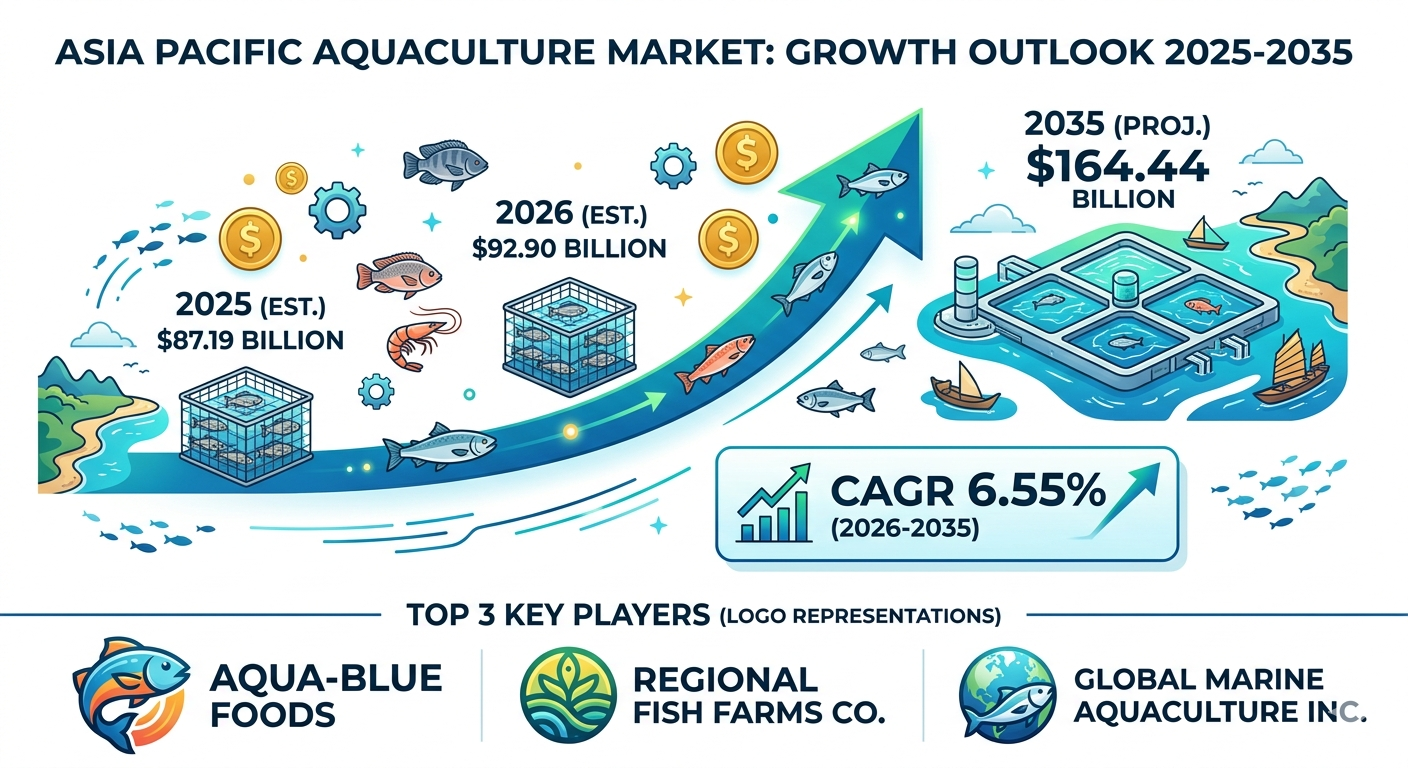
The critical mandate for sustainable marine protein security has positioned the Asia Pacific aquaculture market at the center of the global food-tech and agricultural chemical supply chains. Valued at USD 87.19 billion in 2025, the regional market has grown steadily to an estimated USD 92.90 billion in 2026. Long-term forecasting indicates the market is on track to reach USD 164.44 billion by 2035, expanding at a compound annual growth rate (CAGR) of 6.55% over the forecast period from 2026 to 2035.
By interpolating this growth curve, the market is projected to reach an intermediate valuation of approximately USD 134.42 billion by 2032. This substantial expansion is driven by a structural shift from low-yield traditional farming to intensive, tech-driven Recirculating Aquaculture Systems (RAS) and offshore installations. This transition is further supported by an surging demand for high-value marine species and nutritionally optimized compound feeds across major regional economies.
Market Overview
What is the Asia Pacific Aquaculture Market?
The Asia Pacific aquaculture market represents the industrial cultivation, breeding, and harvesting of aquatic organisms—including finfish, crustaceans, mollusks, and marine algae—across controlled or semi-controlled freshwater, brackish, and marine environments. Serving as the primary hub of global seafood production, this market spans from small-scale inland pond operations to highly automated, large-scale offshore marine enclosures. It relies heavily on an upstream value chain of functional compound feeds, larval live feeds, water purification biotics, and genetic hatchery advancements.
Why is the Asia Pacific Aquaculture Market Important?
The Asia Pacific aquaculture sector is vital because wild capture fisheries can no longer fulfill the animal protein demands of a rapidly growing global population. Aquaculture acts as a stabilizing economic force across the region, generating substantial export revenues, securing millions of coastal livelihoods, and driving innovations in biotechnology. Furthermore, with modern operations shifting toward intensive, land-based recirculating facilities, the sector provides a path toward high-yield food production that minimizes coastal pollution and preserves delicate marine ecosystems.
Market Dynamics & Analytical Insights
What Are the Key Factors Driving the Market?
The rapid industrial scaling of aquaculture across the Asia Pacific is driven by distinct macroeconomic and structural factors:
-
Surging Domestic Seafood Consumption: Rising disposable incomes, expanding urban populations, and a structural dietary shift toward lean proteins have made seafood a staple demand across major Asian metropolitan hubs.
-
Strong International Export Demand: High Western consumption of premium marine species, particularly shrimp and prawns, drives heavy infrastructure investments in export-focused regional hatcheries.
-
Technological Maturation of RAS and Automation: Severe land constraints and strict environmental regulations are accelerating the commercial deployment of land-based recirculating aquaculture systems that minimize water usage and maximize stocking densities.
What are the Primary Challenges Hampering Market Growth?
Despite favorable growth curves, the industry faces severe operational and ecological hurdles:
-
High Early Capital Costs for Advanced Systems: The extensive initial capital expenditures required to set up modern automated offshore cages and closed-loop RAS networks can limit adoption among smaller independent farmers.
-
Vulnerability to Volatile Disease Outbreaks: Concentrated monoculture systems remain highly susceptible to rapid, devastating viral and bacterial pathogens that can wipe out entire seasonal harvests within days.
-
Feed Component Price Fluctuation: The market’s dependence on high-purity fishmeal and oil inputs creates exposure to supply chain vulnerabilities, forcing a costly shift toward alternative plant-based or synthetic proteins.
What is the Value Proposition: Benefits of Using Advanced Aquaculture Methods?
Transitioning away from legacy, traditional farming methods toward modern aquaculture technologies delivers measurable operational efficiencies:
-
Optimized Feed Conversion Ratios (FCR): Utilizing advanced compound feeds coupled with smart automated feeding systems ensures minimal nutrient waste and accelerated biomaterial growth.
-
Precise, Multi-Parameter Environmental Control: Modern closed-loop hatcheries isolate stock from shifting open-water water temperatures, industrial pollution, and unpredictable climate disruptions.
-
Enhanced Post-Larval Survival Rates: Integrating high-density live feed formulations in early hatchery stages significantly strengthens larval immune responses, leading to healthier yields.
Market Segments & Emerging Trends
Which Segment Accounted for the Largest Market Share?
The freshwater culture environment held the largest market share at 58% in 2025, driven by extensive carp, tilapia, and catfish farming operations deep within mainland Asian water networks. On a species basis, the fish segment maintained dominance with a 49% share, reflecting deep-rooted cultural dietary preferences across regional populations. Geographically, China led the market, capturing 46% of the regional market in 2025 through comprehensive state-backed infrastructure development and vast commercial processing networks.
What are the Key Market Trends & Fastest-Growing Segments?
The industry is pivoting from basic, land-intensive pond systems toward automated, high-biosecurity operations. Deep market modeling highlights the fastest-growing sub-sectors:
-
Recirculating Aquaculture Systems (RAS): RAS stands as the fastest-growing technology segment, projected to expand at a 9.31% CAGR as operators seek predictable, weather-independent yields.
-
Online Seafood E-Commerce Platforms: Spurred by digital home-delivery shifts and app-based grocery networks, online retail channels are expanding at a rapid 9.26% CAGR.
-
Offshore Open-Ocean Operations: Growing at an 8.41% CAGR by production type as companies move into deeper water to avoid coastal congestion and environmental run-off.
-
Export-Oriented Commercial Producers: Expanding at an 8.11% CAGR, driven by high global demand for premium, strictly certified shellfish and shrimp species.
Policy & Governance: What are Recent Government Initiatives?
Regulatory shifting and financial incentives heavily shape product design and demand in the Asia Pacific aquaculture sector:
-
China’s Five-Year Green Agriculture Directives: Directs substantial capital subsidies toward shifting inland farms away from high-pollution open ponds and into closed-loop, emission-controlled RAS facilities.
-
India’s Pradhan Mantri Matsya Sampada Yojana (PMMSY): Allocates focused state funding to modernize coastal hatcheries, expand export infrastructure, and extend comprehensive insurance coverage to small-scale aquaculture operations.
-
Southeast Asian Traceability Mandates: Rigid export monitoring standards across Thailand and Vietnam enforce digital auditing of feed ingredients, helping producers secure access to premium European and North American consumer markets.
Competitive Landscape: Top Companies in the Market
Thai Union Group PCL
-
About: Headquartered in Samut Sakhon, Thailand, Thai Union is a leading global seafood producer and one of the largest processors of shelf-stable tuna and value-added shrimp assets in the world.
-
Products: Frozen and chilled seafood, premium processed ocean proteins, and specialized shrimp feeds.
-
Market Cap: THB 48.51 billion / Approx. USD 1.40 billion (May 2026).
Maruha Nichiro Corporation
-
About: Based in Tokyo, Japan, Maruha Nichiro operates a highly integrated global food network, managing everything from deep-sea fishing fleets to state-of-the-art aquaculture facilities.
-
Products: Farmed bluefin tuna, high-grade yellowtail, frozen consumer seafood products, and fine chemical marine extracts.
-
Market Cap: JPY 191.64 billion / Approx. USD 1.22 billion (May 2026).
Kyokuyo Co., Ltd.
-
About: Operating out of Tokyo, Japan, Kyokuyo is an integrated food manufacturer specializing in the procurement, processing, cultivation, and global trade of premium marine products.
-
Products: Farmed bluefin tuna, premium crab sticks, frozen shelf-ready seafood, and institutional food products.
-
Market Cap: JPY 54.17 billion / Approx. USD 345 million (May 2026).
Mowi ASA
-
About: Headquartered in Bergen, Norway, Mowi is the world’s largest producer of Atlantic salmon. The company maintains extensive processing and distribution networks across the Asia Pacific to meet growing premium seafood demands.
-
Products: Fresh salmon fillets, smoked salmon products, and specialized marine feeds.
-
Market Cap: NOK 105.77 billion / Approx. USD 9.80 billion (May 2026).
Cermaq Group AS
-
About: A wholly owned subsidiary of the Mitsubishi Corporation based in Oslo, Norway, Cermaq is a premier international salmon and trout farmer with extensive supply chains across Asian consumer channels.
-
Products: High-grade Atlantic salmon, Coho salmon, and ocean-farmed rainbow trout.
-
Market Cap: Wholly owned subsidiary of Mitsubishi Corporation (Global Conglomerate).
SalMar ASA
-
About: Headquartered in Frøya, Norway, SalMar is an international leader in industrialized ocean farming, pioneering large-scale offshore automated marine production platforms.
-
Products: Raw ocean-farmed salmon, value-added consumer seafood portions, and processing services.
-
Market Cap: Approximately USD 7.20 billion (May 2026).
Cooke Aquaculture Inc.
-
About: Based in New Brunswick, Canada, Cooke Aquaculture is a private, family-owned marine farming enterprise with expanding processing and asset footholds throughout Asian distribution hubs.
-
Products: Farmed Atlantic salmon, sea bass, sea bream, and premium farmed shrimp lines.
-
Market Cap: Privately Held Company.
Nireus SA (Avramar Group)
-
About: Following its structural merger into the Avramar Group, this entity represents a dominant force in Mediterranean aquaculture, exporting high-value whitefish species directly to Asia’s premium culinary sectors.
-
Products: Farmed Mediterranean sea bass, sea bream, stone bass, and specialized aquaculture feeds.
-
Market Cap: Restructured / Privately Managed Asset Base.
What are the Strategic Moves? Market Recent Developments by Major Companies
The strategic alignment within this sector reveals a rapid consolidation around digital traceability and alternative feed components:
-
Thai Union Group (Late 2025): Expanded its venture funding allocations into cell-cultured seafood research and alternative insect-based aquafeed proteins to reduce long-term structural dependencies on wild-caught fishmeal.
-
Maruha Nichiro (Early 2026): Scaled up its land-based, closed-loop bluefin tuna hatchery facilities in Japan, leveraging machine-learning optical sensors to optimize daily feed distribution and limit water contamination.
-
Mowi ASA (2025): Expanded its direct cold-chain logistics operations inside tier-1 Chinese and Indian cities, bypassing traditional wholesale brokers to sell premium packaged salmon directly through online retail applications.
Future of the Market & Conclusion
The future of the Asia Pacific aquaculture market is defined by a shift away from high-labor, open-water farming in favor of precise, technology-driven automated systems. Over the next decade, legacy open-pond techniques will systematically cede share to land-based RAS facilities and automated offshore cages. Companies that invest in direct online retail connections, build biosecure hatcheries, and optimize feed conversion via alternative proteins will lead this expanding multi-billion-dollar market. As wild-capture volumes tighten, advanced aquaculture will become the primary anchor of regional food security.
About Us
Towards Chemical and Materials is a leading global consulting firm specializing in providing comprehensive and strategic research solutions across the chemical and materials industries. With a highly skilled and experienced consultant team, we offer a wide range of services designed to empower businesses with valuable insights and actionable recommendations.
Our Trusted Data Partners
Precedence Research | Statifacts | Towards Packaging | Towards Healthcare | Towards Food and Beverages | Towards Chemical and Materials | Towards Consumer Goods | Nova One Advisor |
For Latest Update Follow Us: https://www.linkedin.com/company/towards-chem-and-materials/
USA: +1 804 441 9344
APAC: +61 485 981 310 or +91 87933 22019
Europe: +44 7383 092 044
Email: [email protected]


Leave a Reply