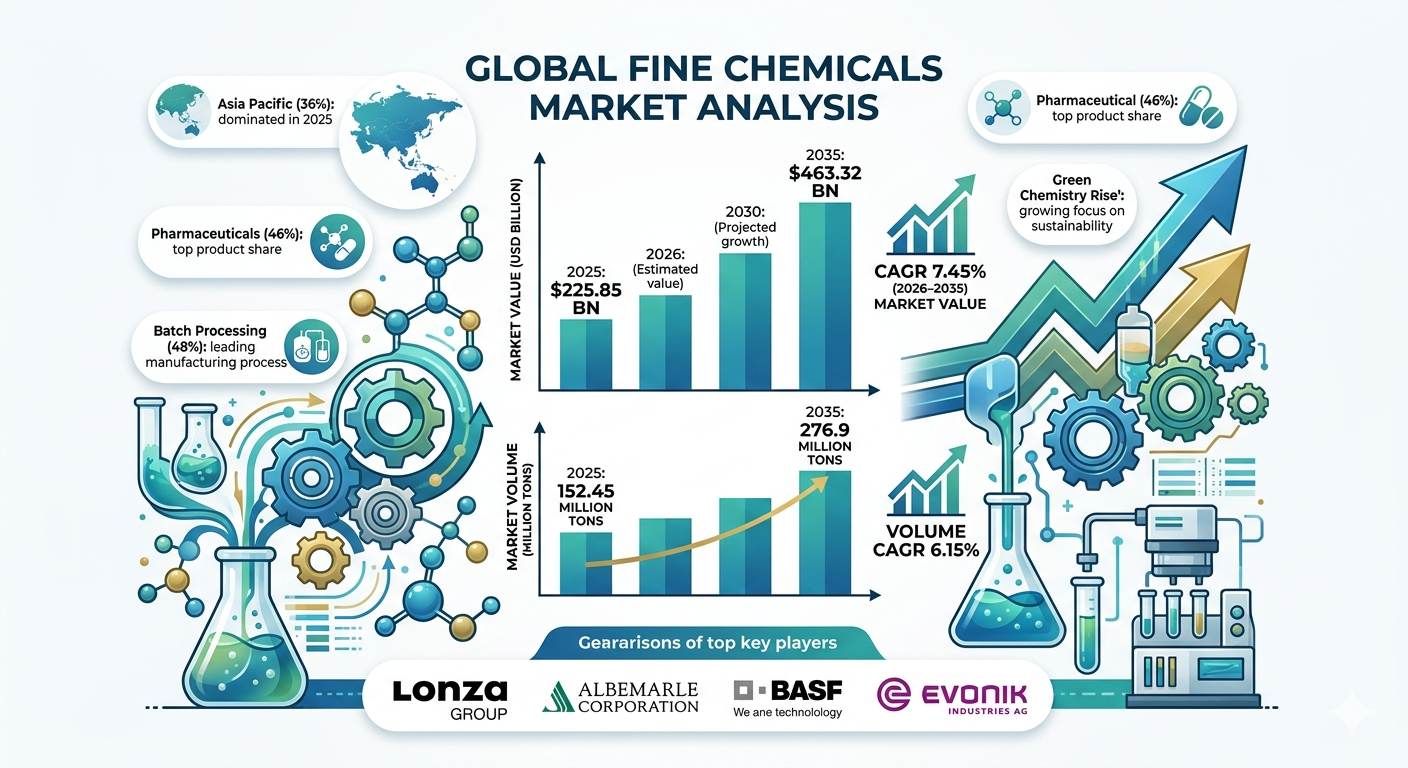
The global fine chemicals market represents a critical, high-value backbone of modern industrial chemistry, providing specialized, highly pure substances produced via multi-step synthesis. In 2025, the global fine chemicals market size was valued at USD 225.85 billion. Moving into 2026, the market is estimated to reach USD 242.68 billion and is projected to exhibit a Compound Annual Growth Rate (CAGR) of 7.45%, ultimately reaching an anticipated market value of USD 463.32 billion by 2035. Simultaneously, volume metrics are expected to scale from 152.45 million tons in 2025 to 276.9 million tons by 2035, expanding at a steady volume CAGR of 6.15%. This growth is primarily fueled by rising global agrochemical requirements and an aggressively expanding health and nutrition sector.
Market Overview: What is the Fine Chemicals Market?
Fine chemicals are specialized chemical substances manufactured in limited, specialized quantities. Unlike bulk or commodity chemicals, fine chemicals are distinguished by their minimal production volume, high added value, exceptional chemical purity, and extensive manufacturing flexibility. They act as the specialized building blocks for several down-stream products, spanning active pharmaceutical ingredients (APIs), advanced agricultural intermediates, catalysts, special peptides, and advanced dyes. The entire supply chain relies heavily on precise manufacturing protocols, starting from advanced feedstock procurement (e.g., petrochemical intermediates, bio-mass, plant oils) and progressing through multi-step chemical synthesis, sophisticated batch or continuous processing, and intensive quality certification.
Market Dynamics & Key Drivers
What Are the Key Factors Driving the Market?
-
Expanding Electronic Applications: The global transition toward advanced semiconductor nodes and sub-nanometer chip configurations mandates high-purity, electronic-grade fine chemicals. Miniaturization trends, advanced wafer polishing, and the production of stretchable electronics and high-bandwidth memory (HBM) are driving massive demand.
-
Robust Agrochemical Requirements: Feeding a growing global population necessitates specialized fungicides, eco-friendly crop protection chemicals, and targeted herbicides. Fine chemicals enhance agricultural productivity and help mitigate yield losses against evolving pesticide resistance.
-
Accelerating Pharmaceutical and Health Demands: The soaring production of complex generic drugs, monoclonal antibodies, and high-potency active pharmaceutical ingredients (HPAPIs) directly boosts market volumes.
What Are the Key Market Restraints?
-
Raw Material Price Volatility: Imbalances in global supply and demand, geopolitical instabilities, container shortages, and fluctuating crude oil prices pose distinct manufacturing challenges.
-
Strict Environmental Mandates: Adapting batch operations to strictly comply with cross-border ecological regulations heavily impacts production margins and operational costs.
Key Market Trends & Technological Shifts
What Are the Recent Key Market Trends?
-
The Rise of Biotech Intermediates: Custom medicine, precision diagnostics, and biopharmaceutical formulations have accelerated the market footprint of pharmaceutical Contract Development and Manufacturing Organizations (CDMOs), increasing reliance on fine chemical synthesis.
-
Expansion of HPAPIs: Oncology therapies and targeted small-dosage formats rely heavily on High-Potency Active Pharmaceutical Ingredients (HPAPIs) to lower systemic drug side effects.
-
The Growth of Green Chemistry: Rising environmental awareness has forced a shift toward bio-lubricants, bio-succinic acid, and bio-surfactants derived from agricultural waste and sustainable biomass.
Prominent Technological Shifts
The fine chemicals market is currently undergoing a structural transformation led by automation, digitalization, and Artificial Intelligence (AI). Heavyweights like BASF, Evonik, Shell, and PPG actively deploy AI to identify optimal synthetic routes, model formulation variations, and proactively discover new fine chemical compounds. AI minimizes byproduct waste, predicts global market pricing fluctuations, detects anomalous batches, and drastically reduces physical experimentation requirements.
Fine Chemicals Market Data Breakdown
Sector Distribution and Regional Shares
The tables below illustrate how different product categories, processing styles, and geographies distribute the global market value.


Leave a Reply