Executive Summary
The global ultrafiltration market is experiencing structural expansion, driven by a broad industrial transition toward strict wastewater management and advanced fluid separation. Valued at USD 5.95 billion in 2025, the market is predicted to rise from USD 6.51 billion in 2026 to approximately USD 14.68 billion by 2035. This projected trajectory represents a compound annual growth rate (CAGR) of 9.45% from 2026 to 2035. Based on this steady growth curve, the market value is estimated to reach approximately USD 11.23 billion by 2032.
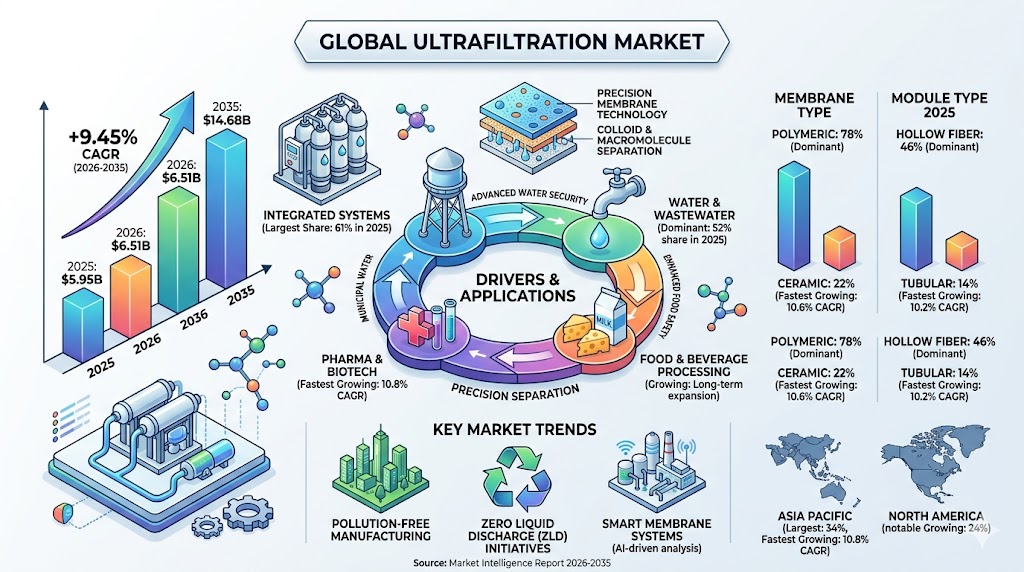
This sustained growth profile is powered by the urgent need for dependable municipal water security, combined with advanced technological shifts in the biotech, pharmaceutical, and food-processing verticals.
Market Overview
What is the ultrafiltration market?
The ultrafiltration market centers on the manufacturing, scaling, and integration of specialized semi-permeable membrane separation systems designed to remove colloidal particles, macromolecules, and microbiological contaminants from process liquids. Functioning as a high-efficiency fluid separation technique, ultrafiltration uses fine filters and hydrostatic pressure to force liquids through a precisely engineered matrix, capturing suspended solids while allowing low-molecular-weight solutes to pass.
This technology is critical for cross-sector scalability, providing advanced pre-treatment and purification steps across multiple manufacturing industries.
Market Dynamics & Key Drivers
What are the key factors driving the market?
The primary catalyst driving this market is the widespread shift toward sustainable industrial wastewater management and pollution-free manufacturing frameworks. As regulatory oversight on industrial effluents tightens globally, manufacturing plants are adopting advanced ultrafiltration units to process and recycle water internally.
Furthermore, major water suppliers are rapidly deploying large-scale ultrafiltration installations to eliminate bacteria, organic matter, and harmful micro-particles from municipal drinking water sources. This structural rollout ensures safer public utility networks and builds strong long-term industrial capabilities.
Key Market Trends
What are the primary market trends?
The most significant trend reshaping the sector is the heavy demand from food processing companies looking to naturally extend product shelf life and improve food quality. Food and beverage manufacturers use ultrafiltration systems for tasks like concentration, protein standardization, and clearing liquids without requiring heat treatment.
Technologically, the industry is moving quickly away from traditional, siloed setups and toward advanced integrated filtration systems. These modern, combined configurations merge ultrafiltration with reverse osmosis or nanofiltration layers, offering superior operational reliability and automated control over fluctuating water quality.
Market Benefits & Product Importance
Why is this market important, and what are the benefits of using ultrafiltration?
Ultrafiltration is a vital process in modern industrial engineering because it balances absolute filtration precision with high energy efficiency. Unlike thermal separation methods, it operates mechanically at ambient temperatures, protecting sensitive components in pharmaceutical and food matrices from heat degradation.
The primary benefit lies in its exceptional separation efficiency. It consistently filters out bacteria, viruses, and macromolecular contaminants without changing the ionic or mineral balance of the liquid. This makes it an ideal, low-maintenance protective barrier for downstream processes like reverse osmosis membranes.
Recent Government Initiatives
What recent government initiatives are impacting the market?
Environmental regulatory bodies worldwide are introducing stricter rules for industrial water filtration and effluent treatment. Governments across the Americas, Europe, and Asia are mandating zero liquid discharge (ZLD) protocols for chemical, heavy manufacturing, and power generation facilities, pushing ultrafiltration technology to the forefront of industrial compliance.
Additionally, state-backed financial incentives and green infrastructure subsidies are accelerating municipal water plant upgrades, helping local utilities fund the transition from legacy sand filters to modern hollow-fiber membrane systems.
Market Segmentation Analysis
Which segment accounted for the largest market share?
An assessment of the market reveals distinct leadership profiles across all major analytical categories:
-
Regional Dominance: The Asia-Pacific region led the market with a 34% share in 2025 and is projected to grow the fastest at a 10.80% CAGR. North America followed, holding a 24% market share in 2025.
-
Membrane & Module Type: Polymeric membranes dominated with a 78% share in 2025. However, ceramic membranes are expected to grow the fastest at a 10.60% CAGR. Structurally, hollow fiber led with a 46% share, while tubular geometries are forecasted to see the fastest growth at a 10.20% CAGR.
-
Application & End-User: Water and wastewater treatment held a dominant 52% share in 2025. The pharmaceutical and biotechnology segment is expected to expand at the fastest CAGR of 10.80%. The municipal segment led the end-user space with a 44% share, while the residential category is projected to grow the fastest at a 10.50% CAGR.
-
System Type: Integrated systems dominated with a 61% share in 2025 and are expected to grow the fastest at a 10.10% CAGR.
Strategic Data Reference
The data table below summarizes the key metrics, growth parameters, and market shares across the global ultrafiltration landscape.
Ultrafiltration Market Core Segment Metrics (Base Year 2025)
| Category | Segment Name | 2025 Market Share (%) | Forecast CAGR (2026–2035) |
| Regional Performance |
Asia Pacific
North America |
34%
24% |
10.80% (Fastest)
Steady Growth |
| Membrane Chemistry |
Polymeric Membranes
Ceramic Membranes |
78%
22% |
Base Volume Leader
10.60% (Fastest) |
| Module Configuration |
Hollow Fiber
Tubular Segment |
46%
14% |
Structural Core
10.20% (Fastest) |
| Application Focus |
Water & Wastewater
Pharma & Biotech |
52%
14% |
Demand Driver
10.80% (Fastest) |
| End-User Vertical |
Municipal Sector
Residential Market |
44%
15% |
Volume Leader
10.50% (Fastest) |
| System Architecture | Integrated Systems | 61% | 10.10% (Fastest) |
Competitive Landscape: Profile of Top Companies
DuPont de Nemours, Inc.
-
About: Headquartered in Wilmington, Delaware, DuPont is a global materials science pioneer offering advanced separation solutions through its Water Solutions division.
-
Products: IntegraFlux™ and IntegraPac™ ultrafiltration modules, utilizing high-permeability PVDF hollow fiber membranes.
-
Market Cap: Approximately USD 19.85 Billion.
Veolia Environnement S.A.
-
About: Based in Paris, France, Veolia is a global leader in resource management and water technologies, offering comprehensive engineering services and advanced treatment equipment.
-
Products: ZeeWeed® ultrafiltration membranes, explicitly designed for drinking water purification and advanced wastewater recycling systems.
-
Market Cap: Approximately USD 30.50 Billion.
Alfa Laval AB
-
About: Located in Lund, Sweden, Alfa Laval is a prominent global provider of specialized heat transfer, centrifugal separation, and fluid handling technologies.
-
Products: Industrial-grade hollow fiber and plate-and-frame ultrafiltration systems optimized for food processing, dairy, and biotechnology uses.
-
Market Cap: Approximately USD 23.43 Billion.
Pentair plc
-
About: Headquartered in London, United Kingdom, with main operational offices in Minnesota, Pentair focuses on smart, sustainable water solutions for municipal, commercial, and residential markets.
-
Products: X-Flow® ultrafiltration membrane technologies, specializing in freshwater pre-treatment and water purification applications.
-
Market Cap: Approximately USD 12.27 Billion.
Recent Strategic Developments
What are the recent developments by major companies?
To address strict clean water mandates and evolving food-grade applications, leading membrane manufacturers have executed key product rollouts over the past year. DuPont scaled production of its bimodal, modified PVDF hollow-fiber lines to provide better fouling resistance and lower operational energy requirements in municipal water treatment.
Concurrently, Veolia expanded the global availability of its ZeeWeed series, securing high-volume municipal retrofitting contracts across expanding cities in the Asia-Pacific region. On the industrial side, Alfa Laval introduced a specialized, automated ultrafiltration system designed for dairy and pharma lines, helping processing plants recover valuable proteins while maintaining high sanitary standards.
Future of the Market
What is the future outlook for the market?
The future of the ultrafiltration market will be shaped by a deep integration of smart technologies and material advancements designed to fight membrane fouling. Over the next decade, standard polymeric systems are expected to face strong competition from high-durability ceramic membranes in harsh industrial environments.
As automation and industrial internet-of-things (IIoT) sensors become standard in modern processing facilities, membrane units will feature real-time permeability monitoring and predictive cleaning cycles. Companies that develop low-energy, highly backwashable membrane materials will capture a significant competitive advantage, positioning themselves at the center of global water reuse initiatives.
About Us
Towards Chemical and Materials is a leading global consulting firm specializing in providing comprehensive and strategic research solutions across the chemical and materials industries. With a highly skilled and experienced consultant team, we offer a wide range of services designed to empower businesses with valuable insights and actionable recommendations.
Our Trusted Data Partners
Precedence Research | Statifacts | Towards Packaging | Towards Healthcare | Towards Food and Beverages | Towards Chemical and Materials | Towards Consumer Goods | Nova One Advisor |
For Latest Update Follow Us: https://www.linkedin.com/company/towards-chem-and-materials/
USA: +1 804 441 9344
APAC: +61 485 981 310 or +91 87933 22019
Europe: +44 7383 092 044
Email: [email protected]


Leave a Reply