Market Overview
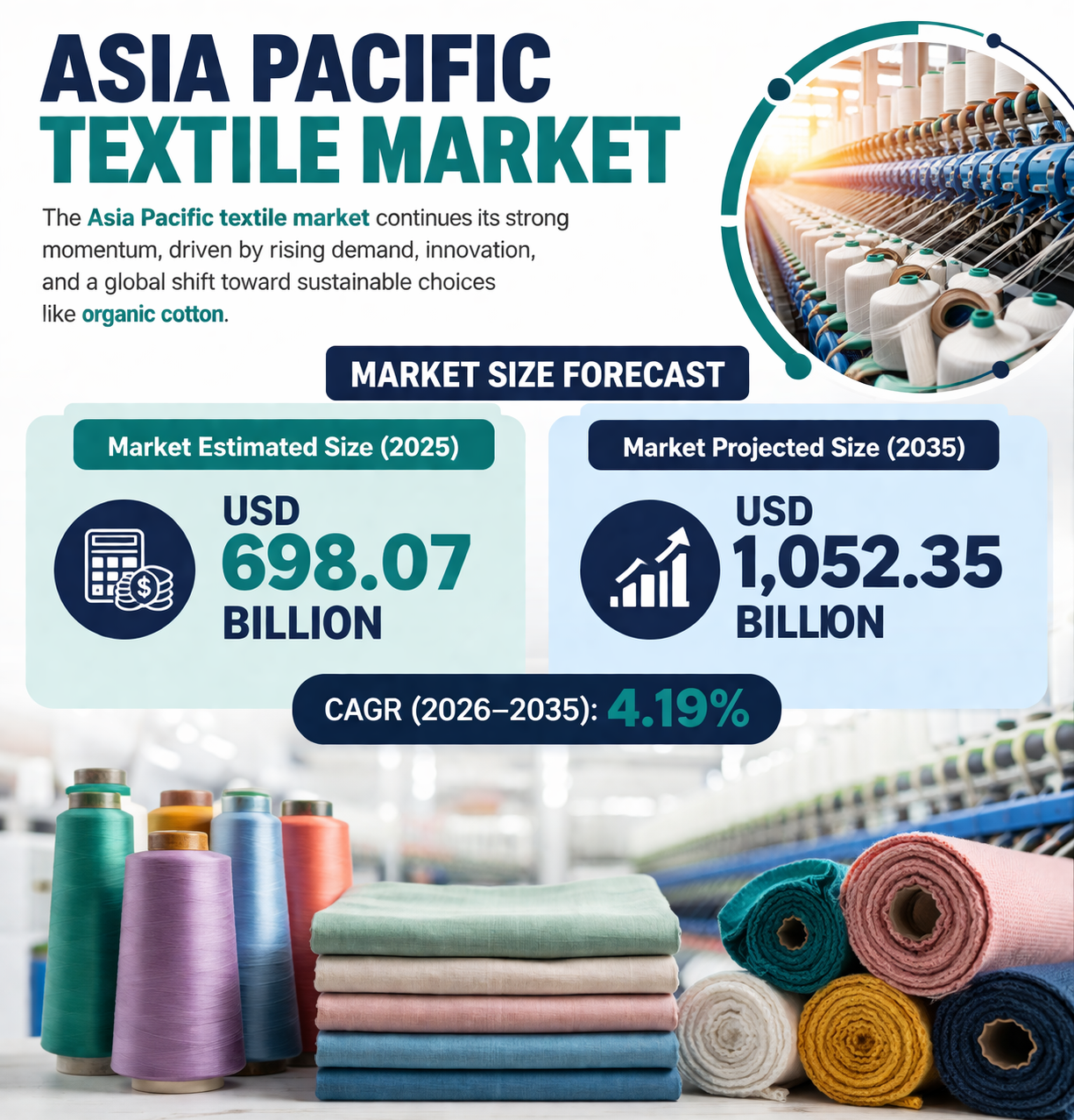
The Asia Pacific textile market is a dynamic and rapidly growing industry. Valued at USD 698.07 billion in 2025, it is projected to reach USD 1,052.35 billion by 2035, with a CAGR of 4.19% from 2026 to 2035. The market is being driven by several factors, including the increasing demand for synthetic and natural fibers, innovation in textile manufacturing technologies, and the global shift towards organic cotton.
Asia Pacific holds a significant share of the global textile industry, with countries like China, India, and Bangladesh being major players in textile production and exports. The region’s textile sector spans a wide range of applications, from fashion and apparel to industrial and technical textiles, making it an essential component of the global economy.
What is Market Growth?
The Asia Pacific textile market is experiencing steady growth, with the market size expected to reach USD 727.32 billion in 2026, growing at a CAGR of 4.19% from 2026 to 2035. By 2035, the market is projected to reach USD 1,052.35 billion. The market volume, driven by the demand for textiles in apparel, industrial, and technical applications, will continue to expand significantly, especially as sustainable and organic fibers gain momentum.
What Are the Key Market Trends?
The Asia Pacific textile market is witnessing several key trends:
- Sustainability and Organic Cotton: The global shift towards organic cotton is a major driver of change in the market. Consumers are increasingly demanding eco-friendly textiles, and manufacturers are responding by adopting sustainable practices and sourcing organic materials.
- Rise in Synthetic Fibers: Synthetic fibers, such as polyester and nylon, continue to dominate the market, accounting for 47.40% of the industry share in 2025. These fibers are favored for their durability, versatility, and cost-effectiveness, which makes them a top choice for various textile applications.
- Growth in Non-Woven Fabrics: Non-woven fabrics, which are used in industries such as healthcare, automotive, and construction, are expected to grow at the fastest rate in the market. This growth is driven by the increasing demand for disposable and functional textiles.
- Advances in Textile Technology: Technological innovations in textile manufacturing, such as automation, 3D weaving, and digital printing, are making textile production more efficient and opening up new opportunities for customized designs and functionality.
What Are the Recent Government Initiatives?
Governments in the Asia Pacific region are playing an active role in shaping the textile market through various initiatives:
- Promotion of Sustainable Practices: Many countries in the region are encouraging textile manufacturers to adopt sustainable practices through tax incentives, subsidies, and government-supported initiatives. These efforts are aimed at reducing the environmental impact of textile production.
- Industrial Growth and Support: Governments are implementing policies to promote the growth of textile manufacturing industries, particularly in emerging economies like India, Vietnam, and Bangladesh. These policies include subsidies for machinery upgrades, training programs, and market access improvements.
- Export Initiatives: Countries like China and India are actively promoting textile exports, benefiting from favorable trade agreements and partnerships with global markets. The focus is on improving quality and expanding product offerings, including high-performance technical textiles.
What Are the Benefits of Using Textiles?
The use of textiles in various industries offers numerous benefits:
- Versatility: Textiles are incredibly versatile and are used across multiple sectors, including apparel, automotive, construction, and healthcare. This makes the textile industry a vital component of various supply chains.
- Economic Contribution: The textile industry is a significant contributor to the economies of many Asia Pacific countries, generating employment, exports, and value-added products.
- Innovation and Functionality: With advances in textile technology, modern textiles offer enhanced features such as water resistance, fire retardancy, UV protection, and breathability. These innovations have expanded the range of applications for textiles.
- Sustainability: The increasing shift towards organic and eco-friendly textiles offers long-term environmental benefits, reducing the carbon footprint and ensuring the sustainability of the industry.
What Are the Key Factors Driving the Market?
Several factors are driving the growth of the Asia Pacific textile market:
- Rising Consumer Income: As incomes in Asia Pacific countries rise, consumers are increasingly demanding higher-quality and more diverse textile products, driving market growth in both the fashion and industrial sectors.
- Urbanization and Infrastructure Development: Ongoing urbanization and infrastructure development are creating a greater demand for textiles, particularly in the construction, automotive, and healthcare industries.
- Technological Advancements: The adoption of advanced manufacturing technologies in the textile industry is improving production efficiency and expanding the range of functional textiles, thereby boosting market demand.
- Sustainability Focus: As consumers and governments alike prioritize sustainability, there is growing demand for eco-friendly materials like organic cotton, biopolymers, and biodegradable fabrics, all of which are helping drive the market’s shift toward more sustainable practices.
What Is the Future of the Market?
The future of the Asia Pacific textile market is promising, with continued growth expected in the coming decade. The shift towards sustainable and organic textiles will play a crucial role in shaping the market, while the demand for high-performance fabrics in industries such as automotive, healthcare, and electronics will continue to rise. By 2035, the market is projected to reach USD 1,052.35 billion, driven by innovation in textile production and the growing need for functional and sustainable materials.
Why Is the Textile Market Important?
The textile market is vital for several reasons:
- Economic Significance: Textiles contribute significantly to the GDP of many Asia Pacific countries, providing employment to millions and driving industrial development.
- Global Supply Chain: Textiles are a critical part of global supply chains, with applications in numerous industries, including fashion, healthcare, construction, and automotive.
- Sustainability and Environmental Responsibility: As the world shifts towards more sustainable production practices, the textile industry plays a pivotal role in ensuring that materials are sourced responsibly and products are designed with minimal environmental impact.
The Asia Pacific textile market is crucial for the continued development of the region’s economy, while also contributing to global efforts to address environmental challenges.
Which Segment Accounted for the Largest Market Share?
In 2025, China dominated the Asia Pacific textile market with a market share of 53.33%. This dominance is due to China’s position as the largest producer and exporter of textiles in the region, benefiting from a highly developed manufacturing infrastructure, skilled workforce, and substantial government support for the industry. China’s leadership in synthetic fiber production, particularly polyester, further solidifies its dominant position in the market.
The Asia Pacific textile market is set to expand significantly over the next decade, driven by rising demand for high-performance materials, sustainability, and technological advancements. As the industry continues to innovate and adapt to changing consumer preferences, it will remain a cornerstone of global textile production and trade.
About Us
Towards Chemical and Materials is a leading global consulting firm specializing in providing comprehensive and strategic research solutions across the chemical and materials industries. With a highly skilled and experienced consultant team, we offer a wide range of services designed to empower businesses with valuable insights and actionable recommendations.
Our Trusted Data Partners
Precedence Research | Statifacts | Towards Packaging | Towards Healthcare | Towards Food and Beverages | Towards Chemical and Materials | Towards Consumer Goods | Nova One Advisor |
For Latest Update Follow Us: https://www.linkedin.com/company/towards-chem-and-materials/
USA: +1 804 441 9344
APAC: +61 485 981 310 or +91 87933 22019
Europe: +44 7383 092 044
Email: [email protected]


Leave a Reply