Market Overview
The global agricultural adjuvants market, valued at USD 4.75 billion in 2025, is on a steady growth trajectory, with an estimated value of USD 5.03 billion in 2026. By 2035, the market is projected to reach USD 8.47 billion, showcasing a robust growth rate driven by increasing demand for crop protection products. Agricultural adjuvants are chemical additives used to enhance the performance of pesticides, herbicides, and fungicides, improving their effectiveness and application efficiency.
The growing global demand for food production, paired with the challenges of climate change and the need for sustainable agricultural practices, is driving the adoption of adjuvants that improve pesticide performance and reduce the environmental impact of agrochemicals. The agricultural adjuvants market plays a critical role in optimizing crop yields while minimizing resource use.
What is Market Growth?
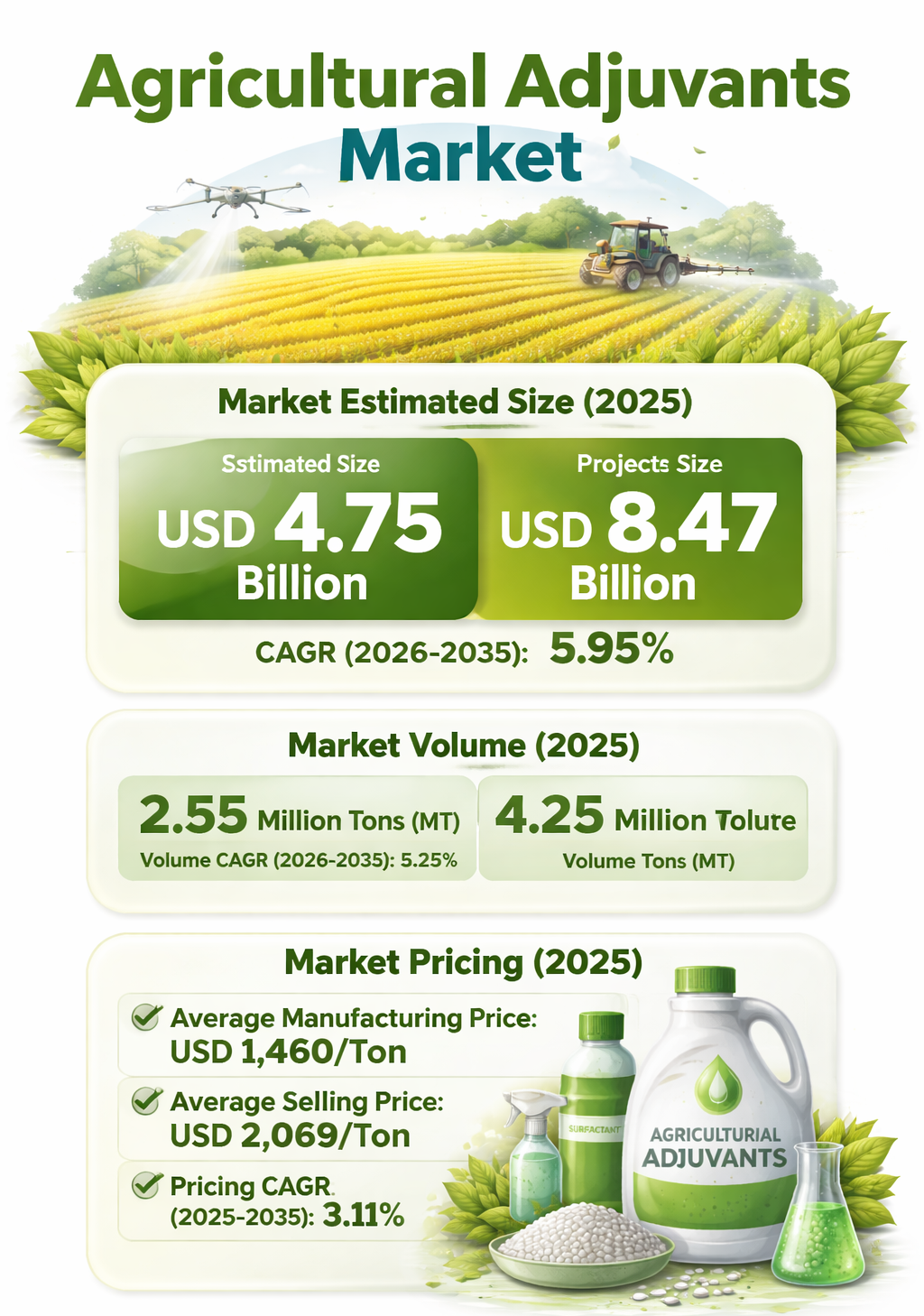
The agricultural adjuvants market is expected to grow at a steady pace, with a projected CAGR of 5.95% from 2026 to 2035. By 2035, the market size is expected to reach USD 8.47 billion. In terms of volume, the market is projected to grow from 2.55 million tons in 2025 to 4.25 million tons by 2035, reflecting a CAGR of 5.25%. This growth reflects the increasing adoption of adjuvants in both developed and emerging markets as the agriculture industry seeks to boost efficiency, enhance crop protection, and meet growing food demand.
Key Takeaways
- By region, North America dominated the agricultural adjuvants market with 32% share in 2025.
- By region, Asia Pacific is expected to be the fastest-growing region in the market, with a CAGR of 7.80% in the forecast period.
- By type, the activator adjuvants segment dominated the market with 62% share in 2025 and sustain its position with the fastest growing CAGR of 7.1% during the forecast period.
- By formulation type, the liquid formulations segment dominated the market with 71% share in 2025 and sustain its position with the fastest growing CAGR of 7.0% during the forecast period.
- By application, the herbicides segment dominated the market with 46% share in 2025 and maintained its position with a rapid CAGR of 7.2% in the coming years.
- By crop type, the cereals and grains segment dominated the market with 38% share in 2025.
- By crop type, the fruit and vegetable segment is expected to be the fastest-growing in the market with a CAGR of 7.50% in the forecast period.
Market Size and Volume Forecast
- Market Estimated Size (2025): USD 4.75 Billion | CAGR (2026–2035): 5.95%
- Market Projected Size (2035): USD 8.47 Billion
- Market Volume (2025): 2.55 Million Tons (MT)| Volume CAGR (2026–2035): 5.25%
- Market Projected Volume (2035): 4.25 Million Tons (MT)
- Market Pricing (2025):
- Average Manufacturing Price: USD 1,460/Ton
- Average Selling Price: USD 2,069/Ton
- Pricing CAGR (2025–2035): 3.11%
What Are the Key Market Trends?
Several key trends are shaping the agricultural adjuvants market:
- Shift Toward Sustainable Agriculture: With growing concerns about environmental sustainability, farmers are increasingly seeking eco-friendly adjuvants that help reduce pesticide residues and environmental pollution. The demand for biodegradable and non-toxic additives is rising, aligning with the broader shift toward sustainable agricultural practices.
- Technological Advancements in Formulations: The development of innovative adjuvant formulations is driving market growth. These advancements focus on increasing the effectiveness of adjuvants in various weather conditions and improving their ability to penetrate plant surfaces.
- Integration of Digital Tools in Agriculture: The increasing use of precision agriculture technologies, including drones and sensors, is enhancing the application of agricultural adjuvants. These tools help monitor crop health and optimize the application of pesticides, reducing waste and improving efficiency.
- Regulations Driving Adoption: Growing global regulatory pressure on the use of agrochemicals is pushing the industry toward safer and more efficient adjuvants. This trend is leading to the development of adjuvants that work at lower doses, improving safety and reducing the overall environmental footprint.
What Are the Recent Government Initiatives?
Governments around the world are implementing initiatives to regulate and promote the use of agricultural adjuvants in a sustainable manner:
- Sustainability Regulations: Many governments are introducing and enforcing regulations that require more sustainable and eco-friendly agricultural practices. This includes the use of non-toxic, biodegradable adjuvants that align with environmental protection goals.
- Incentives for Sustainable Practices: Some governments offer financial incentives or subsidies to farmers and agrochemical companies that adopt environmentally friendly practices, including the use of safe adjuvants.
- Support for Research and Development: Government-funded research initiatives are supporting the development of innovative adjuvants that are more effective, efficient, and environmentally friendly. These programs are encouraging the creation of next-generation adjuvants designed to meet modern agricultural challenges.
These government initiatives are promoting a more responsible and sustainable approach to pesticide use, which is crucial in supporting long-term food security and environmental sustainability.
What Are the Benefits of Using Agricultural Adjuvants?
Agricultural adjuvants offer several benefits that make them essential for modern farming practices:
- Improved Effectiveness of Pesticides: Adjuvants help increase the effectiveness of pesticides, fungicides, and herbicides by improving their adhesion, spreading, and penetration into plant surfaces. This leads to better pest control and crop protection.
- Reduced Chemical Use: By enhancing the efficiency of pesticides, adjuvants reduce the amount of chemicals required for effective pest management, contributing to lower costs and environmental impact.
- Enhanced Crop Yield: The use of adjuvants can help protect crops from pests, diseases, and environmental stress, resulting in higher crop yields and better quality produce.
- Environmental Protection: Adjuvants that reduce pesticide runoff and increase product efficacy help minimize the environmental impact of agrochemicals, ensuring that farming practices remain sustainable.
These benefits make adjuvants a key part of modern agricultural practices, driving their increasing adoption.
What Are the Key Factors Driving the Market?
Several factors are driving the growth of the agricultural adjuvants market:
- Rising Global Food Demand: As the global population continues to grow, the demand for higher agricultural productivity is increasing. Adjuvants help maximize crop yields by improving the effectiveness of pesticides and fertilizers.
- Sustainability Pressures: The growing need for sustainable farming practices and reduced chemical usage is encouraging the adoption of more efficient and eco-friendly adjuvants that help minimize environmental impact.
- Technological Advancements: Innovations in adjuvant formulations and application technologies are making them more efficient, driving greater market adoption. Precision agriculture tools are also making it easier to apply adjuvants more accurately.
- Government Support for Sustainable Agriculture: As governments enforce stricter regulations on pesticide use, the demand for safe, effective, and environmentally friendly adjuvants is growing.
These factors combine to create a favorable environment for the growth of the agricultural adjuvants market.
What Is the Future of the Market?
The future of the agricultural adjuvants market looks bright, with continued growth expected through 2035. The market will be driven by the increasing adoption of sustainable farming practices, innovations in adjuvant formulations, and rising global demand for food. As the agricultural sector embraces new technologies, the role of adjuvants in optimizing crop protection and enhancing yield efficiency will continue to expand. The market is also likely to see increased investment in R&D for eco-friendly adjuvants that reduce environmental impact while maintaining high performance.
Why Is the Agricultural Adjuvants Market Important?
The agricultural adjuvants market is critical for several reasons:
- Boosting Agricultural Productivity: Adjuvants help farmers achieve higher crop yields by improving the effectiveness of pesticides and fertilizers, which is essential for feeding the growing global population.
- Sustainability: As agriculture becomes more focused on sustainability, adjuvants that reduce chemical usage and environmental impact will be vital in creating more eco-friendly farming practices.
- Economic Value: By improving pest control efficiency, adjuvants contribute to reducing the cost of farming operations, benefiting both farmers and the wider agricultural industry.
As the market for agricultural products continues to expand, adjuvants will remain essential for ensuring that farming practices are both productive and sustainable.
Which Segment Accounted for the Largest Market Share?
The largest market share in the agricultural adjuvants market is held by the surfactants segment, which is used to improve the spread, adhesion, and absorption of pesticides. Surfactants are essential in ensuring that agrochemicals efficiently cover the surface area of plants and penetrate deeply for effective pest control. This segment is expected to continue dominating the market due to its versatility and widespread use in various agricultural applications, including herbicides, fungicides, and insecticides.
The agricultural adjuvants market is positioned for steady growth, driven by the need for sustainable farming practices, technological advancements, and increasing food demand. As the industry continues to innovate, agricultural adjuvants will play a key role in enhancing crop protection and boosting overall agricultural productivity.
About Us
Towards Chemical and Materials is a leading global consulting firm specializing in providing comprehensive and strategic research solutions across the chemical and materials industries. With a highly skilled and experienced consultant team, we offer a wide range of services designed to empower businesses with valuable insights and actionable recommendations.
Our Trusted Data Partners
Precedence Research | Statifacts | Towards Packaging | Towards Healthcare | Towards Food and Beverages | Towards Chemical and Materials | Towards Consumer Goods | Nova One Advisor |
For Latest Update Follow Us: https://www.linkedin.com/company/towards-chem-and-materials/
USA: +1 804 441 9344
APAC: +61 485 981 310 or +91 87933 22019
Europe: +44 7383 092 044
Email: [email protected]


Leave a Reply