The European construction landscape is undergoing a profound “Green Renaissance.” As the continent pivots toward the ambitious goal of carbon neutrality, the materials forming our skylines are shifting from carbon-heavy staples to innovative, circular, and energy-efficient alternatives. This isn’t just a trend; it’s a structural overhaul of how Europe builds for the future.
Executive Summary
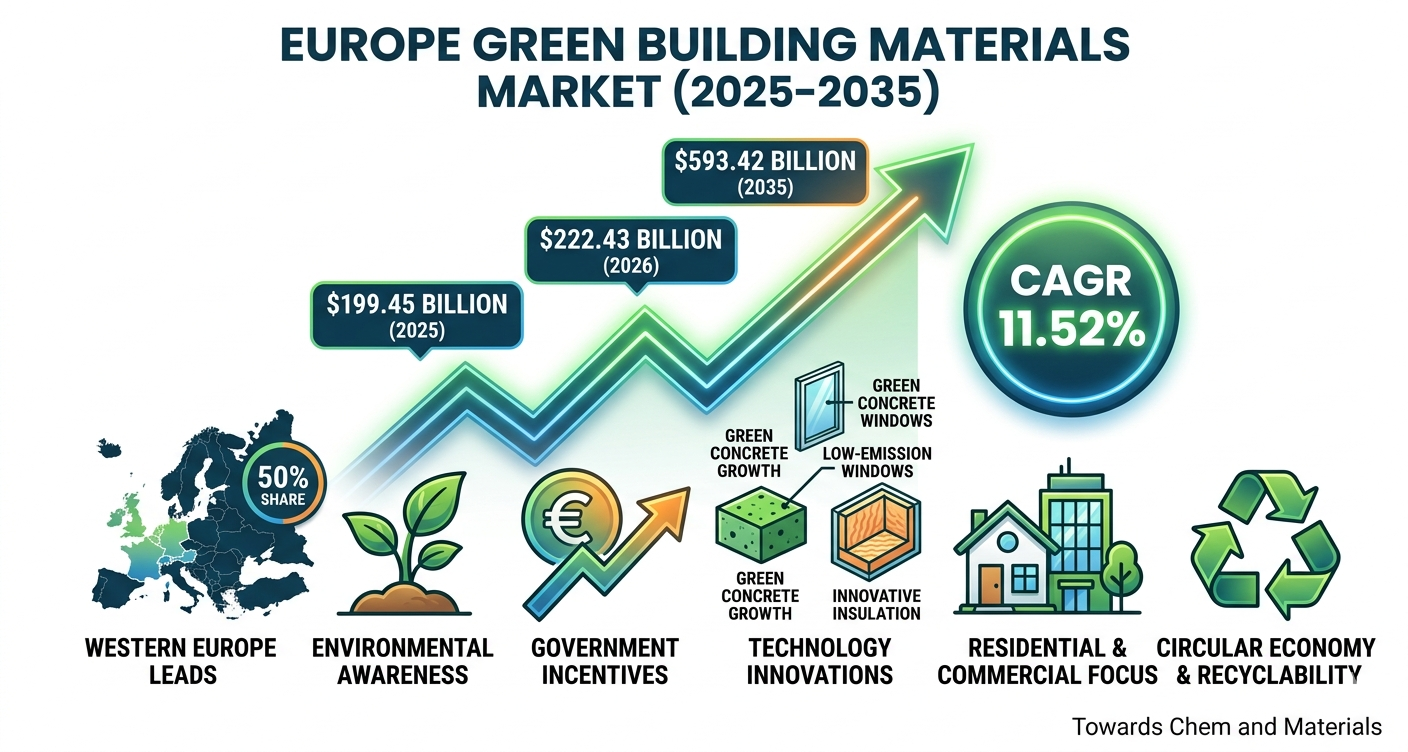
The Europe Green Building Materials Market is entering a decade of hyper-growth. Valued at USD 199.45 billion in 2025, the market is estimated to reach USD 222.43 billion in 2026. By 2035, the sector is projected to soar to USD 593.42 billion, progressing at a formidable CAGR of 11.52% from 2026 to 2035. This double-digit growth signals a massive shift in procurement strategies across the residential and commercial sectors.
Market Overview: A Shift Toward Circularity
In 2026, green building materials are no longer “niche” products for luxury eco-homes; they are the baseline for European infrastructure. From low-carbon green concrete to high-performance insulation, these materials are defined by their ability to reduce a building’s environmental footprint throughout its entire lifecycle.
Western Europe remains the heartbeat of this market, currently commanding a 50% share. This regional dominance is driven by a sophisticated mix of historical preservation through “smart renovations” and cutting-edge new builds that utilize advanced HVAC and ventilation systems to maximize energy usage efficiency.
Market Growth: What is Driving the 11.52% CAGR?
The projected growth to USD 593.42 billion by 2035 is fueled by a convergence of environmental necessity and economic viability.
-
The “Northern” Surge: While Western Europe holds the volume, Northern Europe is the “growth engine,” projected to expand at the fastest pace due to exceptionally strict energy-efficiency mandates and a culture of material science innovation.
-
Volume Expansion: The total market volume is expected to climb from approximately 169.9 million tons to over 406 million tons by 2035. This indicates that the market is scaling physically as much as it is financially.
Key Market Trends: Decarbonizing the “Gray” Gold
One of the most significant shifts in the industry is the rise of Green Concrete. Historically, concrete production was a carbon nightmare; however, advancements in substitute raw materials and low-emission production are making green concrete a preferred choice for both residential developers and commercial giants.
Additionally, the industry is moving toward “Recyclability & Sustainability” as a core technology. The focus is no longer just on how much energy a building saves while in use, but on the circular economy—ensuring that materials like timber, recycled steel, and bio-based flooring can be repurposed at the end of the building’s life.
Market Recent Government Initiatives: The “Clean Industrial Deal”
Regulation is the invisible hand guiding this market. In March 2025, the European Commission introduced the Clean Industrial Deal. This landmark initiative is designed to bolster Europe’s industrial competitiveness while simultaneously accelerating decarbonization efforts in the face of global geopolitical shifts.
Beyond this, individual nations are offering aggressive subsidies and tax incentives for “Green Renovations.” These policies are specifically targeted at the housing sector to improve the thermal performance of older structures, making green insulation materials a high-volume necessity.
Benefits of Using Green Building Materials
Why are developers making the switch? Beyond mere compliance, the benefits are tangible:
-
Operational Savings: Energy-efficient technologies significantly lower utility costs for end-users.
-
Healthier Living: Materials like low-VOC paints and natural flooring create indoor environments that promote respiratory health and overall well-being.
-
Future-Proofing Assets: Green-certified buildings (LEED, BREEAM) command higher resale values and lower insurance premiums.
-
Carbon Credits: Commercial developers are increasingly using these materials to offset carbon taxes and meet ESG (Environmental, Social, and Governance) targets.
Key Factors Driving the Market: Why Now?
The surge is driven by a “perfect storm” of three factors:
-
Environmental Awareness: Consumer demand for “healthier living spaces” has moved from the fringe to the mainstream, specifically boosting the residential segment.
-
Climatic Shifts: Increasingly volatile European weather—from heatwaves to extreme cold—has made high-grade insulation materials (which hold a 40% market share) a non-negotiable requirement.
-
Technological Maturity: Innovations in smart windows and thermally broken doors have made sustainable options more affordable and accessible than ever before.
Future of the Market: A $593 Billion Horizon
Looking toward 2035, we expect the market to be dominated by Smart Building Materials. This includes windows that adjust their tint based on sunlight intensity and insulation that can regulate humidity levels. The commercial sector will likely lead the growth charge in the latter half of the decade as multinational corporations race to minimize their carbon footprints to align with EU-wide sustainability disclosure requirements.
Why is This Market Important?
Construction has historically been one of the highest carbon-emitting industries in Europe. This market represents the solution. It is the bridge between the old “extract-use-discard” model and a new “sustainable-circular” model. It is critical for energy security (reducing dependence on imported heating fuels) and for meeting the goals of the European Green Deal.
Segmental Insight: Who Leads the Way?
The Insulation Dominance
The Insulation Materials segment is the current heavyweight, holding 40% of the market. This is due to the urgent need for retrofitting Europe’s aging building stock to prevent heat loss. As climatic conditions shift, these materials—ranging from mineral wool to cellulose—are the first line of defense in energy conservation.
Residential vs. Commercial
The Residential Segment currently leads with a 45% share, driven by homeowners’ desire for lower energy bills and healthier interiors. However, the Commercial Segment is the “one to watch” for growth. Driven by corporate sustainability mandates and the need for eco-friendly office spaces to attract top talent, this segment will expand at the fastest CAGR through 2035.
Competitive Landscape: The Power Players
The market is populated by innovators and industrial giants, including:
-
Saint-Gobain
-
BASF SE
-
Kingspan Group
-
Knauf Insulation
-
Sika AG
These companies are increasingly investing in R&D to overcome the market’s primary challenge: the need for specialized labor. As BIM (Building Information Modeling) and geothermal integration become standard, these leaders are not just selling materials—they are providing the expertise to build the cities of tomorrow.
Contact Us https://www.towardschemandmaterials.com/contact-us
About Us
Towards Chem and Materials is a leading global consulting firm specializing in providing comprehensive and strategic research solutions across the chemical and materials industries. With a highly skilled and experienced consultant team, we offer a wide range of services designed to empower businesses with valuable insights and actionable recommendations.
Email: [email protected]
Web: https://www.towardschemandmaterials.com/
For Latest Update Follow Us: https://www.linkedin.com/company/towards-chem-and-materials/?viewAsMember=true


Leave a Reply