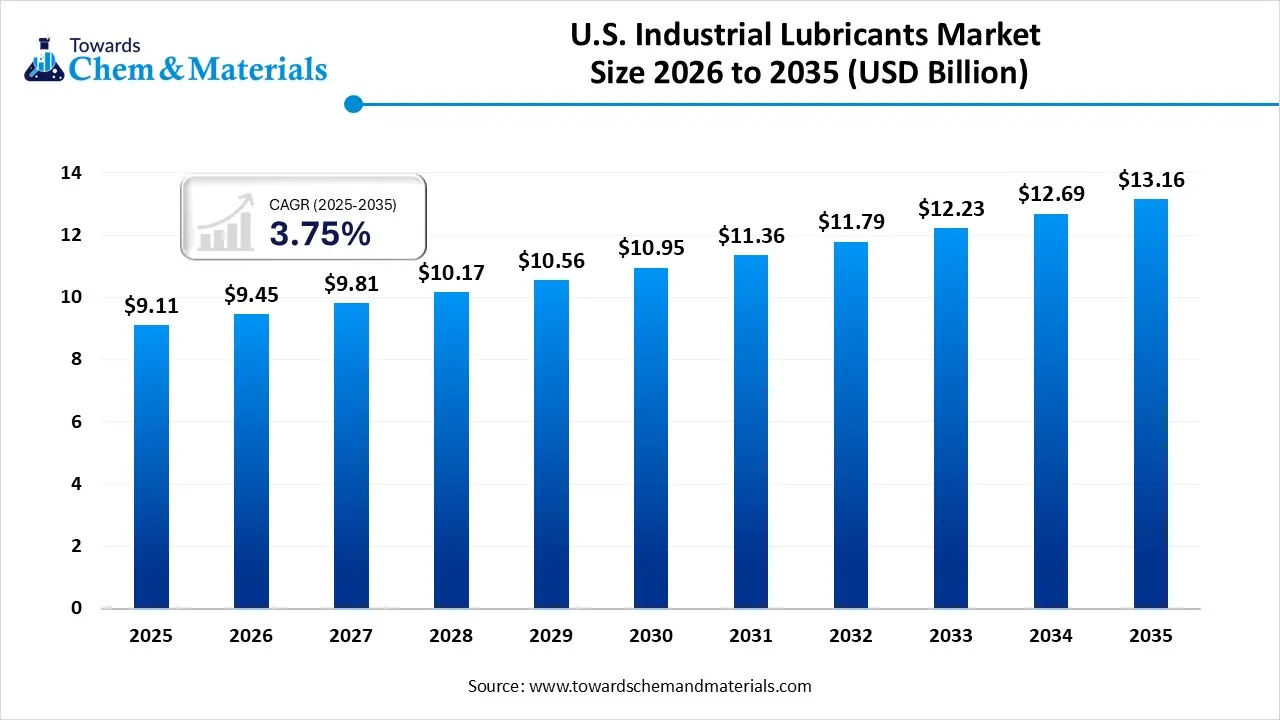
The U.S. industrial lubricants market was valued at USD 9.11 billion in 2025 and is projected to grow from USD 9.45 billion in 2026 to USD 13.16 billion by 2035, expanding at a CAGR of 3.75% during the forecast period (2026–2035). Growth in the market is largely driven by increasing domestic demand across the energy sector, manufacturing industries, and infrastructure development, alongside ongoing technological innovation and stringent environmental regulations.
Download a sample of this report @ https://www.towardschemandmaterials.com/download-sample/6231
Industrial lubricants are essential for reducing friction, improving machine efficiency, and enhancing the lifespan of industrial equipment. In the United States, the market is undergoing a notable transformation as manufacturers shift from high-volume commodity lubricants toward specialized, technology-driven fluids. This transition is supported by the expansion of advanced manufacturing systems, robotics, and autonomous industrial operations that require high-performance lubrication solutions capable of operating in extreme conditions.
At the same time, sustainability initiatives are accelerating the adoption of synthetic and bio-based lubricant formulations. These products align with broader decarbonization goals and environmental mandates, encouraging innovation in lubricant chemistry and formulation. Furthermore, the integration of smart lubrication technologies and predictive analytics systems enables operators to extend lubricant life through condition-based monitoring, reducing downtime and operational costs. As a result, the market is increasingly focused on operational efficiency, advanced thermal management fluids, and environmentally responsible lubrication technologies.
Market Highlights
Several segments are shaping the competitive dynamics of the U.S. industrial lubricants market.
By Product Type:
The process oils segment held the largest share of the market in 2025, accounting for approximately 35%. Process oils are widely used in tire manufacturing and rubber processing industries, making them essential for large-scale industrial production.
By Base Oil:
The mineral oil segment dominated the market with around 60% share in 2025. Mineral oils remain widely used due to their cost-effectiveness, reliability, and compatibility with conventional industrial equipment, although synthetic alternatives are gradually gaining momentum.
By End-Use Industry:
The manufacturing sector represented the largest end-use segment, accounting for approximately 38% of market share in 2025. The United States has a vast and diversified industrial base including automotive, heavy machinery, chemicals, and metal processing, all of which require large volumes of lubricants.
Meanwhile, the energy and power sector is expected to grow at the fastest CAGR of 3.19% during the forecast period. Growth in renewable energy infrastructure, particularly wind turbines and advanced power generation systems, is driving demand for specialized lubricants capable of handling high loads and temperature variations.
Key Technological Shifts and the Role of AI
The U.S. industrial lubricants market is rapidly evolving into a digitally integrated ecosystem. The integration of Artificial Intelligence (AI) and the Internet of Things (IoT) is transforming traditional lubricants into data-driven diagnostic tools.
Modern lubrication systems now include embedded sensors capable of monitoring lubricant condition, contamination levels, and molecular integrity in real time. These sensors send performance data to predictive maintenance platforms, allowing operators to anticipate equipment failures before they occur. This shift from reactive maintenance to proactive monitoring significantly improves operational efficiency and reduces unexpected downtime.
Machine learning algorithms are also being used to optimize lubricant usage across industrial plants. By analyzing performance patterns and environmental conditions, AI systems can determine the optimal lubrication intervals and quantities required for machinery.
Additionally, AI-driven chemical modeling is accelerating innovation in lubricant formulation. Advanced simulation tools allow researchers to test different additive combinations digitally, enabling the creation of customized synthetic molecules designed for high-temperature, high-pressure industrial environments. These developments are particularly beneficial for autonomous manufacturing facilities and next-generation industrial plants, where reliability and performance are critical.
Overall, the adoption of AI-enabled lubrication technologies is extending equipment life, reducing environmental waste, and supporting the industry’s transition toward technological circularity and sustainability.
Trade Analysis: Import and Export Statistics
International trade also plays an important role in shaping the U.S. industrial lubricants market. The United States continues to act as both a major exporter and a global supply hub for specialized lubrication products.
-
The United States exported 1,221 shipments of industrial lubricants.
-
Mexico exported 43 shipments of U.S. industrial lubricants.
-
Germany exported 14 shipments of U.S. industrial lubricants.
-
Between May 2024 and April 2025, the global market recorded 920 shipments of U.S. industrial lubricants.
These trade patterns highlight the strong international demand for high-performance U.S. lubricant technologies, particularly in sectors such as manufacturing, automotive, and energy.
To own our research study instantly, Click here @ https://www.towardschemandmaterials.com/checkout/6231
Key Market Trends
Stringent Environmental Regulations
Environmental policies are increasingly shaping the future of the industrial lubricants market. Regulatory bodies such as the U.S. Environmental Protection Agency (EPA) are emphasizing carbon reduction, sustainability, and circular economy principles. As a result, industries are adopting re-refined base oils, biodegradable lubricants, and low-emission lubricant formulations to meet environmental standards.
Regional and Industrial Expansion
Rapid industrial expansion across various U.S. regions is contributing to lubricant demand. Growth in electrification, renewable energy infrastructure, and domestic manufacturing initiatives is reinforcing the country’s position as a global industrial powerhouse. Government initiatives aimed at strengthening domestic supply chains are also encouraging increased lubricant consumption across multiple industries.
Transition Toward Bio-Based and Synthetic Lubricants
Market players are increasingly investing in bio-based and advanced synthetic lubricants with improved thermal stability and performance characteristics. These lubricants enhance machinery efficiency, minimize wear, and reduce maintenance downtime. As industries move toward sustainable manufacturing practices, demand for environmentally friendly lubrication solutions is expected to grow steadily.
Recent Market Developments
The U.S. industrial lubricants market has seen several strategic partnerships and acquisitions aimed at strengthening innovation and supply chain capabilities.
-
June 2025: UE Systems partnered with Perma USA to launch UltraTrak VARIO, a lubrication technology equipped with ultrasonic sensors that enables real-time monitoring, improved equipment reliability, and automated maintenance.
-
April 2025: Shell, through its subsidiary Pennzoil-Quaker State Company, collaborated with Blue Tide Environmental to complete a world-scale used oil re-refining plant in Baytown, Texas. The project supports domestic lubricant supply and strengthens circular economy initiatives.
-
October 2024: U.S. Lubricants and U.S. Venture Company acquired Jones Oil Warehouse to expand their distribution footprint in the Mid-Atlantic region, enhancing service capabilities and product availability.
You can place an order or ask any questions, please feel free to contact us at sales@towardschemandmaterials.com
Key Market Players
The U.S. industrial lubricants market is highly competitive, with several multinational and specialized manufacturers leading innovation and product development. Key companies operating in the market include:
-
ExxonMobil Corporation – Offers high-performance synthetic gear oils and hydraulic fluids for heavy-duty industrial applications.
-
Chevron Corporation – Produces advanced hydraulic fluids, extreme-pressure gear lubricants, and industrial system cleaning solutions.
-
BP p.l.c. (through its Castrol brand) – Provides specialized synthetic lubricants and greases for precision manufacturing.
-
Shell plc
-
TotalEnergies SE
-
Fuchs SE
-
Phillips 66
-
Valvoline Global Operations
-
Quaker Houghton
-
The Lubrizol Corporation
-
AMSOIL Inc.
-
Klüber Lubrication
-
BASF SE
-
Idemitsu Kosan Co., Ltd.
-
CITGO Petroleum Corporation
About Us
Towards Chemical and Materials is a leading global consulting firm specializing in providing comprehensive and strategic research solutions across the chemical and materials industries. With a highly skilled and experienced consultant team, we offer a wide range of services designed to empower businesses with valuable insights and actionable recommendations.
Explore the comprehensive statistics and insights on healthcare industry data and its associated segmentation: Get a Subscription

Leave a Reply