Market Overview
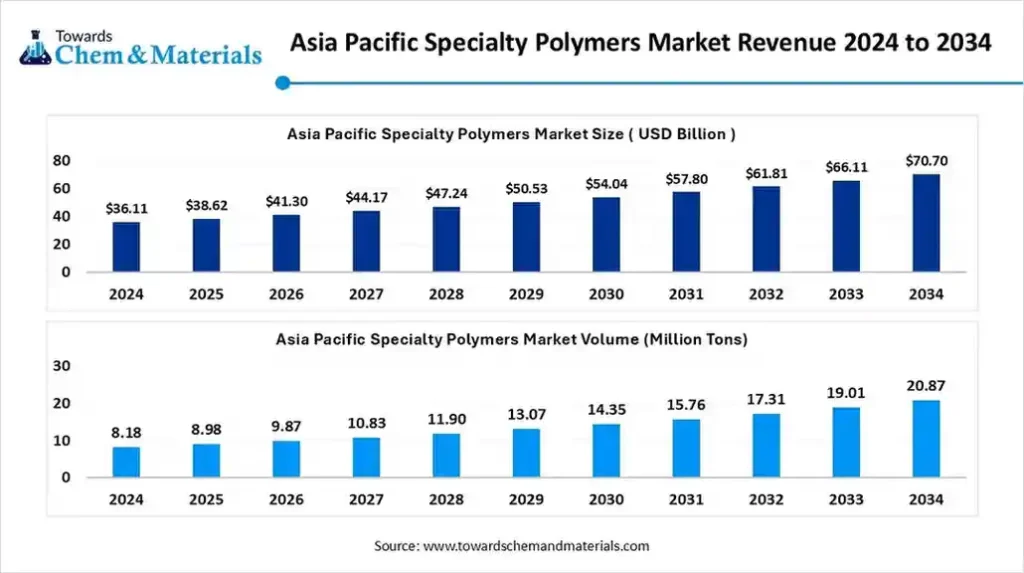
The Asia Pacific specialty polymers market is valued at USD 38.62 billion in 2025 and projected to reach approximately USD 70.70 billion by 2034, expanding at a CAGR of 6.95% from 2025 to 2034. This remarkable growth is attributed to the accelerating demand for lightweight, durable, and high-performance materials across diverse sectors, including electronics, automotive, construction, and packaging.
Specialty polymers—often known for their advanced chemical and physical properties—are increasingly used in applications requiring heat resistance, chemical stability, and electrical conductivity. The expansion of smart devices, electric vehicles (EVs), renewable energy systems, and Internet of Things (IoT) infrastructure is creating strong growth momentum throughout Asia Pacific.
Countries such as China, Japan, South Korea, and India are leading the charge with robust manufacturing bases and innovation ecosystems. Additionally, regional governments are emphasizing sustainable polymer solutions, encouraging the shift from petroleum-based to bio-based and recyclable polymers.
Market Dynamics
Key Growth Drivers
-
Booming Electronics and IoT Manufacturing
Asia Pacific’s dominance in consumer electronics and smart device production is a key driver. Specialty polymers such as fluoropolymers, thermoplastic elastomers (TPEs), and polyimides are critical for flexible displays, connectors, circuit boards, and other electronic components. -
Lightweight Automotive Solutions
The region’s automotive sector is undergoing transformation with a surge in electric vehicles and fuel-efficient models. Specialty polymers replace metals and conventional plastics to reduce weight, enhance safety, and improve energy efficiency. -
Sustainability and Regulatory Push
Governments are implementing stringent environmental regulations promoting low-VOC adhesives, bio-based surfactants, and biodegradable polymers. Companies are investing heavily in eco-friendly polymer technologies to comply with these mandates. -
Infrastructure and Construction Growth
Urbanization in emerging economies like India and Indonesia is driving the need for durable coatings, sealants, and polymer-based composites that extend infrastructure life and reduce maintenance costs.
Market Restraints
-
High Production and Processing Costs
Specialty polymers involve complex synthesis and advanced formulations, resulting in higher production costs compared to conventional plastics. -
Limited Recycling Infrastructure
While demand for sustainable polymers is growing, the lack of advanced recycling facilities in developing countries continues to limit the circular economy potential. -
Volatility in Raw Material Prices
Dependence on petrochemical feedstocks makes the industry vulnerable to crude oil price fluctuations, impacting overall profitability.
Opportunities
-
Bio-Based Polymer Development
Expanding research into biodegradable and renewable feedstock polymers offers lucrative opportunities, aligning with global sustainability goals. -
Advancements in Additive Manufacturing
The integration of specialty polymers in 3D printing and high-performance coatings opens new frontiers in customized production. -
Strategic Mergers and Acquisitions
Recent deals, such as DKSH’s acquisition of APN Plastics, demonstrate growing market consolidation and regional expansion strategies.
Challenges
-
Competition from Low-Cost Alternatives
Commodity plastics pose a cost challenge, especially in price-sensitive applications. -
Complex Supply Chains
Import-export regulations and raw material dependency complicate logistics across Asia Pacific markets.
Report Scope
| Report Attributes | Details |
| Market Size in 2026 | USD 41.30 Billion |
| Expected Size by 2034 | USD 70.70 Billion |
| Growth Rate from 2025 to 2034 | CAGR 6.95% |
| Base Year of Estimation | 2024 |
| Forecast Period | 2025 – 2034 |
| Segment Covered | By Product Type, By Form, By Application, By Technology |
| Key Companies Profiled | Evonik Industries AG, Solvay SA , Covestro AG , Arkema S.A. , Celanese Corporation , Eastman Chemical Company, Mitsubishi Chemical / Mitsubishi Chemical Holdings , Toray Industries, Inc. , Kuraray Co., Ltd. , LG Chem / LG Energy Solution , Sumitomo Chemical , SABIC , Solvay |
Market Insights
The Asia Pacific specialty polymers market is poised for transformation as industries focus on innovation and sustainability. Companies are transitioning toward green chemistry and bio-based materials while maintaining high performance.
In May 2025, DKSH acquired APN Plastics, strengthening its distribution capabilities and product portfolio in the specialty polymer segment. Similarly, Lubrizol’s new facility in Jurong, Singapore (July 2025), underscores the importance of regional innovation hubs equipped with R&D and testing capabilities to cater to local markets.
Another major insight is the growing investment in recyclable polymer technologies and high-temperature-resistant materials, particularly in electronics, renewable energy, and aerospace applications. These trends reflect a broader move toward sustainable, high-efficiency production cycles.
For more information, visit the Towards Chemical and Materials website or email the team at sales@towardschemandmaterials.com| +1 804 441 9344
More Insights in Towards Chemical and Materials:
- U.S. Nanomaterials Market : The U.S. nanomaterials market size is calculated at USD 4.39 billion in 2025, expected to reach USD 5.01 billion by 2026, and is projected to be worth around USD 14.41 billion by 2034, growing at a compound annual growth rate (CAGR) of 14.11% over the forecast period from 2025 to 2034.
- Gas Separation Membrane Market : The global gas separation membrane market size was valued at approximately USD 1.85 billion in 2024 and is projected to grow at a CAGR of 6.95% from 2025 to 2034, reaching a value of USD 3.62 billion by 2034.
- U.S. Recycled Polyester Market : The U.S. recycled polyester market size is calculated at USD 3.13 billion in 2025, with an expected value of USD 3.43 billion in 2026, and is projected to reach USD 7.16 billion by 2034, growing at a CAGR of 9.65% from 2025 to 2034.
- U.S. Water and Wastewater Treatment Market : The U.S. water and wastewater treatment market size was approximately USD 130.31 billion in 2025, is estimated to reach USD 139.35 billion in 2026, and is projected to grow to around USD 238.36 billion by 2034, with an estimated compound annual growth rate (CAGR) of about 6.94% between 2025 and 2034.
- U.S. Aquaculture Market : The U.S. aquaculture market size is valued at USD 80.81 billion in 2025 and is expected to be worth around USD 126.55 billion by 2034, growing at a compound annual growth rate (CAGR) of 5.11% over the forecast period from 2025 to 2034.
- U.S. Agrochemicals Market : The U.S. agrochemicals market size is calculated at USD 35.88 billion in 2025 and is predicted to increase from USD 36.58 billion in 2026 to approximately USD 42.69 billion by 2034, expanding at a CAGR of 1.95% from 2025 to 2034.
- U.S. Aquaculture Market : The U.S. aquaculture market size is valued at USD 80.81 billion in 2025 and is expected to be worth around USD 126.55 billion by 2034, growing at a compound annual growth rate (CAGR) of 5.11% over the forecast period from 2025 to 2034.
- Phenolic Resins Market : The global phenolic resins market size is accounted for USD 16.44 billion in 2025 and is anticipated to hit around USD 27.17 billion by 2034, growing at a compound annual growth rate (CAGR) of 5.74% over the forecast period from 2025 to 2034. Asia Pacific dominated the phenolic resins market with a market share of 31% in 2024.
- U.S. Steel Rebar Market : The U.S. steel rebar market size reached USD 7.31 billion in 2025 and is expected to be worth around USD 11.59 billion by 2034, growing at a compound annual growth rate (CAGR) of 5.25% over the forecast period 2025 to 2034.
- Sustainable Materials Market : The global sustainable materials market size is estimated at USD 375.38 billion in 2025 and is predicted to increase from USD 422.08 billion in 2026 to approximately USD 1,078.35 billion by 2034, expanding at a CAGR of 12.44% from 2025 to 2034.
Market Segmentation
By Type
-
Thermoplastic Elastomers (TPEs) – Used in flexible automotive and consumer products.
-
Engineering Thermoplastics (ETPs) – Including polyamides and polycarbonates, offering high durability and mechanical strength.
-
Fluoropolymers – Provide exceptional chemical resistance and are used in semiconductors and electronics.
-
Conductive Polymers – Growing in demand due to the rise in wearable electronics and sensors.
-
Biodegradable Polymers – Witnessing rapid adoption in packaging and consumer goods.
By End-Use Industry
-
Electronics and Electrical – Dominant segment driven by Asia’s role as the global manufacturing hub.
-
Automotive – Increasing use in lightweight body panels, seals, and interior components.
-
Construction – Demand for sealants, insulation materials, and coatings.
-
Packaging – Transition toward recyclable and bio-based polymers.
-
Healthcare – Use in biocompatible materials for medical devices and implants.
By Country
-
China – The largest market with major polymer producers and R&D facilities.
-
Japan – A leader in high-performance specialty polymers for electronics and mobility.
-
India – Rapidly industrializing, with high potential in automotive and construction sectors.
-
South Korea – Focused on advanced materials for batteries and semiconductors.
-
Australia & Southeast Asia – Growing demand for sustainable construction and packaging materials.
Competitive Landscape and Top Companies
1. Evonik Industries AG
About: A leading German specialty chemicals company known for innovative polymer materials.
Products: High-performance polyamides, polyimides, and PMMA.
Market Cap: Approx. USD 14 billion (2025).
2. Solvay SA
About: A Belgian multinational delivering sustainable chemical and polymer solutions.
Products: Specialty fluoropolymers, aromatic polyamides, and advanced composites.
Market Cap: Around USD 12.5 billion (2025).
3. Covestro AG
About: A global pioneer in polymer materials for coatings, adhesives, and electronics.
Products: Polycarbonate resins, polyurethane systems, thermoplastic elastomers.
Market Cap: Approx. USD 8 billion (2025).
4. Arkema S.A.
About: A France-based chemical producer with a strong portfolio in performance polymers.
Products: Polyamides, PVDF, and biopolymers under Rilsan and Pebax brands.
Market Cap: USD 9.5 billion (2025).
5. Celanese Corporation
About: A global technology and specialty materials company headquartered in the U.S.
Products: Engineering polymers, acetate tow, thermoplastic composites.
Market Cap: USD 15 billion (2025).
6. Eastman Chemical Company
About: Renowned for sustainable materials innovation and circular economy focus.
Products: Specialty copolyesters, cellulose esters, and advanced materials for packaging.
Market Cap: USD 9 billion (2025).
7. Mitsubishi Chemical Holdings
About: Japan’s largest chemical conglomerate focusing on advanced materials and green chemistry.
Products: Polycarbonate resins, PMMA, and carbon fiber composites.
Market Cap: Approx. USD 25 billion (2025).
8. Toray Industries, Inc.
About: A Japanese multinational specializing in polymer, chemical, and fiber technologies.
Products: Nylon, PBT resins, and carbon fiber composites for automotive and aerospace.
Market Cap: USD 16 billion (2025).
9. Kuraray Co., Ltd.
About: Focuses on specialty polymers for packaging, construction, and medical applications.
Products: EVOH resins, PVB, and high-performance elastomers.
Market Cap: USD 7 billion (2025).
10. LG Chem / LG Energy Solution
About: A South Korean conglomerate leading in materials for batteries and electronics.
Products: Specialty resins, ABS polymers, and high-performance thermoplastics.
Market Cap: USD 35 billion (2025).
11. Sumitomo Chemical Co., Ltd.
About: A diversified Japanese company providing specialty materials for multiple industries.
Products: Polyolefins, super engineering plastics, and photoresists.
Market Cap: USD 12 billion (2025).
12. SABIC
About: A Saudi multinational and one of the world’s largest chemical producers.
Products: Specialty polycarbonates, resins, and engineered thermoplastics.
Market Cap: USD 70 billion (2025).
Recent Developments
-
May 2025: DKSH acquired APN Plastics, strengthening its distribution of specialty polymers and expanding regional reach across Asia Pacific.
-
July 2025: Lubrizol inaugurated a state-of-the-art facility in Jurong, Singapore, dedicated to R&D and product customization for Southeast Asian consumers.
-
2024–2025: Leading companies such as Evonik, Solvay, and BASF increased investments in bio-based polymer research, aligning with the region’s growing demand for green solutions.
Future Outlook
The Asia Pacific specialty polymers market is expected to witness significant transformation through digital manufacturing, sustainability-driven innovations, and regional partnerships. Governments and corporations are collaborating to develop recycling infrastructures and biopolymer standards, ensuring a shift toward a circular economy.
Emerging applications in EV battery components, flexible electronics, and renewable energy systems will further enhance market growth. As industries prioritize lightweight materials and carbon-neutral production, Asia Pacific is positioned as a global hub for specialty polymer innovation.
Frequently Asked Questions (FAQs)
1. What is the projected size of the Asia Pacific specialty polymers market by 2034?
The market is projected to reach approximately USD 70.70 billion by 2034, growing at a CAGR of 6.95% from 2025 to 2034.
2. Which industries are driving demand for specialty polymers in Asia Pacific?
Key industries include electronics, automotive, construction, packaging, and healthcare, with rapid expansion in smart devices and electric vehicles.
3. What are the major trends shaping the specialty polymers market?
Trends include the rise of biodegradable and bio-based polymers, green chemistry innovations, and sustainable manufacturing practices.
4. Who are the leading companies in the Asia Pacific specialty polymers market?
Top players include Evonik Industries AG, Solvay SA, Covestro AG, Arkema S.A., Celanese Corporation, and Mitsubishi Chemical Holdings.
5. What challenges does the market face?
Challenges include high production costs, limited recycling infrastructure, and raw material price volatility.
Immediate Delivery Available | Buy This Premium Research Report@ https://www.towardschemandmaterials.com/checkout/5970
About Us
Towards Chemical and Materials is a leading global consulting firm specializing in providing comprehensive and strategic research solutions across the chemical and materials industries. With a highly skilled and experienced consultant team, we offer a wide range of services designed to empower businesses with valuable insights and actionable recommendations.
Our Trusted Data Partners
Precedence Research | Statifacts | Towards Packaging | Towards Healthcare | Towards Food and Beverages | Towards Chemical and Materials | Towards Consumer Goods | Nova One Advisor |
For Latest Update Follow Us: https://www.linkedin.com/company/towards-chem-and-materials/
USA: +1 804 441 9344
APAC: +61 485 981 310 or +91 87933 22019
Europe: +44 7383 092 044
Leave a Reply