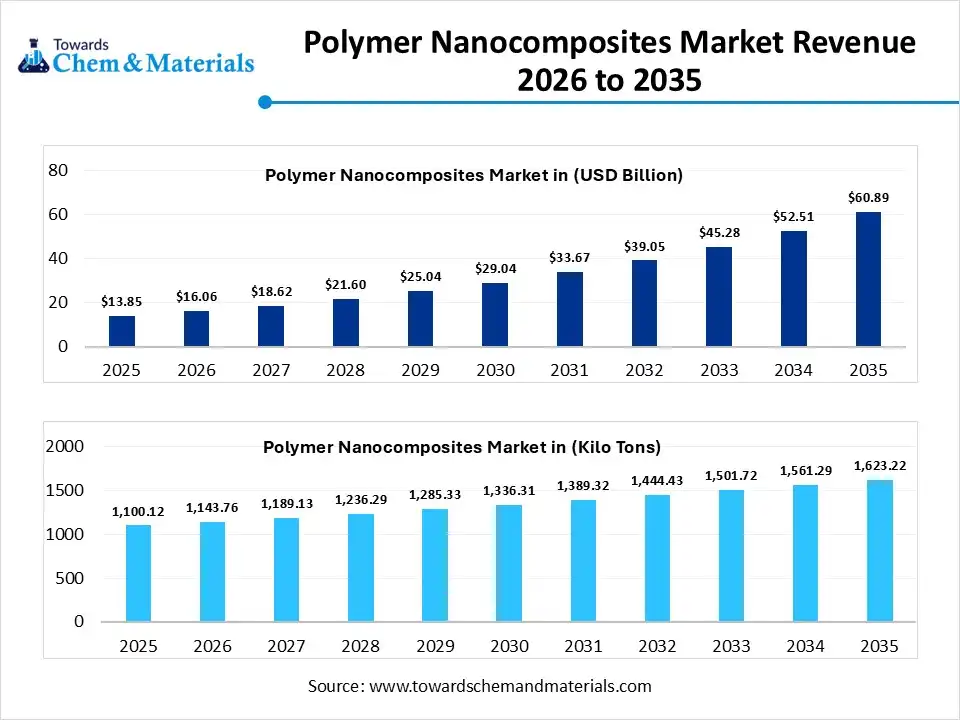
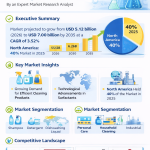
The global Polymer Nanocomposites (PNCs) market is set for significant growth in the coming years. With an estimated market size of USD 13.85 billion in 2026, the industry is expected to grow at an impressive CAGR of 15.96%, reaching USD 60.89 billion by 2035. In this post, we explore the key market players, market trends, and insights that will shape the future of this thriving industry.
Get All the Details in Our Solutions –Download Sample: https://www.towardschemandmaterials.com/download-sample/6149
Key Players in the Polymer Nanocomposites Market
Leading the charge in the polymer nanocomposites market are several industry giants known for their commitment to innovation and sustainability. Some of the top players include:
-
BASF SE: Renowned for developing advanced polymer nanocomposites offering superior thermal stability and mechanical strength for lightweight automotive and sustainable construction materials.
-
Dow Chemical Company: Leveraging material science to produce high-performance nanocomposites that enhance barrier properties and durability in advanced packaging and infrastructure applications.
-
DuPont de Nemours, Inc.: Specializing in carbon nanotube-reinforced resins, providing high-strength, heat-resistant solutions for the aerospace and electronics industries.
-
Evonik Industries AG: Known for silica and metal-oxide-based polymer nanocomposites that improve properties like scratch resistance, flame retardancy, and transparency.
-
Arkema S.A. and Cabot Corporation are also making significant strides in advancing the commercial use of PNCs.
These players are not only driving product development but also setting new standards for the industry with eco-friendly, high-performance materials.
Market Segmentation & Key Insights
The polymer nanocomposites market is witnessing rapid transformations across multiple sectors, with increasing adoption in industries such as packaging, automotive, aerospace, and electronics. Let’s dive deeper into the critical market segments and insights:
1. Polymer Matrix
In 2025, thermoplastics accounted for 64.2% of the polymer nanocomposites market. This is largely attributed to their easy processability, recyclability, and widespread use across industries. By 2035, thermoplastics will continue to dominate, although the bio-based and biodegradable polymers segment is expected to grow at the fastest pace due to rising environmental concerns.
-
Thermoplastics (CAGR: 3.53%)
-
Thermosets (CAGR: 6.52%)
-
Elastomers & Rubbers (CAGR: 4.49%)
-
Bio-based & Biodegradable Polymers (CAGR: 7.58%)
2. Nanomaterial Type
The nanoclays segment, valued at 39.5% of the market share in 2025, continues to lead due to its cost-effectiveness and excellent reinforcement properties in various plastic matrices. In the future, carbon nanotubes (CNTs) are expected to grow at an accelerated rate, driven by demand for advanced performance materials.
3. End-Use Industry
The packaging industry holds the largest market share (32.2% in 2025) due to the growing need for lightweight, strong, and protective materials. Polymer nanocomposites play a key role in improving barrier properties, extending shelf life, and reducing packaging thickness.
Other rapidly growing segments include:
-
Automotive: Lightweight and durable materials for engine components and interior trims.
-
Electrical & Electronics: Nanocomposites enhance the heat resistance, electrical conductivity, and durability of electronic devices.
-
Aerospace & Defense: Advanced airframe components and ballistic protection.
4. Regional Insights
The Asia Pacific region is set to dominate the polymer nanocomposites market with a 48.23% market share in 2025. This dominance is driven by a combination of robust infrastructure, cost-effective manufacturing, and the rising demand for lightweight, high-performance materials in automotive, packaging, and electronics.
-
Asia Pacific (CAGR: 15.98%)
-
North America (CAGR: 5.91%)
-
Europe (CAGR: 4.99%)
China, in particular, continues to be a major contributor to the growth of this market, with extensive research, mass applications, and the export of nanocomposite materials. The U.S., on the other hand, remains a hotbed for innovation, with strong investment in polymer nanocomposites, particularly for aerospace and medical applications.
5. Regulatory Landscape
The regulatory environment is becoming increasingly important as more industries adopt polymer nanocomposites. Major regulatory bodies such as the U.S. Environmental Protection Agency (EPA) and the European Chemicals Agency (ECHA) are setting stringent guidelines to ensure the safe and responsible use of nanomaterials.
Key Regulatory Frameworks:
-
EPA’s Toxic Substances Control Act (TSCA) (U.S.)
-
REACH Regulation (EC) No 1907/2006 (EU)
-
China’s NMPA Technical Guidelines
Sustainability and Eco-Friendly Trends in the Market
The demand for sustainable and eco-friendly nanocomposites is one of the major drivers behind the market’s growth. As industries, especially packaging, move towards reducing their carbon footprint, bio-based and biodegradable nanocomposites are gaining popularity. Additionally, the development of multifunctional nanocomposites with properties such as self-healing, improved strength, and environmental responsiveness is expected to further fuel market growth.
Looking Ahead: The Future of Polymer Nanocomposites
The market for polymer nanocomposites is moving towards more controlled and precise material engineering. As industries shift from basic mixing to nanoscale design, the result is enhanced material performance and predictability. These advancements are not just reducing the need for trial-and-error processes but are also ensuring greater reliability and consistency in the final products.
The market is also witnessing a surge in demand for multifunctional materials that can sense pressure, temperature, and electrical changes. This creates exciting possibilities across diverse industries, ranging from aerospace to healthcare.
For more information, visit the Towards Chemical and Materials website or email the team at sales@towardschemandmaterials.com| +1 804 441 9344
More Insights in Towards Chemical and Materials:
Polypropylene Random Copolymer Market : The global polypropylene random co-polymer market size was estimated at USD 16.10 billion in 2025 and is expected to increase from USD 16.91 billion in 2026 to USD 26.33 billion by 2035, growing at a CAGR of 5.04% from 2026 to 2035. In terms of volume, the market is projected to grow from 11,423.22 kilo tons in 2025 to 18,511.23 kilo tons by 2035. growing at a CAGR of 4.95% from 2026 to 2035. Asia Pacific dominated the polypropylene random copolymer market with the largest volume share of 44.01% in 2025.
Asia Pacific Polymer Foam Market : The Asia Pacific polymer foam market size was estimated at USD 72.19 billion in 2025 and is expected to increase from USD 76.6 billion in 2026 to USD 131.7 billion by 2035, growing at a CAGR of 6.12% from 2026 to 2035. In terms of volume, the market is projected to grow from 18200.12 kilo tons in 2025 to 25733.12 kilo tons by 2035. growing at a CAGR of 3.52% from 2026 to 2035.
Organosilicon Polymers Market : The global organosilicon polymers market size was estimated at USD 18.86 billion in 2025 and is expected to increase from USD 19.75 billion in 2026 to USD 29.88 billion by 2035, growing at a CAGR of 4.71% from 2026 to 2035. In terms of volume, the market is projected to grow from 8.40 million tons in 2025 to 14.60 million tons by 2035. growing at a CAGR of 7.10% from 2026 to 2035. Asia Pacific dominated the Organosilicon Polymers market with the largest volume share of 47.19% in 2025.
Polymeric Methylene Diphenyl Diisocyanate (PMDI) Market : The global polymeric methylene diphenyl diisocyanate (PMDI) market size was estimated at USD 14.28 billion in 2025 and is expected to increase from USD 15.30 billion in 2026 to USD 28.49 billion by 2035, growing at a CAGR of 7.15% from 2026 to 2035. In terms of volume, the market is projected to grow from 8.4 million tons in 2025 to 14.6 million tons by 2035. growing at a CAGR of 5.70% from 2026 to 2035. Asia Pacific dominated the polymeric methylene diphenyl diisocyanate (PMDI) market with the largest volume share of 44% in 2025.
Conductive Polymers Market : The global conductive polymers market size was estimated at USD 6.45 billion in 2025 and is expected to increase from USD 7.01 billion in 2026 to USD 14.81 billion by 2035, growing at a CAGR of 8.67% from 2026 to 2035. In terms of volume, the market is projected to grow from 214.5 kilo tons in 2025 to 481.0 kilo tons by 2035 growing at a CAGR of 8.41% from 2026 to 2035. Asia Pacific dominated the conductive polymers market with the largest volume share of 46.12% in 2025.
Natural Gas Market : The global natural gas market size accounted for USD 4.19 trillion in 2024 and is predicted to increase from USD 4.41 trillion in 2025 to approximately USD 6.96 trillion by 2034, expanding at a CAGR of 5.20% from 2025 to 2034.
Gas Separation Membrane Market : The global gas separation membrane market size was valued at approximately USD 1.85 billion in 2024 and is projected to grow at a CAGR of 6.95% from 2025 to 2034, reaching a value of USD 3.62 billion by 2034.
Bio-Renewable Chemicals Market : The global bio-renewable chemicals market size was valued at USD 15.11 billion in 2024 and is growing to approximately USD 39.01 billion by 2034, with a developing compound annual growth rate (CAGR) of 9.95% over the forecast period 2025 to 2034.
Natural Aroma Chemicals Market : The global natural aroma chemicals market size was reached at USD 4.55 billion in 2024 and is estimated to surpass around USD 5.91 billion by 2034, growing at a compound annual growth rate (CAGR) of 2.65% during the forecast period 2025 to 2034.
Natural Ferulic Acid Market : The global natural ferulic acid market size was reached at USD 14.82 billion in 2024 and is expected to hit around USD 30.40 billion by 2034, exhibiting a compound annual growth rate (CAGR) of 7.45% during the forecast period 2025 to 2034.
Immediate Delivery Available | Buy This Premium Research Report@ https://www.towardschemandmaterials.com/checkout/6149
About Us
Towards Chemical and Materials is a leading global consulting firm specializing in providing comprehensive and strategic research solutions across the chemical and materials industries. With a highly skilled and experienced consultant team, we offer a wide range of services designed to empower businesses with valuable insights and actionable recommendations.
Our Trusted Data Partners
Precedence Research | Statifacts | Towards Packaging | Towards Healthcare | Towards Food and Beverages | Towards Chemical and Materials | Towards Consumer Goods | Nova One Advisor |
For Latest Update Follow Us: https://www.linkedin.com/company/towards-chem-and-materials/
USA: +1 804 441 9344
APAC: +61 485 981 310 or +91 87933 22019
Europe: +44 7383 092 044
Email: sales@towardschemandmaterials.com
Web: https://www.towardschemandmaterials.com/
Frequently Asked Questions (FAQ) on the Polymer Nanocomposites Market
1. What are polymer nanocomposites?
Polymer nanocomposites (PNCs) are materials that consist of a polymer matrix combined with nanoscale reinforcements such as nanoclays, carbon nanotubes (CNTs), and nanoparticles. These composites exhibit enhanced properties, such as improved strength, heat resistance, barrier properties, and electrical conductivity, making them ideal for use in industries like automotive, packaging, electronics, and aerospace.
2. What is driving the growth of the polymer nanocomposites market?
The market for polymer nanocomposites is primarily driven by the increasing demand for lightweight, high-strength materials that can improve product performance and reduce environmental impact. Industries like packaging, automotive, aerospace, and electronics are adopting these materials for their superior mechanical, thermal, and electrical properties. Additionally, the rising focus on sustainability and eco-friendly products is fueling the adoption of bio-based and biodegradable nanocomposites.
3. Which industries are adopting polymer nanocomposites the most?
The top industries adopting polymer nanocomposites include:
-
Packaging: For lightweight, durable, and protective packaging solutions.
-
Automotive: To create lighter, stronger components, improving fuel efficiency and overall vehicle performance.
-
Electrical & Electronics: For creating high-performance, energy-efficient components like sensors, displays, and batteries.
-
Aerospace & Defense: For making high-strength, lightweight materials that improve the durability and efficiency of aircraft and military equipment.
-
Biomedical: In applications like drug delivery systems and medical implants due to their strength and biocompatibility.
4. Which polymer matrix type dominates the market?
In 2025, thermoplastics dominate the market, accounting for 64.2% of the market share. Their popularity can be attributed to their ease of processing, recyclability, and adaptability to existing manufacturing systems. However, bio-based and biodegradable polymers are expected to experience the highest growth rate due to the increasing demand for environmentally friendly solutions.
5. What are the key nanomaterials used in polymer nanocomposites?
The main nanomaterials used in polymer nanocomposites are:
-
Nanoclays (e.g., Montmorillonite, Kaolinite): The most widely used due to their cost-effectiveness and ability to enhance the strength, heat resistance, and barrier properties of plastics.
-
Carbon Nanotubes (CNTs): Known for their exceptional strength and electrical conductivity, CNTs are gaining traction in industries that require high-performance materials.
-
Graphene: Famous for its excellent electrical and thermal properties, it’s used in advanced electronic applications.
-
Metal Oxides and Nanofibers: These materials contribute to enhancing properties like strength, stability, and durability.
Leave a Reply