Market Overview
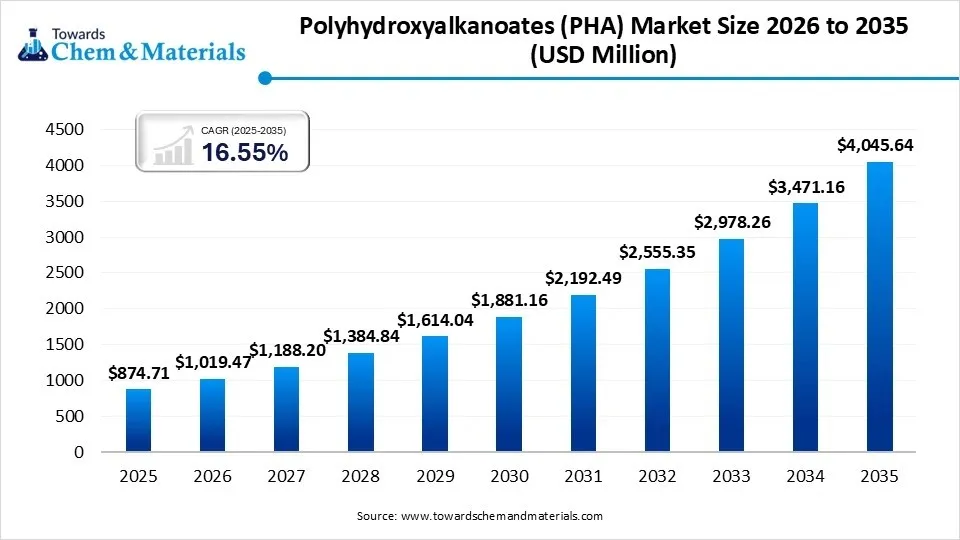
The global Polyhydroxyalkanoates (PHA) market, valued at USD 874.71 million in 2025, is expected to see significant growth, reaching USD 4,045.64 million by 2035, growing at a robust compound annual growth rate (CAGR) of 16.55%. PHA is a class of biodegradable plastics produced from renewable sources such as plant oils, sugars, and waste biomass. As industries shift toward more sustainable solutions to address environmental concerns, the demand for PHAs in packaging, agriculture, textiles, and other sectors is rapidly increasing. One of the key drivers of this market is the increasing global push for sustainable, biodegradable alternatives to traditional petroleum-based plastics, particularly due to mounting regulations against single-use plastics.
Europe currently leads the market with the largest revenue share of 58.00% in 2025. Strict regulatory policies surrounding plastic waste and growing environmental awareness among consumers are fueling demand for PHAs. The rising corporate Environmental, Social, and Governance (ESG) commitments are further accelerating market growth. North America, particularly the U.S., is also poised for the fastest growth in the coming decade due to heightened demand for eco-friendly products and stringent environmental laws.
Market Dynamics
The growth trajectory of the PHA market is shaped by several key dynamics, including regulatory pressures, technological advancements, and shifting consumer preferences. These dynamics are playing a crucial role in the accelerated adoption of PHA-based solutions across various industries.
1. Regulatory Pressures
Governments worldwide are enforcing stricter regulations against single-use plastics and promoting the use of biodegradable alternatives. The European Union’s Single-Use Plastics Directive, which targets the reduction of single-use plastic waste, has been a major driver for the widespread adoption of PHA. Similarly, the U.S. and China are also implementing measures to reduce plastic pollution, which is expected to further boost the demand for sustainable materials like PHA.
2. Technological Advancements
Recent technological innovations have improved the scalability and cost-effectiveness of PHA production. Advances in microbial fermentation and genetic engineering are significantly enhancing production yields and lowering the cost of PHA, making it more competitive with traditional plastics. Companies are increasingly focusing on using waste-derived feedstocks for production, which is not only environmentally beneficial but also economically advantageous.
3. Consumer Awareness
As consumers become more environmentally conscious, there is a growing preference for products that use sustainable materials. This trend is particularly noticeable in the packaging industry, where PHA is increasingly seen as an ideal alternative to conventional plastics due to its biodegradability and compostability. Additionally, industries like agriculture and medical devices are also adopting PHA due to its biocompatibility and versatility.
Report Scope
| Report Attribute | Details |
| Market Size in 2026 | USD 1,019.47 Million |
| Revenue Forecast in 2035 | USD 4,045.64 Million |
| Growth Rate | CAGR 16.55% |
| Forecast Period | 2026 – 2035 |
| Base Year | 2025 |
| Dominant Region | Europe |
| Segment Covered | By Type, By End-use, By Region |
| Key companies profiled | RWDC Industries, Biomer, Paques Biomaterials, Full Cycle Bioplastics, Danimer Scientific, TianAn Biologic Materials Co., Ltd., Kaneka Corporation, CJ CheilJedang Corporation, Bluepha Co., Ltd., P&G Chemicals, Tepha, Inc., Newlight Technologies LLC, Bio-on S.p.A., Yield10 Bioscience, Inc., PHB Industrial S.A, TianAn Biologic Materials Co., Ltd. |
Market Insights
The PHA market is evolving rapidly as a result of its environmental benefits and technological improvements. Notably, its applications are becoming more diverse, spanning from packaging to biomedical uses. Technological advancements in fermentation processes and the use of renewable resources for PHA production have made it a more cost-effective and sustainable option for a wide range of industries.
Additionally, bio-based plastics like PHA are gaining popularity in biomedical applications, including drug delivery systems, tissue engineering, and bioresorbable implants. The packaging sector remains the largest end-user of PHA, comprising over 60% of the total market share in 2025. PHA’s use in packaging is driven by regulatory bans on single-use plastics and a demand for compostable and eco-friendly alternatives in food and beverage packaging.
Market Segments
The PHA market is segmented into type, end-use applications, and regions, each with its own unique characteristics and growth prospects. Below is a breakdown of these segments:
By Type
PHA can be classified into three types based on the length of the polymer chain. These types vary in their mechanical properties and applications.
- Short-Chain-Length Polyhydroxyalkanoates (SCL-PHA): SCL-PHA dominated the market in 2025, with a market share of 57.00%. This segment is particularly popular in the packaging sector due to its superior mechanical strength and cost-effectiveness. SCL-PHA has been widely adopted for biodegradable packaging materials, as it offers fast biodegradation in natural environments, making it a preferred alternative to traditional plastics.
- Medium-Chain-Length Polyhydroxyalkanoates (MCL-PHA): This segment held 28.50% of the market share in 2025 and is often used in applications requiring greater flexibility and elasticity, such as in medical products and coatings.
- Long-Chain-Length Polyhydroxyalkanoates (LCL-PHA): The LCL-PHA segment is expected to grow at the fastest rate during the forecast period from 2026 to 2035. LCL-PHA has superior biodegradability and is being increasingly used in agriculture, medical, and specialty packaging applications.
By End-Use
PHA is used in a variety of end-use sectors, with packaging being the largest consumer.
- Packaging: The packaging segment led the PHA market in 2025, with a share of 60.23%. Growing demand for compostable packaging materials, driven by regulatory bans on single-use plastics, continues to fuel PHA’s adoption in food and beverage packaging, as well as in consumer goods packaging.
- Agriculture: The agricultural segment accounted for 12.45% of the market share in 2025, with PHA being used for biodegradable agricultural films and coatings.
- Textiles: PHA is also gaining traction in the textiles industry, with an estimated market share of 10.12% in 2025. It is used for producing biodegradable fabrics and eco-friendly textiles.
- Flame Retardants: This segment is expected to grow at the fastest CAGR between 2026 and 2035, driven by the increasing demand for non-halogenated flame retardants and the growing focus on sustainable materials.
By Region
- Europe: Europe accounted for the largest share of the PHA market, 58.00%, in 2025. Strict regulations against single-use plastics, a strong focus on the circular economy, and the high demand for eco-friendly packaging have made Europe the dominant region in the PHA market. Countries like Germany are at the forefront of PHA adoption, driven by significant investments in biopolymer production and research.
- North America: North America is expected to experience the fastest growth in the market during the forecast period. The U.S. is the major market in this region, with increasing demand for sustainable products and biodegradable plastics in packaging and medical applications.
- Asia Pacific: The Asia Pacific region accounted for 15.00% of the market share in 2025 and is expected to witness significant growth, driven by rising demand for biodegradable packaging, agriculture, and biomedical applications.
Get Premium report here : https://www.towardschemandmaterials.com/checkout/6282
Top Companies in the Polyhydroxyalkanoates (PHA) Market
Several key players are leading the PHA market with innovations in production processes and applications.
RWDC Industries
- About: RWDC Industries focuses on the development of PHA materials for the replacement of single-use plastics, including packaging and personal care products.
- Products: PHA for biodegradable food packaging, cosmetic packaging, and personal care items.
- Market Cap: Private company, market capitalization not disclosed.
Biomer
- About: Biomer specializes in the production of PHA for medical, pharmaceutical, and packaging applications.
- Products: High-purity PHA for medical devices, drug delivery systems, and biodegradable packaging.
- Market Cap: Private company, market capitalization not disclosed.
Danimer Scientific
- About: Danimer Scientific is a leading innovator in the field of biodegradable plastics, producing PHA-based materials for a wide range of applications.
- Products: PHA for packaging, agriculture, biomedical, and consumer goods.
- Market Cap: USD 1.5 billion (as of 2025).
Kaneka Corporation
- About: Kaneka is a global player in the PHA market, known for its sustainable biopolymer solutions.
- Products: Kaneka PHA for packaging, medical applications, and agriculture.
- Market Cap: USD 6.5 billion (as of 2025).
CJ CheilJedang Corporation
- About: CJ CheilJedang is a major player in the PHA market, producing high-quality biodegradable plastics.
- Products: PHA for biodegradable packaging, consumer goods, and textiles.
- Market Cap: USD 12 billion (as of 2025).
FAQs
- What is the projected growth rate of the polyhydroxyalkanoates (PHA) market from 2026 to 2035?
The PHA market is expected to grow at a compound annual growth rate (CAGR) of 16.55% from 2026 to 2035. - Which region is leading the polyhydroxyalkanoates (PHA) market?
Europe is the dominant region in the PHA market, accounting for 58.00% of the market share in 2025. - What are the main drivers of growth in the PHA market?
The main drivers include stricter regulations against single-use plastics, growing consumer demand for eco-friendly products, and innovations in production efficiency. - What are the key applications of polyhydroxyalkanoates (PHA)?
PHA is primarily used in packaging, agriculture, biomedical applications, and consumer goods, especially due to its biodegradability and sustainability. - Which companies are leading the polyhydroxyalkanoates (PHA) market?
Key companies in the PHA market include RWDC Industries, Biomer, Danimer Scientific, Kaneka Corporation, and CJ CheilJedang Corporation.
This article provides a comprehensive view of the Polyhydroxyalkanoates (PHA) market, analyzing its growth, key trends, technological advancements, and the companies driving its expansion. As the demand for sustainable alternatives to traditional plastics increases, PHA is set to play a pivotal role in creating a more eco-friendly future.
Leave a Reply