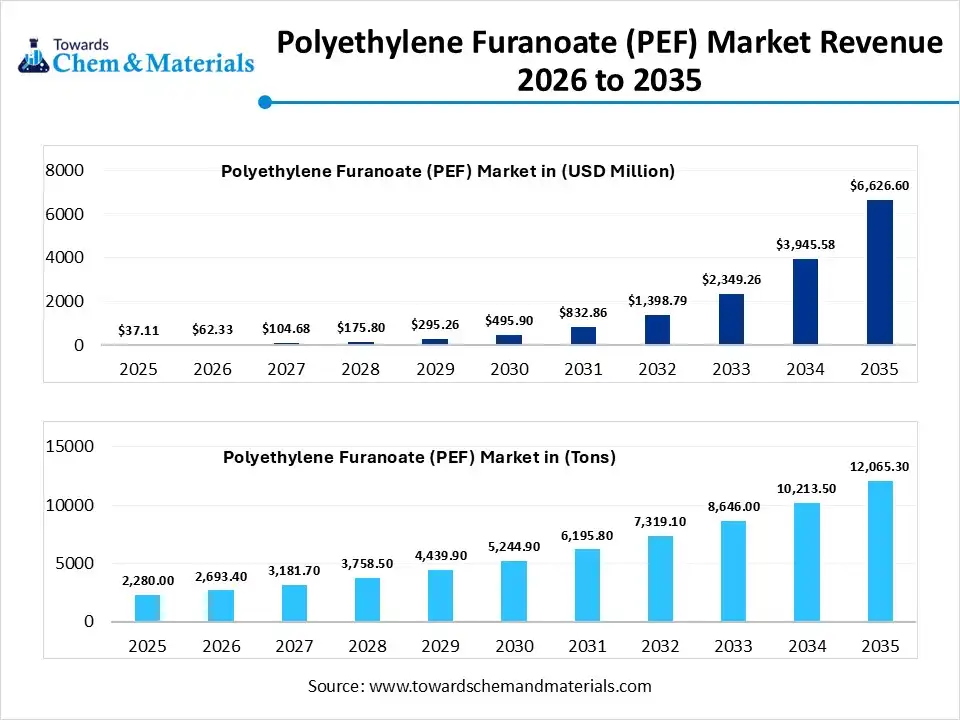
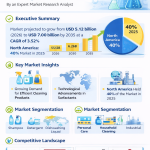
The global polyethylene furanoate (PEF) market is poised for exponential growth, driven by the increasing demand for sustainable and bio-based alternatives to traditional petroleum-based plastics. From a market size of USD 37.11 million in 2025, the polyethylene furanoate market is expected to grow to USD 6,626.60 million by 2035, expanding at a remarkable compound annual growth rate (CAGR) of 67.95% between 2026 and 2035. In terms of volume, the market is projected to grow from 2,280.0 tons in 2025 to 12,065.3 tons by 2035, with a CAGR of 18.13%.
PEF is a bio-based polyester derived from renewable plant sugars like fructose and glucose. As a recyclable alternative to PET (polyethylene terephthalate), it offers superior properties such as better barrier resistance to oxygen and carbon dioxide, higher mechanical strength, and improved heat resistance. The growing shift toward a circular economy, combined with stricter regulations on single-use plastics, is fueling the widespread adoption of PEF across industries, including food packaging, pharmaceuticals, and textiles.
Get All the Details in Our Solutions –Download https://www.towardschemandmaterials.com/download-sample/6148
Market Overview: Understanding the Significance of Polyethylene Furanoate
Polyethylene Furanoate (PEF) represents a breakthrough in the development of eco-friendly and high-performance materials. It is made from 100% renewable resources, making it a perfect substitute for conventional petroleum-based plastics, which are a major contributor to environmental pollution. PEF has gained traction in several industries, particularly in packaging, due to its excellent barrier properties that help extend the shelf life of products, such as beverages and food, while minimizing environmental impact.
The increasing focus on sustainability is a major driving force behind the PEF market’s expansion. Governments and regulatory bodies are enforcing stricter rules regarding the use of single-use plastics, providing financial incentives for companies adopting more sustainable practices. As a result, companies are shifting towards bioplastics like PEF to meet environmental standards and consumer preferences for eco-friendly products.
Additionally, the rising consumer awareness about plastic waste and environmental damage is driving the demand for more sustainable packaging solutions. With superior mechanical properties and recyclability, PEF is emerging as a viable solution that addresses both the performance and environmental concerns that traditional plastics cannot.
Market Dynamics: Key Drivers, Trends, and Challenges
Key Drivers of Market Growth
-
Sustainability and Regulatory Pressures: As governments across the world tighten regulations on plastic waste and single-use plastics, companies are increasingly turning to bio-based alternatives like PEF. This growing regulatory support for eco-friendly materials is propelling the market forward.
-
Technological Advancements: Advances in manufacturing technologies are improving the production efficiency of PEF, making it more cost-effective. Innovations in polymerization and bio-refining processes are enhancing the material’s properties, such as thermal stability, barrier performance, and strength, making it suitable for a wider range of applications.
-
Growing Demand for Eco-friendly Packaging: The food and beverage industry, which is one of the largest end-users of packaging materials, is driving demand for PEF. With growing consumer preference for sustainable packaging, PEF is becoming a key material for manufacturers aiming to reduce their carbon footprint and meet consumer expectations for environmentally friendly products.
-
Rising Consumer Awareness: Increased awareness about the environmental impact of plastic waste is pushing consumers and businesses alike to seek out more sustainable alternatives. PEF’s plant-based composition and recyclability make it an attractive choice in this growing trend toward sustainability.
Challenges to Market Growth
-
Cost of Production: While PEF offers significant environmental benefits, its production costs remain relatively high compared to traditional plastics like PET. Although costs are expected to decrease with advancements in production technologies, the price difference still poses a challenge for widespread adoption, particularly in price-sensitive markets.
-
Competition from Other Bio-based Plastics: The PEF market faces competition from other bio-based plastics, such as PLA (Polylactic Acid) and PBAT (Polybutylene adipate terephthalate), which offer similar benefits in terms of sustainability. The availability of alternatives may slow the adoption rate of PEF in certain industries.
-
Scaling Up Production: As demand for PEF grows, scaling up production capabilities to meet global requirements will be a challenge. Major players in the industry need to expand their manufacturing capacity and streamline production processes to make PEF more widely available.
Invest in Premium Global Insights Immediate Delivery Available@https://www.towardschemandmaterials.com/checkout/6148
Market Segments: A Detailed Breakdown
By Source
-
Plant-based: The plant-based segment held a significant share of the market in 2025, accounting for 42.4%. This dominance is driven by the increasing demand for bio-based and renewable materials. The use of plant sugars to create PEF is aligned with the growing global emphasis on sustainability and circular economy practices.
-
Bio-based: The bio-based segment is projected to grow at the fastest CAGR during the forecast period. This segment’s growth is largely driven by the increasing demand for renewable materials in packaging and other applications, as well as technological advancements in production.
By Grade
-
Standard Grade: The standard grade segment accounted for 54.80% of the market in 2025 and is projected to grow at a CAGR of 19.85% from 2026 to 2035. This segment’s dominance can be attributed to its superior mechanical strength and moisture barrier properties, which make it ideal for various applications in the packaging industry.
-
High-performance Grade: The high-performance grade segment is expected to grow at the fastest CAGR of 21.34% from 2026 to 2035. This growth is driven by stringent environmental regulations and increasing demand for high-performance materials in sectors like food packaging, automotive, and electronics.
By Application
-
Bottles: The bottles segment held the largest market share of 67.4% in 2025. PEF’s superior barrier properties make it ideal for packaging beverages, particularly carbonated drinks and juices, where extended shelf life and product freshness are critical.
-
Films & Sheets: The films and sheets segment is expected to grow at the fastest rate over the forecast period. The rise in e-commerce and processed food sectors is driving demand for PEF in packaging, as it provides excellent moisture, oxygen, and CO2 barrier properties.
By End-Use Industry
-
Packaging: The packaging segment dominated the PEF market in 2025, with a 59.1% share. This dominance is attributed to the increased demand for sustainable and high-performance packaging solutions, particularly in the food and beverage industry.
-
Fiber & Textiles: The fiber and textiles segment is expected to grow at the fastest CAGR during the forecast period. PEF fibers offer superior properties such as high durability and tensile strength compared to conventional polyester fibers, making them ideal for industrial applications.
For more information, visit the Towards Chemical and Materials website or email the team at sales@towardschemandmaterials.com| +1 804 441 9344
More Insights in Towards Chemical and Materials:
Polyethylene Wax Market : The global polyethylene wax market size was valued at USD 2.35 billion in 2024 and is expected to hit around USD 3.56 billion by 2034, growing at a CAGR of 4.25% from 2025 to 2034. The growing demand and applications from various industries like textile, plastics, coating, and adhesives due to its versatility fuel the growth of the market.
Polyethylene Terephthalate Catalyst Market : The global polyethylene terephthalate catalyst market size was valued at USD 784.88 million in 2024 and is expected to hit around USD 1,321.75 million by 2034, growing at a compound annual growth rate (CAGR) of 5.35% over the forecast period from 2025 to 2034. Asia Pacific polyethylene terephthalate catalyst market dominated with the largest revenue share of 48% in 2024.
U.S. Recycled Polyethylene Terephthalate Market : The U.S. recycled polyethylene terephthalate market size is calculated at USD 3.85 billion in 2024, grew to USD 4.12 billion in 2025, and is projected to reach around USD 7.53 billion by 2034. The market is expanding at a CAGR of 6.94% between 2025 and 2034.
Linear Low-Density Polyethylene (LLDPE) Market :The global linear low-density polyethylene (LLDPE) market size was reached at USD 70.95 Billion in 2024 and is expected to be worth around USD 118.69 billion by 2034, growing at a compound annual growth rate (CAGR) of 5.28% over the forecast period 2025 to 2034. The shift towards sustainable materials, growing demand for flexible packaging, and expansion of e-commerce drive the growth of the market.
Polyethylene Terephthalate (PET) Market : The global polyethylene terephthalate (PET) market size was reached at 39.25 USD Billion in 2024 and is expected to be worth around 68 USD Billion by 2034, growing at a compound annual growth rate (CAGR) of 5.65% over the forecast period 2025 to 2034. The growth of the market is driven by the growing demand for PET from industries like packaging and food and beverages industry due to its growing applications which fuels the growth of the market.
Regional Insights: Geographical Growth Patterns
Europe
Europe dominates the global polyethylene furanoate market, accounting for 48.80% of the market volume in 2025. The region’s strong regulatory framework, which encourages the use of bio-based plastics, is a major factor driving the adoption of PEF. Germany, in particular, is a key market player due to stringent environmental regulations and a growing emphasis on reducing plastic waste.
Asia Pacific
Asia Pacific is expected to witness substantial growth, with a projected CAGR of 21.56% from 2026 to 2035. The growth in this region is driven by industrialization, urbanization, and government initiatives aimed at promoting sustainable materials. China, in particular, is a major player in the region, with a focus on cost-effective PEF production methods.
North America
North America accounted for 15.30% of the market share in 2025. The region’s growth is attributed to increasing investments in PEF production and growing consumer demand for alternative packaging materials. Major companies like Coca-Cola and Danone are leading the way by incorporating PEF into their packaging solutions.
Top Companies in the Polyethylene Furanoate (PEF) Market
1. Avantium N.V.
-
About: Avantium N.V. is a leading innovator in the production of bio-based polymers, including PEF. The company is at the forefront of the transition from fossil-based plastics to sustainable, renewable alternatives.
-
Products: PEF, plant-based polymers, renewable packaging solutions
-
Market Cap: Approximately USD 1.5 billion
2. Sulzer Ltd.
-
About: Sulzer Ltd. is a global leader in engineered materials and technologies, providing solutions for a wide range of industries, including PEF production.
-
Products: PEF production technology, chemical engineering solutions
-
Market Cap: Approximately USD 4 billion
3. Origin Materials
-
About: Origin Materials focuses on producing sustainable materials from renewable sources. The company is a key player in the PEF market, with its focus on innovation and environmental sustainability.
-
Products: Bio-based PET, PEF, sustainable packaging materials
-
Market Cap: Approximately USD 1.1 billion
4. BASF SE
-
About: BASF SE is one of the largest chemical companies globally and is involved in the development of bio-based materials, including PEF.
-
Products: PEF production solutions, chemical additives, bio-based materials
-
Market Cap: Approximately USD 85 billion
5. Corbion
-
About: Corbion specializes in bio-based products and is actively involved in the development of renewable materials such as PEF.
-
Products: Bio-based polymers, PEF
-
Market Cap: Approximately USD 4.5 billion
FAQs About the Polyethylene Furanoate (PEF) Market
1. What is Polyethylene Furanoate (PEF)?
Polyethylene Furanoate (PEF) is a 100% bio-based, recyclable polyester derived from renewable plant sugars such as glucose and fructose. It is a sustainable alternative to petroleum-based plastics like PET, offering superior barrier properties, mechanical strength, and heat resistance.
2. What are the primary applications of PEF?
PEF is mainly used in packaging applications, including bottles for beverages, food packaging, and films & sheets. It is also utilized in fibers for textiles and industrial applications, as well as in automotive and electronics sectors for molded and extruded components.
3. How is PEF different from PET?
PEF has superior oxygen, carbon dioxide, and water vapor barrier properties compared to PET. It also offers better mechanical strength and heat resistance, making it ideal for packaging sensitive products like beverages and food.
4. What factors are driving the growth of the PEF market?
The growth of the PEF market is primarily driven by the shift towards sustainability, increased demand for eco-friendly packaging, technological advancements in production, and rising consumer awareness of environmental issues.
5. Which regions are leading the PEF market?
Europe leads the PEF market due to stringent environmental regulations and strong demand for sustainable packaging. The Asia Pacific region is expected to experience the fastest growth, driven by industrialization and supportive government initiatives.
About Us
Towards Chemical and Materials is a leading global consulting firm specializing in providing comprehensive and strategic research solutions across the chemical and materials industries. With a highly skilled and experienced consultant team, we offer a wide range of services designed to empower businesses with valuable insights and actionable recommendations.
Our Trusted Data Partners
Precedence Research | Statifacts | Towards Packaging | Towards Healthcare | Towards Food and Beverages | Towards Chemical and Materials | Towards Consumer Goods | Nova One Advisor |
For Latest Update Follow Us: https://www.linkedin.com/company/towards-chem-and-materials/
USA: +1 804 441 9344
APAC: +61 485 981 310 or +91 87933 22019
Europe: +44 7383 092 044
Leave a Reply