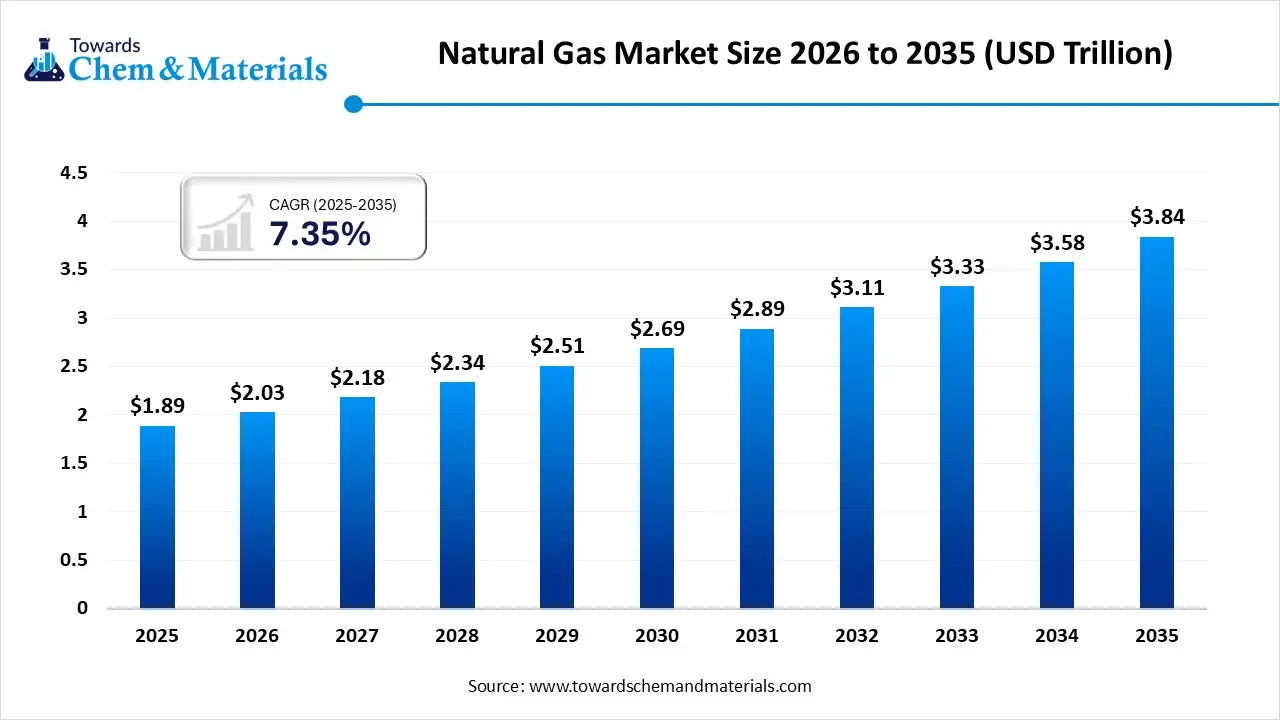
The global natural gas market continues to witness steady expansion, supported by the global shift toward cleaner energy sources and increasing industrial demand. In 2025, the market was valued at USD 1.89 trillion and is projected to grow from USD 2.03 trillion in 2026 to approximately USD 3.84 trillion by 2035, registering a CAGR of 7.35% during the forecast period.
A major driver behind this growth is the rising preference for natural gas as a lower-carbon alternative to coal and oil. The ongoing transition toward sustainable energy systems, coupled with technological advancements in exploration and extraction—particularly in unconventional reserves—continues to strengthen the industry outlook.
Regional Insights
Asia Pacific dominated the global natural gas market in 2025, accounting for the largest revenue share of 40%. Rapid industrialization, urbanization, and increasing energy consumption in countries such as China and India are key contributors to regional growth.
Globally, the market is structured around four major gas regions:
-
European market
-
North American market
-
Asian market
-
Central and South (Latin) American market
Each region operates with distinct pricing mechanisms and contractual structures. While some markets are highly liberalized and financially integrated, others rely on long-term supply contracts with region-specific pricing frameworks.
To own our research study instantly, Click here @ https://www.towardschemandmaterials.com/checkout/5634
Market Segmentation Analysis
By Resource Type
The market is segmented into conventional and unconventional resources, along with liquefied natural gas (LNG).
-
The unconventional segment dominated the market in 2025, accounting for a revenue share of 14.00%, driven by shale gas and tight gas production advancements.
-
The Liquefied Natural Gas (LNG) segment is expected to grow at the fastest CAGR of 10.75% from 2026 to 2035, reflecting increasing global trade flexibility and rising cross-border energy demand.
By End-Use Application
The power generation segment led the market in 2025, holding a revenue share of 43.00%. Natural gas remains a preferred fuel for electricity production due to its relatively lower emissions and operational efficiency compared to coal-fired plants.
In addition to power generation, natural gas plays a crucial role in:
-
Industrial manufacturing
-
Residential and commercial heating
-
Transportation (CNG and LNG vehicles)
-
Petrochemical feedstock production
Growing demand in industrial applications continues to expand overall market growth, particularly in developing economies.
By Distribution Method
The pipeline segment dominated the market in 2025, accounting for 45.00% of total revenue share. Pipelines remain the most cost-effective and efficient method for transporting natural gas over land.
Meanwhile, LNG infrastructure is expanding rapidly to facilitate global seaborne trade, offering flexibility to regions lacking pipeline connectivity.
You can place an order or ask any questions, please feel free to contact us at sales@towardschemandmaterials.com
Market Structure and Trading Dynamics
The natural gas market encompasses the full value chain, including:
-
Exploration and extraction
-
Processing and liquefaction
-
Transportation (pipeline and LNG carriers)
-
Distribution and sales
Natural gas is traded across both physical and financial markets:
-
Physical markets involve actual delivery of gas to end users.
-
Financial markets enable price hedging, futures trading, and speculation, helping manage volatility and price risks.
Recent Developments
Recent strategic initiatives highlight increasing investments in natural gas infrastructure and portfolio expansion:
-
In May 2025, Amplify ETFs, in partnership with Samsung Asset Management, launched the Amplify Samsung U.S. Natural Gas Infrastructure ETF, aimed at providing exposure to companies supporting U.S. natural gas infrastructure development.
-
In December 2024, BP and XRG finalized a deal to launch Arcius Energy, a new natural gas platform designed to integrate technical expertise and build a competitive global gas portfolio.
These developments reflect growing financial and corporate interest in strengthening gas supply chains and infrastructure.
Key Companies in the Natural Gas Market
Several major global energy companies are actively shaping the natural gas landscape through exploration, production, trading, and infrastructure development. Leading players include:
-
ExxonMobil
-
Chevron
-
Shell plc
-
TotalEnergies
-
BP
-
Gazprom
-
QatarEnergy
-
Oil and Natural Gas Corporation (ONGC)
-
Reliance Industries Limited
-
Eni S.p.A.
-
ConocoPhillips
-
Equinor
-
Petroliam Nasional Berhad (Petronas)
-
Sempra Energy
These companies continue to invest in LNG terminals, upstream development, renewable natural gas integration, and digital optimization technologies to maintain competitive advantage.
Future Outlook
The natural gas market is poised for sustained growth through 2035, supported by:
-
Increasing demand for cleaner-burning fossil fuels
-
Expansion of LNG trade routes
-
Technological advancements in unconventional gas extraction
-
Industrial and power sector demand growth
-
Infrastructure modernization
About Us
Towards Chemical and Materials is a leading global consulting firm specializing in providing comprehensive and strategic research solutions across the chemical and materials industries. With a highly skilled and experienced consultant team, we offer a wide range of services designed to empower businesses with valuable insights and actionable recommendations.
Explore the comprehensive statistics and insights on healthcare industry data and its associated segmentation: Get a Subscription
Leave a Reply