Market Overview
The global natural gas industry plays a vital role in the global energy ecosystem, serving as one of the most widely used fuels for power generation, industrial applications, and residential energy needs. Natural gas is often considered a transitional energy source because it produces lower carbon emissions compared to other fossil fuels such as coal and oil. As countries continue shifting toward cleaner and more efficient energy systems, natural gas demand is expected to expand steadily in the coming decade.
Get All the Details in Our Solutions –Download Sample: https://www.towardschemandmaterials.com/download-sample/5634
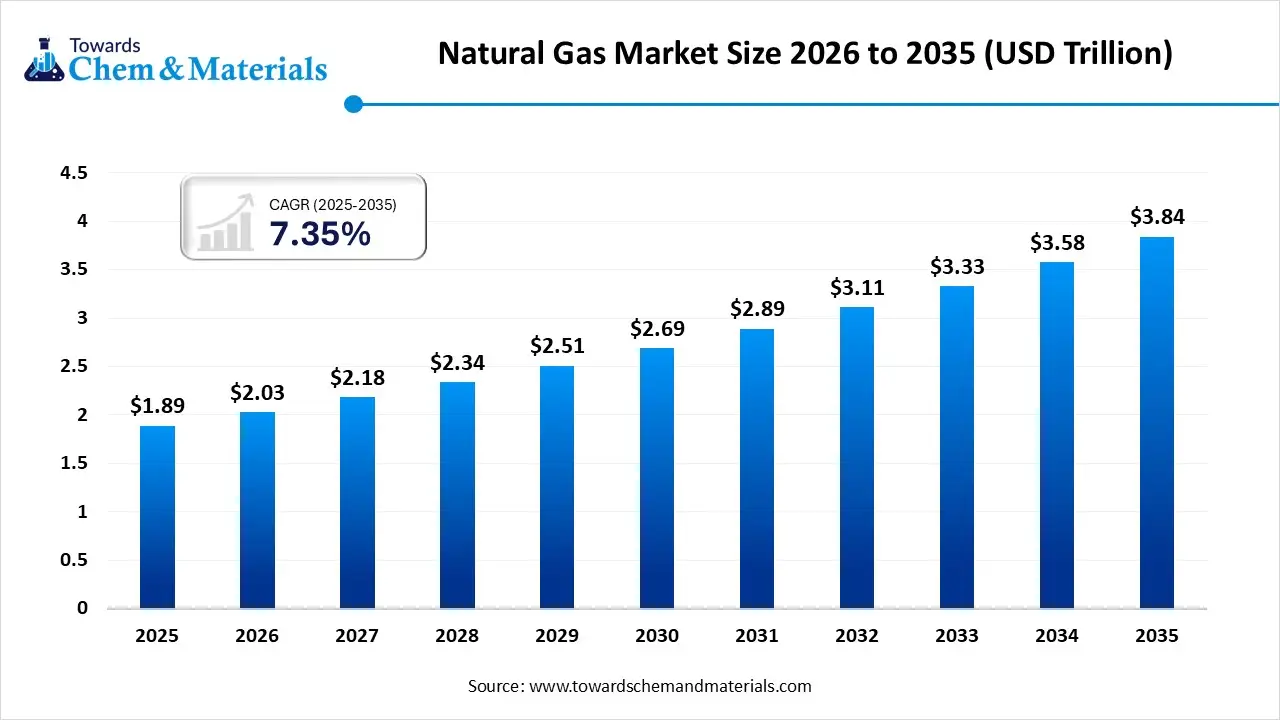
According to industry estimates, the global natural gas market size was valued at approximately USD 1.89 trillion in 2025. The market is projected to grow from USD 2.03 trillion in 2026 to around USD 3.84 trillion by 2035. This represents a compound annual growth rate (CAGR) of 7.35 percent during the forecast period from 2026 to 2035.
The growth of the natural gas market is closely tied to the increasing demand for cleaner energy sources, rising electricity consumption, and the growing integration of natural gas within national energy strategies. Governments, utilities, and private energy companies are investing heavily in infrastructure development, including pipelines, storage systems, and liquefied natural gas (LNG) facilities.
Regionally, the Asia Pacific region accounted for the largest share of the global natural gas market in 2025, contributing approximately 40 percent of total revenue. Rapid industrialization, population growth, expanding urbanization, and increasing electricity demand across countries such as China, India, and Southeast Asian economies are major factors contributing to this regional dominance.
Technological advancements in exploration, extraction, and distribution processes are also helping companies optimize production efficiency and reduce operational costs. Innovations in unconventional gas extraction techniques, including shale gas and tight gas development, are expanding the accessible reserves and strengthening global supply capacity.
As global economies continue to prioritize energy security, affordability, and sustainability, natural gas is expected to remain a crucial part of the global energy mix for the foreseeable future.
Key Takeaways
- Asia Pacific dominated the global natural gas market and accounted for approximately 40 percent of the total revenue share in 2025.
- The unconventional resource type segment represented the largest revenue share of about 14 percent in 2025.
- The liquefied natural gas segment is expected to grow at the fastest CAGR of 10.75 percent during the forecast period from 2026 to 2035.
- The power generation sector led the market by end-use application and accounted for about 43 percent of the total market share in 2025.
- Pipeline transportation remained the leading distribution method and contributed around 45 percent of the overall market share in 2025.
Report Scope
| Report Attributes | Details |
| Market Size in 2026 | USD 2.03 Trillion |
| Expected Size by 2035 | USD 3.84 Trillion |
| Growth Rate from 2025 to 2035 | CAGR 7.35% |
| Base Year of Estimation | 2025 |
| Forecast Period | 2025 – 2035 |
| Dominant Region | Asia Pacific |
| Segment Covered | By Resource Type, By End-Use Application, By Distribution Method, By Region |
| Key Companies Profiled | ExxonMobil, Chevron, Royal Dutch Shell, TotalEnergies, BP, Gazprom, Qatar Petroleum, ONGC (Oil and Natural Gas Corporation), Reliance Industries Limited, Eni S.p.A., ConocoPhillips, Equinor, Petronas, Sempra Energy |
Market Dynamics
Market Drivers
Rising Demand for Cleaner Energy Sources
The global transition toward cleaner and more sustainable energy sources is one of the most significant drivers supporting the growth of the natural gas market. Compared with coal and oil, natural gas produces fewer carbon emissions and pollutants when burned for electricity generation or industrial use.
Many governments are implementing policies aimed at reducing greenhouse gas emissions and improving air quality. As a result, natural gas is increasingly replacing coal in power generation and industrial processes. This shift is particularly visible in developing economies where rapid urbanization and industrial expansion are increasing energy consumption.
Natural gas also offers operational flexibility for power plants. Gas-fired turbines can be quickly started or stopped depending on electricity demand, making them suitable for balancing intermittent renewable energy sources such as solar and wind power.
Increasing Global Electricity Consumption
Another major driver of market growth is the rising global demand for electricity. Rapid economic development, industrial activity, and the expansion of digital infrastructure are contributing to higher electricity consumption worldwide.
Natural gas is widely used in gas turbines and steam turbines for electricity generation because it provides a relatively low-cost and efficient energy source. Many countries are building new gas-based power plants to ensure stable and reliable electricity supply.
The increasing electrification of transportation systems, manufacturing operations, and residential heating solutions is also expected to further boost the demand for natural gas in the coming years.
Infrastructure Expansion
Governments and private investors are significantly expanding natural gas infrastructure. This includes the construction of cross-border pipelines, LNG terminals, regasification facilities, and storage systems.
The development of LNG infrastructure is particularly important because it enables countries without pipeline access to import natural gas from international markets. LNG allows gas to be transported by specialized tankers across long distances, improving global trade and supply stability.
Investments in pipeline networks also help improve domestic gas distribution systems, making natural gas accessible to a wider range of industrial, commercial, and residential consumers.
Market Restraints
One of the key challenges in the natural gas market is price volatility. Natural gas prices can fluctuate due to changes in global supply and demand, geopolitical tensions, weather conditions, and production disruptions.
Unstable pricing may influence investment decisions in exploration and infrastructure projects. Companies operating in the natural gas industry must adopt risk management strategies to mitigate price fluctuations.
Competition from Renewable Energy
While natural gas is considered a cleaner fossil fuel, the rapid growth of renewable energy technologies such as solar, wind, and hydropower may create competitive pressure in the long term.
Governments are increasingly supporting renewable energy deployment through subsidies and policy incentives. As renewable technologies become more cost-competitive, some energy markets may gradually reduce their dependence on fossil fuels.
Market Opportunities
Technological Innovations in Extraction
Technological advancements in drilling and extraction techniques are improving the efficiency and productivity of natural gas production. Innovations such as horizontal drilling and hydraulic fracturing have significantly increased access to unconventional gas reserves.
These technologies enable companies to extract natural gas from previously inaccessible geological formations, expanding global supply potential.
Integration of Renewable Energy in Production
Energy companies are increasingly integrating renewable energy technologies into their production operations. Renewable sources such as solar, wind, biomass, and geothermal energy are being used to power gas extraction and processing facilities.
This approach helps reduce the carbon footprint associated with natural gas production and supports broader sustainability goals within the energy sector.
For more information, visit the Towards Chemical and Materials website or email the team at sales@towardschemandmaterials.com| +1 804 441 9344
Key Trends Influencing the Natural Gas Market
- Several emerging trends are shaping the future development of the natural gas industry.
- One of the most prominent trends is the increasing global economic activity combined with rising electricity demand in developing economies. As countries expand industrial production and improve living standards, energy consumption continues to increase significantly.
- Another trend is the growing adoption of renewable energy technologies in natural gas extraction operations. Oil and gas companies are incorporating renewable power sources into production facilities to reduce operational emissions and improve environmental sustainability.
- The expansion of LNG infrastructure is also transforming the global natural gas trade. LNG allows countries to import natural gas from distant suppliers, reducing dependence on regional pipeline networks and improving supply diversification.
- Government initiatives promoting pipeline expansion and natural gas consumption are also playing a significant role in market growth. Many countries are implementing policies and incentives that encourage industries and households to adopt natural gas as an alternative energy source.
Distribution and Marketing
The final stage of the value chain focuses on delivering natural gas to end users including power plants, industries, businesses, and residential consumers.
Companies active in this stage include
- Marathon Petroleum
- Valero Energy
- Shell
- TotalEnergies
Market Segmentation
By Resource Type
Conventional Natural Gas
Conventional natural gas is extracted from reservoirs where the gas flows naturally through porous rock formations. These reserves have historically been the primary source of natural gas production.
Unconventional Natural Gas
Unconventional natural gas includes resources such as shale gas, coalbed methane, and tight gas. This segment dominated the market in 2025 and accounted for approximately 14 percent of the total revenue share.
The expansion of unconventional gas extraction technologies has significantly increased global natural gas production capacity.
Liquefied Natural Gas
Liquefied natural gas is natural gas that has been cooled to extremely low temperatures to convert it into a liquid form. This process reduces its volume significantly, enabling transportation via LNG tankers.
The LNG segment is expected to grow at the fastest CAGR of 10.75 percent between 2026 and 2035 due to rising global trade and increasing infrastructure investments.
By End Use Application
Power Generation
Power generation represents the largest end use segment in the natural gas market. In 2025, it accounted for approximately 43 percent of total revenue.
Natural gas power plants are widely used due to their efficiency, reliability, and lower emissions compared with coal-fired plants.
Industrial Sector
Industries use natural gas as both a fuel source and a raw material in chemical manufacturing processes.
Residential and Commercial
Natural gas is commonly used for heating, cooking, and water heating in residential and commercial buildings.
By Distribution Method
Pipeline Transportation
Pipeline transportation dominated the distribution segment in 2025 and accounted for approximately 45 percent of the total market share.
Pipelines provide a cost-effective and efficient method for transporting large volumes of natural gas over long distances.
LNG Transportation
LNG transportation is increasingly important for international gas trade, especially for countries without direct pipeline connections.
Regional Insights
Asia Pacific
Asia Pacific held the largest share of the natural gas market in 2025 with around 40 percent of global revenue.
Rapid industrial development, population growth, and expanding urban infrastructure are major drivers of natural gas demand in the region.
Countries such as China, India, Japan, and South Korea are investing heavily in LNG import terminals and pipeline infrastructure to ensure stable energy supply.
North America
North America is one of the leading producers of natural gas due to abundant shale gas reserves and advanced extraction technologies.
Europe
European countries are focusing on diversifying their natural gas supply sources while simultaneously expanding renewable energy capacity.
Middle East and Africa
The Middle East holds some of the world’s largest natural gas reserves and plays a crucial role in global LNG exports.
Recent Developments
In May 2025, Amplify ETFs partnered with Samsung Asset Management to launch the Amplify Samsung U.S. Natural Gas Infrastructure ETF. The fund provides investors exposure to companies involved in developing and operating natural gas infrastructure in the United States.
In December 2024, BP partnered with XRG to launch a new natural gas platform called Arcius Energy. The initiative combines technical expertise from both companies to build a competitive natural gas portfolio.
More Insights in Towards Chemical and Materials:
- Industrial Gas Pipeline Infrastructure Market: The global industrial gas pipeline infrastructure market volume was reached at USD 44.00 million tonnes in 2024 and is expected to be worth around USD 67.55 million tonnes by 2034, growing at a compound annual growth rate (CAGR) of 4.38% over the forecast period 2025 to 2034. The increased need for energy security has been a key enabler of industry development.
- GCC Natural Gas Market: The GCC natural gas market size was estimated at USD 60.85 billion in 2025 and is expected to increase from USD 63.51 billion in 2026 to USD 93.33 billion by 2035, growing at a CAGR of 4.37% from 2026 to 2035.
- Natural Gas Liquid Market: The global natural gas liquid market size was estimated at USD 25.19 billion in 2025 and is expected to increase from USD 26.98 billion in 2026 to USD 50.06 billion by 2035, growing at a CAGR of 7.11%. In terms of volume, the market is projected to grow from 790.25 million tons in 2025 to 940.12 million tons by 2035.
- Biogas Market: The global biogas market size was estimated at USD 171.19 billion in 2025 and is predicted to increase from USD 178.88 billion in 2026 and is projected to reach around USD 265.60 billion by 2035, The market is expanding at a CAGR of 4.49% between 2026 and 2035.
- Green Gas Market: The global green gas market size was estimated at USD 2.11 billion in 2025 and is predicted to increase from USD 2.25 billion in 2026 and is projected to reach around USD 3.96 billion by 2035, The market is expanding at a CAGR of 6.51% between 2026 and 2035.
Immediate Delivery Available | Buy This Premium Research Report@ https://www.towardschemandmaterials.com/checkout/5634
About Us
Towards Chemical and Materials is a leading global consulting firm specializing in providing comprehensive and strategic research solutions across the chemical and materials industries. With a highly skilled and experienced consultant team, we offer a wide range of services designed to empower businesses with valuable insights and actionable recommendations.
Our Trusted Data Partners
Precedence Research | Statifacts | Towards Packaging | Towards Healthcare | Towards Food and Beverages | Towards Chemical and Materials | Towards Consumer Goods | Nova One Advisor |
For Latest Update Follow Us: https://www.linkedin.com/company/towards-chem-and-materials/
USA: +1 804 441 9344
APAC: +61 485 981 310 or +91 87933 22019
Europe: +44 7383 092 044

Leave a Reply