Introduction
The Floating Liquefied Natural Gas (FLNG) Terminals market is expected to experience significant growth in the coming decade. Valued at USD 28.42 billion in 2025, the market is projected to reach USD 66.62 billion by 2034, growing at a compound annual growth rate (CAGR) of 9.93%. FLNG terminals, which include floating storage and regasification units (FSRUs), FLNG vessels, and offshore LNG platforms, play a critical role in the production, storage, and transportation of liquefied natural gas (LNG) from offshore gas fields. This market is set to benefit from the increasing global demand for LNG, coupled with technological advancements and the growing need for more flexible and efficient LNG solutions.
Get All the Details in Our Solutions –Download Sample: https://www.towardschemandmaterials.com/download-sample/5967
This article will explore the key trends, dynamics, and insights driving the FLNG terminals market, as well as the major players contributing to its development.
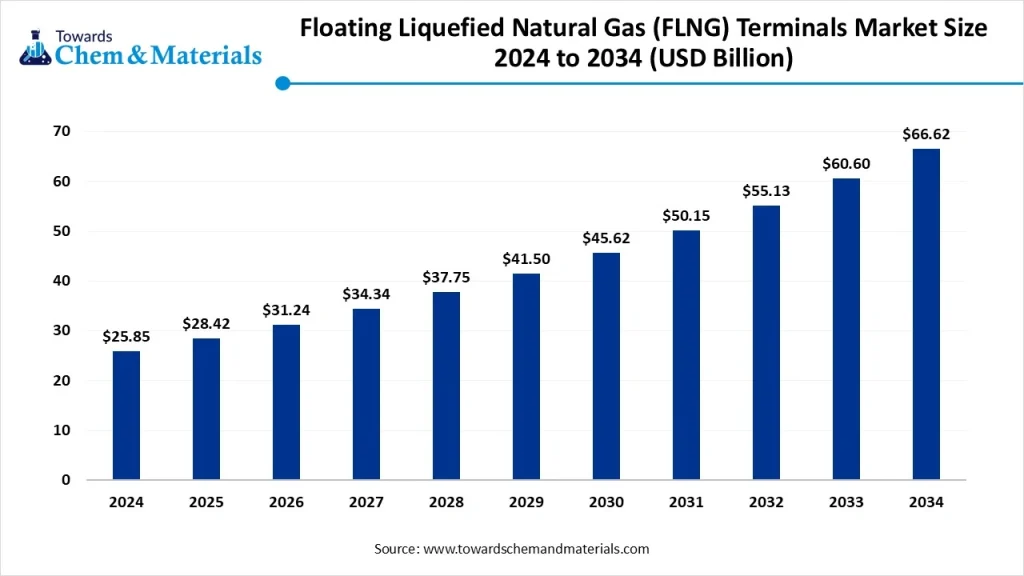
Market Overview
What is Floating Liquefied Natural Gas (FLNG)?
Floating Liquefied Natural Gas (FLNG) terminals are offshore facilities designed for LNG production, storage, and regasification without the need for onshore infrastructure. These terminals include floating liquefied natural gas vessels (FLNG vessels), floating storage and regasification units (FSRUs), and FLNG platforms that support offshore gas field developments.
FLNG terminals offer a flexible solution for developing remote or stranded gas fields that are not connected to onshore facilities, providing a cost-effective and environmentally friendly alternative to traditional land-based LNG facilities. These terminals allow the production, liquefaction, and transportation of LNG directly from offshore locations, helping meet the global demand for cleaner and more efficient energy sources.
The growing demand for LNG as a cleaner fuel source, along with the need for more adaptable and scalable LNG production and transportation systems, is driving the expansion of the FLNG terminals market. As countries and companies shift toward lower-carbon energy alternatives, FLNG terminals provide a unique and practical solution to help meet both supply and environmental goals.
Market Dynamics
Several key dynamics are fueling the growth of the FLNG terminals market, with factors ranging from technological advancements to regulatory support for cleaner energy sources.
1. Rising Global LNG Demand
The demand for liquefied natural gas has been steadily increasing as countries strive to reduce their reliance on coal and oil, and as they adopt cleaner energy solutions. As one of the cleanest fossil fuels available, LNG is being favored by both developed and developing nations as a bridge energy source during the transition to renewable energy. The increasing use of LNG in power generation, industry, and transportation is driving demand for more LNG production and storage capabilities, which in turn boosts the FLNG terminal market.
2. Offshore Gas Field Development
There is a growing interest in developing offshore gas fields, particularly in remote or stranded locations where traditional land-based infrastructure may not be feasible. FLNG terminals allow for the production, liquefaction, and transportation of LNG without the need for extensive onshore facilities, making them an attractive solution for offshore gas field developments.
3. Technological Advancements
Advancements in FLNG technology have made these terminals more efficient and cost-effective. Companies are developing more advanced FLNG vessels, FSRUs, and liquefaction technologies, which have improved the scalability, safety, and flexibility of these facilities. Additionally, innovations in offshore mooring systems, liquefaction processes, and regasification equipment continue to drive the market.
4. Environmental and Regulatory Support
Governments worldwide are increasingly focusing on reducing carbon emissions and transitioning to cleaner energy sources. As part of this shift, many governments are incentivizing the development of LNG infrastructure, including FLNG terminals. The adoption of environmental regulations that favor cleaner fuels, such as LNG, is expected to drive market growth over the forecast period.
5. Cost-Effectiveness and Flexibility
FLNG terminals offer significant cost savings compared to traditional land-based LNG plants. With no need for extensive onshore facilities, FLNG terminals reduce infrastructure costs and provide greater flexibility in managing production and storage capacities. This flexibility is particularly valuable in addressing fluctuating demand and remote locations.
Market Insights
The FLNG terminals market is poised to grow significantly due to a combination of technological innovation, favorable regulatory trends, and the global shift towards cleaner energy solutions. Several insights into the market include:
1. Growing Market in Emerging Economies
Emerging economies, particularly in Asia and Africa, are expected to drive demand for FLNG terminals. These regions are experiencing rapid industrialization, urbanization, and an increasing demand for cleaner energy sources, which will fuel the need for LNG infrastructure.
2. Increased Investment in FLNG Projects
Both private and public sectors are increasing investments in FLNG technology and infrastructure. Major oil and gas companies are funding large-scale FLNG projects to meet growing LNG demand, while governments are providing subsidies and support for the development of FLNG terminals as part of their national energy strategies.
3. Expansion of LNG Import and Export Terminals
The growing importance of LNG in global trade is leading to the development of more import and export terminals, including FLNG terminals. These terminals help countries to diversify their energy sources and meet the increasing global demand for LNG, particularly in regions like Asia-Pacific, Europe, and North America.
4. Technological Advancements in Offshore Platforms
The development of more advanced and efficient offshore platforms has significantly improved the operational capacity and sustainability of FLNG terminals. Innovations in liquefaction technology and energy-efficient processes are expected to play a critical role in expanding the market, particularly as companies focus on reducing the environmental impact of LNG production.
5. Focus on Sustainability
Sustainability is a key focus in the FLNG sector. Companies are increasingly adopting sustainable technologies to minimize emissions and reduce the environmental impact of FLNG operations. As global pressure to meet climate goals intensifies, FLNG terminals will play a key role in the transition to a lower-carbon energy system.
Market Segments
The FLNG terminals market can be segmented based on type, application, and geography.
By Type
-
Floating Storage and Regasification Units (FSRUs): FSRUs are used for regasifying LNG at offshore locations and are typically used in regions without onshore LNG regasification infrastructure. These units allow for the efficient import of LNG to areas lacking domestic gas production.
-
Floating Liquefied Natural Gas (FLNG) Vessels: FLNG vessels are used for the liquefaction of natural gas at offshore sites, enabling the transportation of LNG from remote offshore fields to global markets. These vessels are essential for the development of stranded gas fields.
-
FLNG Platforms: FLNG platforms are fixed structures that enable the production, liquefaction, and storage of LNG offshore. These platforms are typically used in deeper waters where floating vessels cannot operate.
By Application
-
LNG Production: FLNG terminals play a key role in offshore LNG production, where they extract and liquefy natural gas from remote fields, making it easier to transport the gas to global markets.
-
LNG Storage: FLNG terminals serve as storage units for LNG, allowing gas to be stored offshore before it is transported to various destinations.
-
LNG Transportation: FLNG terminals are integral in the transportation of LNG, allowing for the direct transfer of liquefied natural gas from offshore fields to LNG carriers for export to global markets.
By Geography
-
Asia-Pacific: The largest market for FLNG terminals due to the high demand for energy in countries like China, Japan, and India. The region is expected to witness significant growth in FLNG terminal infrastructure.
-
North America: The U.S. and Canada are key markets for FLNG terminals, particularly in the Gulf of Mexico, where offshore gas fields are increasingly being developed.
-
Europe: Europe is expanding its LNG infrastructure to reduce dependence on pipeline gas and diversify its energy sources. Several countries in the region are investing in FLNG terminals to enhance their energy security.
More Insights in Towards Chemical and Materials:
- Fertilizer Catalysts Market : The global fertilizer catalysts market size is calculated at USD 3.56 billion in 2025 and is expected to be worth around USD 4.75 billion by 2034, growing at a compound annual growth rate (CAGR) of 3.25% over the forecast period 2025 to 2034.
- Recycled Engineering Plastics Market : According to the new market research report the global recycled engineering plastics market size is calculated at USD 5.09 billion in 2025 and is expected to reach USD 7.89 billion by 2034, growing at a CAGR of 4.99% from 2025 to 2034.
- Bio-Renewable Chemicals Market : The global bio-renewable chemicals market size was valued at USD 15.11 billion in 2024 and is growing to approximately USD 39.01 billion by 2034, with a developing compound annual growth rate (CAGR) of 9.95% over the forecast period 2025 to 2034.
- Renewable Polypropylene Market : According to an exclusive report, the global renewable polypropylene market size is estimated at USD 63.88 billion in 2025 and is expected to hit around USD 133.67 billion by 2034, growing at a compound annual growth rate (CAGR) of 8.55% over the forecast period from 2025 to 2034.
- TPE Films and Sheets Market : The global TPE films and sheets market size is estimated at USD 3.78 billion in 2025 and is expected to hit around USD 6.57 billion by 2034, growing at a compound annual growth rate (CAGR) of 6.35% over the forecast period from 2025 to 2034. the Asia Pacific dominated the TPE films and sheets market with a market share of 49% in 2024.
Top Companies in the FLNG Terminals Market
-
Samsung Heavy Industries Co., Ltd.
-
About: A leading shipbuilder in South Korea, Samsung Heavy Industries specializes in constructing floating structures for LNG production and storage.
-
Products: FLNG vessels, FSRUs, LNG carriers, offshore platforms.
-
Market Cap: USD 7.5 billion (2024).
-
-
TechnipFMC plc
-
About: A global leader in the oil and gas sector, TechnipFMC offers integrated services and solutions for FLNG projects.
-
Products: FLNG systems, subsea pipelines, offshore equipment.
-
Market Cap: USD 8.5 billion (2024).
-
-
MODEC, Inc.
-
About: MODEC is a Japanese company providing offshore floating production solutions, including FLNG facilities.
-
Products: FLNG vessels, FSRUs, offshore platforms, floating production storage and offloading units (FPSOs).
-
Market Cap: USD 3.4 billion (2024).
-
-
BW Offshore Ltd.
-
About: BW Offshore specializes in offshore energy infrastructure, including FLNG terminals.
-
Products: FLNG units, FPSOs, offshore gas production solutions.
-
Market Cap: USD 1.8 billion (2024).
-
-
Shell plc
-
About: Shell is a global energy company with a significant portfolio of FLNG projects, including the groundbreaking Prelude FLNG.
-
Products: FLNG vessels, offshore energy production solutions.
-
Market Cap: USD 180 billion (2024).
-
Recent Developments
-
ABB: In September 2025, ABB was awarded a contract to provide electrical power and propulsion systems for Singapore’s first floating storage and regasification unit (FSRU), to be built by Hanwha Ocean.
-
Eni: In August 2025, Eni launched the Nguya FLNG unit and floating production and compression unit (FPU) for its Congo LNG project, with a total liquefaction capacity of 3 million tonnes per year.
Frequently Asked Questions (FAQs)
-
What is the FLNG terminals market?
-
The FLNG terminals market involves the design, development, and operation of floating facilities for LNG production, storage, and regasification.
-
-
What is driving the growth of the FLNG terminals market?
-
The growing demand for LNG, offshore gas field exploration, technological advancements, and the transition to cleaner energy are the key drivers of market growth.
-
-
What are the types of FLNG terminals?
-
FLNG terminals include floating storage and regasification units (FSRUs), FLNG vessels, and FLNG platforms.
-
-
Which regions are leading the FLNG market?
-
Asia-Pacific, North America, and Europe are the key regions driving the growth of the FLNG terminals market.
-
-
What are the benefits of FLNG terminals?
-
FLNG terminals offer flexibility, cost savings, and the ability to develop remote or stranded gas fields without the need for extensive onshore infrastructure.
-
Immediate Delivery Available | Buy This Premium Research Report@ https://www.towardschemandmaterials.com/checkout/5967
About Us
Towards Chemical and Materials is a leading global consulting firm specializing in providing comprehensive and strategic research solutions across the chemical and materials industries. With a highly skilled and experienced consultant team, we offer a wide range of services designed to empower businesses with valuable insights and actionable recommendations.
Our Trusted Data Partners
Precedence Research | Statifacts | Towards Packaging | Towards Healthcare | Towards Food and Beverages | Towards Chemical and Materials | Towards Consumer Goods | Nova One Advisor |
For Latest Update Follow Us: https://www.linkedin.com/company/towards-chem-and-materials/
USA: +1 804 441 9344
APAC: +61 485 981 310 or +91 87933 22019
Europe: +44 7383 092 044

Leave a Reply