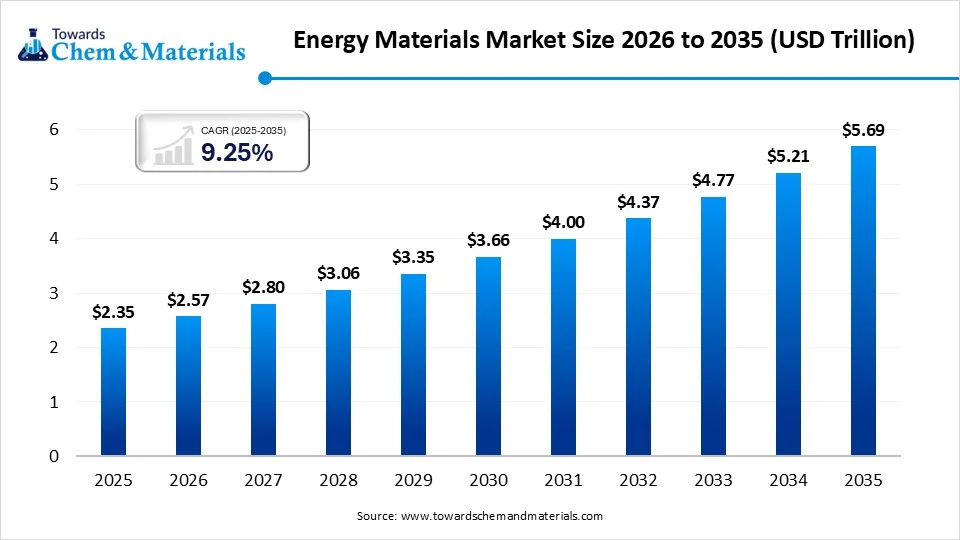
According to Towards Chemical and Materials, the global energy materials market was valued at USD 2.35 trillion in 2025 and is projected to grow from USD 2.57 trillion in 2026 to USD 5.69 trillion by 2035, registering a CAGR of 9.25% during 2026–2035.
The market growth is primarily driven by the global transition toward decarbonized energy systems, increasing renewable energy deployment, and the rising demand for advanced materials used in energy generation, storage, and transmission infrastructure.
Energy materials include metals & alloys, battery materials, photovoltaic materials, fuel-cell components, and other advanced functional materials that improve the efficiency, safety, and sustainability of energy systems.
Download a Sample Report Here @ https://www.towardschemandmaterials.com/download-sample/6255
In 2025, Asia Pacific dominated the market due to strong investments in renewable energy infrastructure and electric vehicle manufacturing. Meanwhile, North America is expected to witness the fastest growth owing to rapid development in grid-scale energy storage and advanced battery technologies.
Key segments shaping the market include:
-
Metals & alloys – largest material segment with 54.60% revenue share in 2025
-
Transmission & distribution infrastructure – leading application segment with 25.70% share
-
Energy storage systems – fastest growing application segment
Energy Materials Market Dynamics
1. Market Drivers
Transition toward renewable and low-carbon energy systems
Governments and industries worldwide are accelerating investments in solar, wind, hydrogen, and battery technologies, which require advanced materials such as lithium, cobalt, nickel, and high-performance alloys.
Expansion of electric vehicles and energy storage
The rapid adoption of electric vehicles (EVs) and grid-scale storage systems is increasing the demand for lithium-ion batteries and other electrochemical materials.
Infrastructure modernization
Growing electricity demand and the modernization of transmission and distribution networks are increasing the consumption of conductive metals, alloys, and high-performance materials.
2. Market Restraints
Supply chain constraints for critical minerals
Key materials such as lithium, cobalt, and rare earth elements have limited geographical supply, creating risks related to price volatility and supply security.
High production and processing costs
Advanced energy materials often require complex chemical processing and specialized manufacturing, increasing overall production costs.
Environmental and regulatory challenges
Mining and refining operations face strict environmental regulations and sustainability concerns, which may limit production expansion.
3. Market Opportunities
Battery recycling and circular economy
The development of battery recycling technologies and secondary material recovery is creating new opportunities for sustainable material supply.
Green hydrogen and advanced fuel cells
Increasing investments in green hydrogen infrastructure are expected to boost demand for catalysts, membranes, and specialized materials used in fuel cells.
Technological innovation
Artificial intelligence, robotics, and high-performance computing are enabling faster material discovery and testing, accelerating innovation in the sector.
Request Research Report Built Around Your Goals: sales@towardschemandmaterials.com
4. Market Challenges
Geopolitical dependency on raw materials
Several countries rely heavily on imports of key minerals from a limited number of suppliers, creating geopolitical risks and trade uncertainties.
Technological complexity
Developing next-generation materials such as solid-state batteries and nanomaterials requires extensive R&D investments and long development cycles.
Recycling and waste management
Handling end-of-life batteries and renewable energy components remains a significant technical and regulatory challenge.
Energy Materials Market Emerging Trends
Advanced material innovation
Companies are increasingly developing nano-structured materials, low-toxicity compounds, and high-density battery chemistries that improve performance and safety.
Integration of smart materials
Smart materials capable of responding to environmental changes are being used to improve energy efficiency and system reliability.
Automation and AI-driven research
Self-driving laboratories powered by AI, robotics, and advanced computing are enabling faster discovery of high-performance materials for energy applications.
Growth of circular economy models
Recycling and reuse of materials, particularly in battery production, are gaining momentum to reduce dependency on raw mineral extraction.
Immediate Delivery Available | Buy This Premium Research Report (Global Deep Dive
USD 3200) @ https://www.towardschemandmaterials.com/checkout/6255
Energy Materials Market Regional Insights
1. North America
North America is expected to register the fastest CAGR during the forecast period. The region is witnessing strong growth in grid-scale energy storage systems, along with increasing investments in advanced materials such as solid-state batteries, nanomaterials, and phase-change materials.
The United States leads the regional market due to strong government support for domestic supply chains and the increasing demand for battery materials and sustainable energy infrastructure.
2. Europe
Europe holds a significant share of the market due to strict environmental regulations and strong sustainability initiatives.
The region is investing heavily in high-performance materials, recycling technologies, and green hydrogen infrastructure.
Germany plays a major role in the regional market with significant investments in electric mobility, heat pumps, and energy storage technologies.
3. Asia Pacific
Asia Pacific dominated the global energy materials market in 2025. The growth of the region is supported by:
-
Rapid expansion of renewable energy capacity
-
Large-scale EV production
-
Strong battery manufacturing ecosystem
China leads the regional market due to its dominance in battery cell manufacturing and mineral refining, along with large investments in solar, wind, and energy storage projects.
4. Latin America
Latin America is emerging as an important region in the market due to its abundant reserves of lithium and other critical minerals. Countries such as Chile and Argentina play a vital role in supplying raw materials for global battery production.
5. Middle East and Africa
The Middle East and Africa region is gradually increasing its presence in the market through renewable energy investments, mineral exploration, and hydrogen projects. Governments are focusing on diversifying energy resources and supporting clean energy infrastructure.
Immediate Delivery Available | Buy This Premium Research Report@ https://www.towardschemandmaterials.com/checkout/6255
Energy Materials Market Recent Developments
-
October 2025: Brown University School of Engineering partnered with Panasonic Energy Co., Ltd. to develop improved lithium-ion battery materials and study degradation mechanisms to enhance battery performance.
-
June 2025: Redwood Materials launched Redwood Energy, a new division focused on repurposing retired EV batteries for grid-scale energy storage, strengthening the battery recycling ecosystem.
About Us
Towards Chemical and Materials is a leading global consulting firm specializing in providing comprehensive and strategic research solutions across the chemical and materials industries. With a highly skilled and experienced consultant team, we offer a wide range of services designed to empower businesses with valuable insights and actionable recommendations.
Our Trusted Data Partners
Towards chem and Material | Precedence Research | Statifacts | Towards Packaging | Towards Healthcare | Towards Food and Beverages | Towards Automotive | | Nova One Advisor | Nutraceuticals Func Foods | Onco Quant | Sustainability Quant | Specialty Chemicals Analytics | TCM Blog
For Latest Update Follow Us: https://www.linkedin.com/company/towards-chem-and-materials/
USA: +1 804 441 9344
APAC: +61 485 981 310 or +91 87933 22019
Europe: +44 7383 092 044



Leave a Reply