Executive Summary
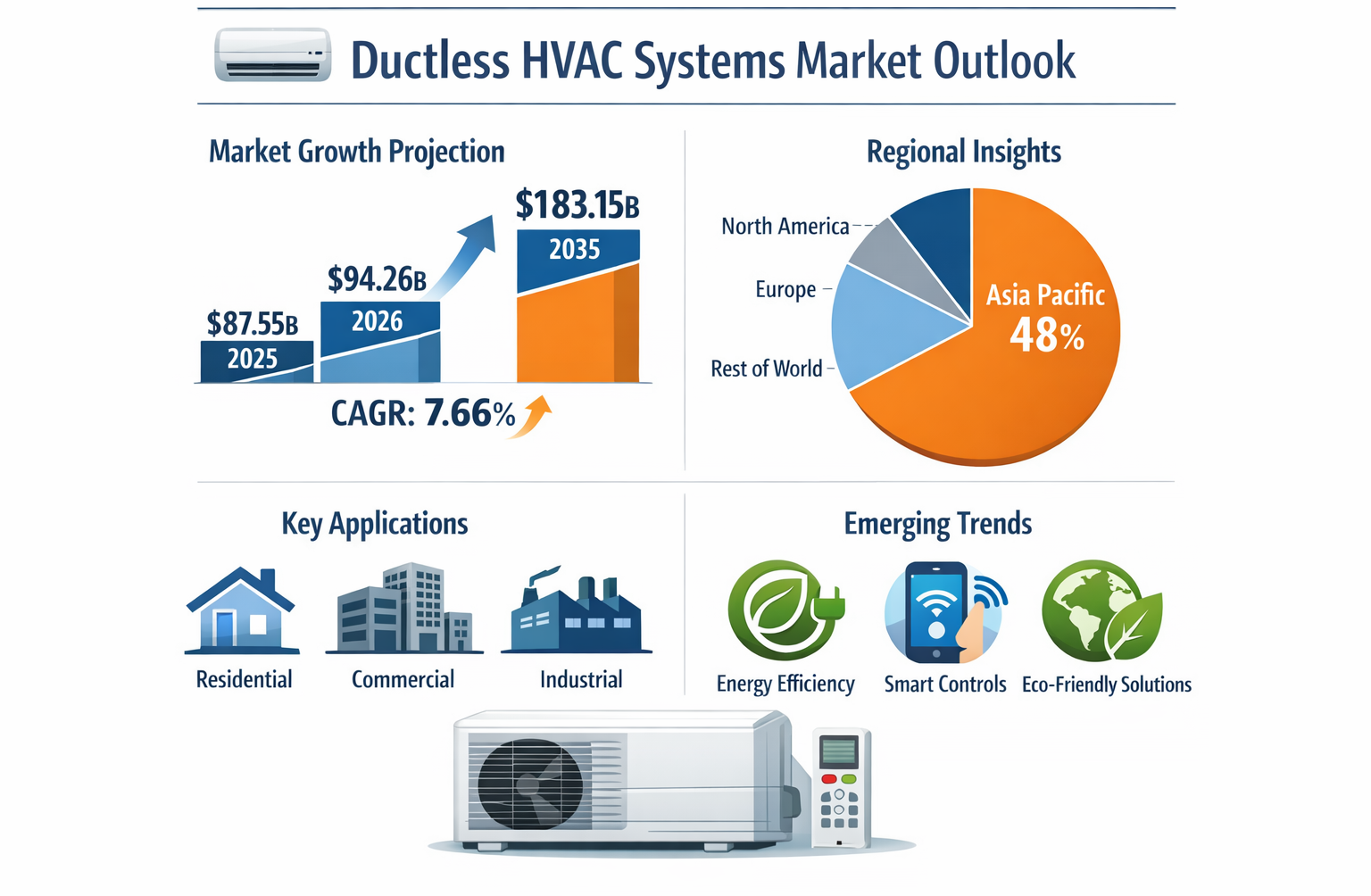
The global ductless HVAC systems market was valued at USD 87.55 billion in 2025 and is expected to grow from USD 94.26 billion in 2026 to USD 183.15 billion by 2035, with a compound annual growth rate (CAGR) of 7.66% from 2026 to 2035. The Asia Pacific region is projected to continue dominating the market, holding the largest revenue share of 48.00% in 2025. This growth is driven by increasing demand for energy-efficient and space-saving solutions in residential, commercial, and industrial sectors, as well as the growing adoption of smart HVAC technologies.
What Are Ductless HVAC Systems?
Ductless HVAC systems, also known as ductless mini-split systems, provide heating and cooling solutions without the need for ductwork. These systems consist of an outdoor compressor and one or more indoor units that directly distribute conditioned air into individual rooms or zones. Popular for their energy efficiency, flexible installation, and ease of use, ductless HVAC systems are increasingly used in residential, commercial, and industrial applications.
What Are the Primary Drivers for the Ductless HVAC Systems Market?
- Energy Efficiency Demands: The increasing emphasis on energy-efficient solutions is one of the primary drivers for the ductless HVAC market. These systems offer better energy performance compared to traditional systems, resulting in lower energy consumption and cost savings.
- Increasing Residential and Commercial Demand: As real estate and construction industries continue to grow, there is a rising demand for customizable and space-saving HVAC solutions in residential homes, apartments, and commercial buildings. Ductless HVAC systems cater to this need by offering easy installation and the ability to control temperature in individual rooms or zones.
- Environmental Regulations and Sustainability: Stringent environmental regulations around the world are pushing industries to adopt green technologies. Ductless systems use inverter-driven compressors and refrigerants with lower global warming potential (GWP), making them an attractive option for businesses and homeowners aiming to reduce their carbon footprint.
- Technological Advancements: The development of smart HVAC systems that integrate with home automation technologies (such as IoT-enabled thermostats and smart sensors) has boosted the popularity of ductless HVAC systems. These systems offer improved control, comfort, and convenience.
- Rising Demand for Smart Homes: With the growing adoption of smart home technologies, ductless HVAC systems are gaining traction due to their integration with home automation systems, enabling users to control temperature remotely.
Key Segments and Trends in the Ductless HVAC Systems Market
1. By Type: Wall-mounted, Ceiling-mounted, Floor-mounted
- Wall-mounted systems: These are the most common type, offering flexibility and ease of installation. They are ideal for residential homes, particularly for cooling or heating single rooms.
- Ceiling-mounted systems: Used in both residential and commercial spaces, ceiling-mounted ductless systems are often chosen for their discreet appearance and even air distribution.
- Floor-mounted systems: These systems are gaining popularity in spaces that require more quiet operation and greater flexibility for installation.
2. By End-Use Application
- Residential: The growing trend towards home renovations and energy-efficient homes is propelling the adoption of ductless HVAC systems in residential buildings.
- Commercial: Offices, retail spaces, and hospitality establishments are increasingly turning to ductless systems for their flexibility and ability to zone temperature control.
- Industrial: Ductless systems are being deployed in warehouses, manufacturing plants, and industrial facilities where temperature control in specific areas is crucial for operations.
3. By Refrigerant Type
- R-32 Refrigerant: Increasingly popular due to its lower GWP and higher efficiency, R-32 is expected to see strong growth in the ductless HVAC systems market.
- R-410A Refrigerant: Despite being phased out in some regions due to environmental concerns, R-410A is still widely used in existing systems.
4. By Region
- Asia Pacific: The Asia Pacific region is expected to continue dominating the market, driven by the rapid urbanization, construction booms, and energy efficiency initiatives in countries like China, India, and Japan.
- North America: The North American market is seeing increasing adoption of ductless HVAC systems in residential and commercial buildings due to energy efficiency incentives and green building regulations.
- Europe: With a focus on sustainability and stringent environmental regulations, Europe is embracing eco-friendly HVAC solutions, including ductless systems.
- Middle East & Africa (MEA): The demand for ductless HVAC systems is also rising in the MEA region, driven by extreme climate conditions and the growing construction industry.
Competitive Landscape
Key players in the ductless HVAC systems market include:
- Daikin Industries: A global leader in HVAC solutions, Daikin has a strong presence in the ductless systems market, focusing on energy-efficient and environmentally friendly solutions with advanced inverter technology.
- Mitsubishi Electric: Mitsubishi Electric continues to innovate with its range of ductless mini-split systems, offering smart, energy-efficient systems that cater to residential, commercial, and industrial applications.
- LG Electronics: Known for its smart HVAC solutions, LG’s ductless HVAC systems are equipped with AI technology, enabling real-time control and enhanced comfort.
- Fujitsu General: Fujitsu is a major player in the ductless HVAC market, offering systems with low noise levels, high performance, and energy-efficient features.
- Carrier Global Corporation: Carrier offers a wide range of ductless HVAC products, with a focus on advanced technology and green initiatives to meet growing demand for energy-efficient heating and cooling solutions.
Regional Market Outlook
Asia Pacific (APAC)
- Market Share: Asia Pacific held 48.00% of the global market in 2025. The rapid growth in residential construction, commercial real estate, and industrial expansion in countries like China, India, and Japan continues to drive demand for ductless HVAC systems.
- Trends: In APAC, particularly in China and India, there is a strong preference for affordable, energy-efficient HVAC systems due to high population density and increasing urbanization.
North America
- North America continues to see growth, especially in smart home applications, energy-efficient buildings, and green technology adoption. The U.S. and Canada have stringent environmental standards that favor the adoption of ductless HVAC systems.
Europe
- Europe is also witnessing strong growth due to the demand for eco-friendly and high-performance HVAC systems, with a focus on sustainability and reduced carbon footprints. Countries such as Germany, France, and the UK are expected to lead the market in Europe.
Latin America & MEA
- The Latin American and Middle East regions are gradually increasing their demand for ductless HVAC systems, driven by climate extremes, growing industrial sectors, and the expansion of the construction and hospitality industries.
Conclusion: What Does the Future Hold for the Ductless HVAC Systems Market?
The ductless HVAC systems market is poised for significant growth, driven by demand for energy-efficient, customizable, and smart HVAC solutions across residential, commercial, and industrial applications. The market will continue to grow at a CAGR of 7.66% from 2026 to 2035, with the Asia Pacific region remaining the largest market due to rapid urbanization and construction expansion.
- Opportunities: Companies that innovate in smart, IoT-enabled systems and energy-efficient technologies will be well-positioned to lead the market. The increasing focus on green building solutions and environmentally friendly refrigerants will also drive market growth.
- Challenges: The primary challenges will include the high initial cost of ductless HVAC systems compared to traditional systems and the competitive pressure from other HVAC technologies.
In conclusion, the ductless HVAC market offers substantial growth potential for companies that can leverage advanced technologies, meet energy efficiency regulations, and address the growing demand for smart and eco-friendly solutions.



Leave a Reply