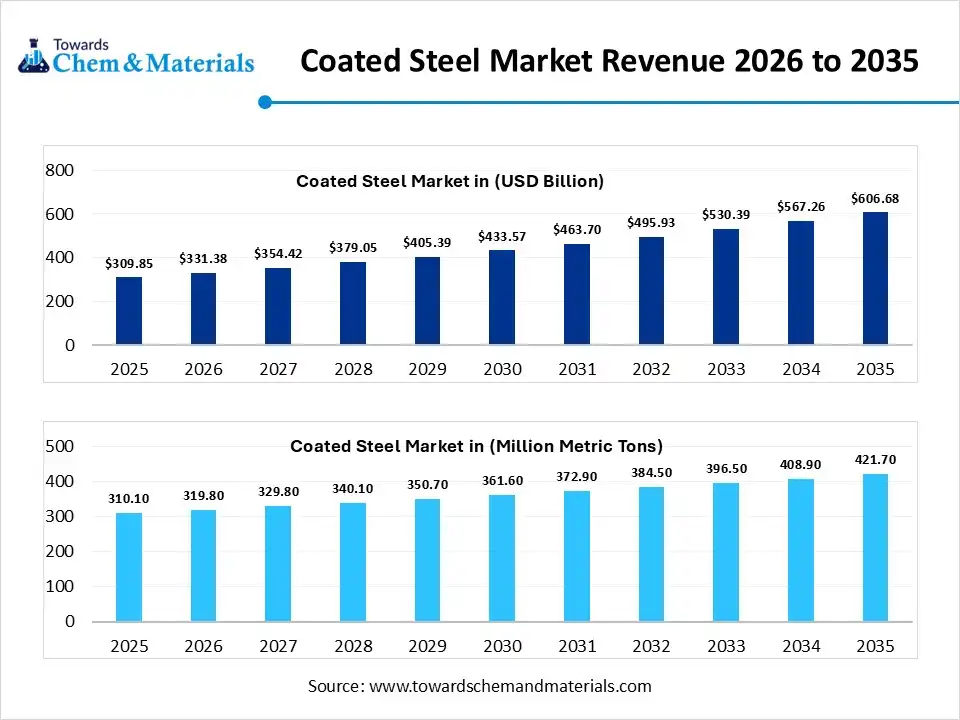
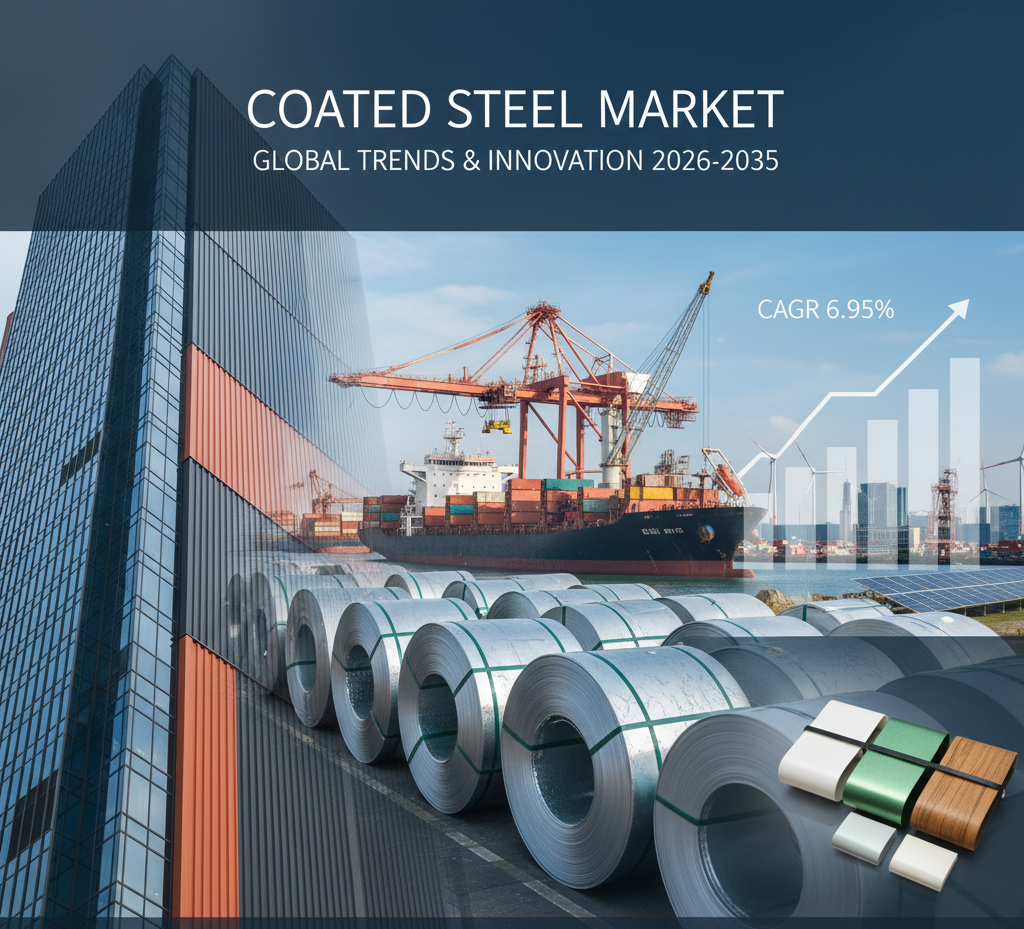
The global coated steel market size was estimated at USD 309.85 billion in 2025 and is expected to increase from USD 331.38 billion in 2026 to USD 606.68 billion by 2035, growing at a CAGR of 6.95% from 2026 to 2035. In terms of volume, the market is projected to grow from 310.1 million metric tons in 2025 to 421.7 million metric tons by 2035. growing at a CAGR of 3.12% from 2026 to 2035. Asia Pacific dominated the coated steel market with the largest volume share of 61.50% in 2025
This growth is underpinned by the massive shift toward sustainable infrastructure, the rapid expansion of the electric vehicle (EV) sector, and the rising demand for aesthetically superior, long-lasting construction materials. Coated steel, defined by its protective layers that prevent oxidation and enhance durability, has become the backbone of modern industrial design.
Market Dynamics
Market Growth Factors
-
Sustainable Construction and Green Buildings: With a global focus on net-zero targets, coated steel products like GreenCoat and solar-reflective coatings are in high demand. These materials improve the energy efficiency of buildings by reducing thermal load.
-
The Electric Vehicle (EV) Revolution: Coated steel provides the necessary corrosion resistance and lightweight strength for battery enclosures and vehicle frames, making it indispensable for the automotive transition.
-
Urbanization in Emerging Economies: Affordable housing projects and massive infrastructure investments in nations like India and Vietnam are fueling high-volume consumption of galvanized and color-coated sheets.
-
Technological Advancements in Coating: The shift from traditional methods to Zinc-Aluminium-Magnesium (ZAM) technology offers up to three times the corrosion resistance of standard coatings, expanding the material’s lifespan.
-
Expansion of Home Appliances: The “Smart Home” trend has led to increased production of refrigerators, washing machines, and HVAC systems, all of which rely on pre-painted or color-coated steel for durability and style.
Market Challenges
Despite the growth, the industry faces volatility in raw material prices, particularly for zinc, tin, and iron ore. Additionally, stringent environmental regulations regarding Volatile Organic Compounds (VOCs) in organic coatings require manufacturers to invest heavily in R&D for eco-friendly alternatives.
Market Opportunities
The development of Smart Cities presents a massive opportunity for the deployment of coated steel in smart utilities and public infrastructure. Furthermore, the growing demand for Pre-Engineered Buildings (PEB) allows for faster construction cycles, where coated steel is the primary material of choice.
Value Chain Analysis
The coated steel value chain is a complex ecosystem involving raw material extraction, chemical processing, and rigorous quality certification.
-
Feedstock Procurement: This initial stage focuses on sourcing base steel (hot-rolled or cold-rolled) and coating materials such as zinc, aluminum, tin, and polymers. Major players at this stage include ArcelorMittal, Nucor Corporation, and POSCO.
-
Chemical Synthesis and Processing: Steel undergoes advanced chemical treatments including phosphating, acid washing, and hot-dip coating. Technologies such as Chemical Vapor Deposition (CVD) and surface spontaneous polymerization are utilized to ensure a uniform bond. Key chemical partners include Akzo Nobel, PPG Industries, and BASF.
-
Manufacturing and Coating: Here, the base metal is transformed into metallic-coated or organic-coated products via continuous galvanizing lines (CGL) or color coating lines (CCL).
-
Quality Testing and Certifications: Final products are tested for thickness, flexibility, hardness, and weather resistance. Standard certifications like ISO 9001 and PCI are mandatory to ensure compliance with international building codes.
More Insights in Towards Chemical and Materials:
- Automotive Stainless Steel Market : The global automotive stainless steel market size was estimated at USD 131.85 billion in 2025 and is expected to increase from USD 136.00 billion in 2026 to USD 179.79 billion by 2035, growing at a CAGR of 3.15% from 2026 to 2035. In terms of volume, the market is projected to grow from 4.50 million tons in 2025 to 7.50 million tons by 2035. growing at a CAGR of 5.18% from 2026 to 2035. Asia Pacific dominated the automotive stainless-steel market with the largest volume share of 52.59% in 2025.
- Iron and Steel Casting Market : The global iron and steel casting market size was estimated at USD 185.79 billion in 2025 and is expected to increase from USD 196.17 billion in 2026 to USD 320.07 billion by 2035, growing at a CAGR of 5.59% from 2026 to 2035. In terms of volume, the market is projected to grow from 112.8 kilo tons in 2025 to 170.7 kilo tons by 2035. growing at a CAGR of 4.23% from 2026 to 2035. Asia Pacific dominated the iron and steel casting market with the largest volume share of 56.23% in 2025.
- Stainless Steel Powder Market : The global stainless steel powder market size was estimated at USD 899.72 million in 2025 and is predicted to increase from USD 942.55 million in 2026 and is projected to reach around USD 1,432.39 million by 2035, The market is expanding at a CAGR of 4.76% between 2026 and 2035. Asia Pacific dominated the stainless-steel powder market with a market share of 45.77% the global market in 2025.
- Alloy Steel Market : The global alloy steel market size was estimated at USD 84.75 billion in 2025 and is predicted to increase from USD 90.91 billion in 2026 and is projected to reach around USD 170.97 billion by 2035, The market is expanding at a CAGR of 7.27% between 2026 and 2035. Asia Pacific dominated the alloy steel market with a market share of 52.11% the global market in 2025.
- Steel Casting Market : The global steel casting market size is calculated at USD 38.99 billion in 2025 and is predicted to increase from USD 41.15 billion in 2026 and is projected to reach around USD 66.80 billion by 2035, The market is expanding at a CAGR of 5.53% between 2026 and 2035.
Market Segmentation Analysis
By Coating Type
-
Metallic Coatings: This segment dominated the market with a 63.80% volume share in 2025. It includes galvanizing and galvalume processes essential for heavy industrial use.
-
Organic/Color Coatings: This is the fastest-growing segment, projected to grow at a CAGR of 4.27% in volume. Its growth is driven by the demand for aesthetic presentation in appliances and architecture.
-
Tinplate: Widely used in the packaging industry for food and beverage containers.
By Resin Type
-
Polyester: Accounted for 48.00% of the revenue volume share in 2025 due to its cost-effectiveness and versatility.
-
PVDF (Polyvinylidene Fluoride): The fastest-growing resin segment, favored in high-end architecture for its superior color retention and UV resistance.
By Application and End-Use
-
Roofing & Cladding: The leading application area, holding a 42.00% volume share in 2025.
-
Building & Construction: The primary end-use sector, representing 50.00% of the market share, followed closely by the automotive and home appliance industries.
Regional Insights
Asia Pacific: The Global Powerhouse
The Asia Pacific region is the undisputed leader, holding a 61.50% share of the market volume in 2025. Valuation is expected to rise from USD 190.56 billion in 2025 to USD 373.11 billion by 2035.
-
Japan: A critical hub for high-tech coated steel used in advanced electronics and EVs.
-
India and China: Driven by aggressive infrastructure mandates and the world’s largest consumer appliance markets.
North America: The Innovation Hub
North America is anticipated to be the fastest-growing region during the forecast period with a CAGR of 4.74%. Growth is centered on commercial construction, large-scale warehouses, and the modernization of the automotive supply chain to support lightweight vehicle parts.
Europe: The Green Leader
Europe held a 17.32% volume share in 2025. The region leads in the adoption of eco-friendly coatings and high-performance materials for renewable energy infrastructure, such as wind turbines and solar panel frames.
Competitive Landscape: Top Companies
1. ArcelorMittal S.A.
-
About: Headquartered in Luxembourg, it is one of the world’s leading integrated steel and mining companies.
-
Products: Offers a wide range of metallic and organic coatings, including the recently launched Optigal® series for construction.
-
Market Cap: Approximately USD 30.58 billion (as of early 2026).
2. China Baowu Steel Group
-
About: The world’s largest steel producer by volume, formed by the merger of Baosteel and Wuhan Iron and Steel.
-
Products: Specializes in hot-dip galvanizing, electro-galvanizing, and high-end color-coated coils.
-
Market Cap: Private (State-owned enterprise with massive global revenue exceeding USD 130 billion).
3. Nippon Steel Corporation
-
About: Japan’s premier steelmaker focusing on high-value-added products.
-
Products: Known for decorative home appliance sheets and lightweight automotive steel.
-
Market Cap: Approximately USD 21.74 billion.
4. POSCO Holdings
-
About: A South Korean giant transitioning into a “green materials” provider.
-
Products: Manufactures high-resistance alloy coated steel and magnesium-alloy coatings.
-
Market Cap: Approximately USD 38.08 billion.
5. Tata Steel Limited
-
About: An Indian multinational with deep roots in the global steel supply chain.
-
Products: Flagship brands include COLORBOND, ZINCALUME, and GalvaRoS.
-
Market Cap: Approximately USD 28.15 billion (INR 2.32 Trillion).
Frequently Asked Questions
- What is the projected CAGR for the coated steel market through 2035 The market is expected to grow at a Compound Annual Growth Rate of 6.95 percent from 2026 to 2035.
- Which region currently dominates the global coated steel market The Asia Pacific region dominates the market, accounting for a 61.50 percent share of the global volume as of 2025.
- What are the primary drivers for the growth of color coated steel The primary drivers include the expansion of the electronic appliances market, a focus on aesthetic architectural design, and the rise of smart city developments.
- Who are the key stakeholders in the coated steel value chain Key stakeholders include feedstock providers like iron ore miners, chemical synthesis companies like PPG and AkzoNobel, and major steel manufacturers like ArcelorMittal and Tata Steel.
- Which application segment holds the largest market share The building and construction segment holds the largest share, specifically within the roofing and cladding application area, which accounted for 42 percent of the volume in 2025.
Leave a Reply